
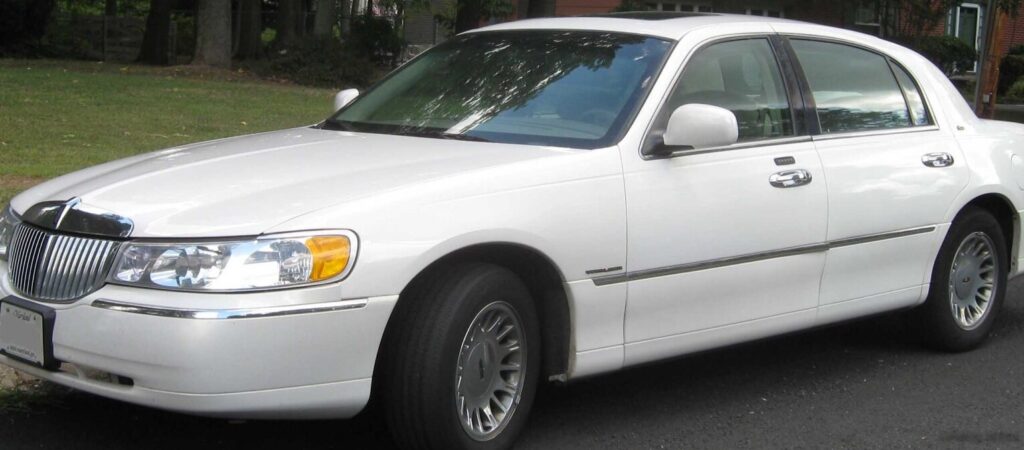
The Lincoln Town Car III (FN145), specifically equipped with the 4.6-liter V8 engine producing 208 horsepower, represented a continuation of Lincoln’s long-standing tradition of full-size luxury sedans. Produced from 1998 to 2000, this generation Town Car built upon the success of its predecessors, offering a blend of comfort, spaciousness, and traditional American styling. It occupied a key position in Lincoln’s lineup as its flagship model, aimed at buyers seeking a large, comfortable, and well-equipped vehicle. The FN145 Town Car shared its platform with the Ford Crown Victoria and Mercury Grand Marquis, benefiting from economies of scale while maintaining a distinct Lincoln identity.
Technical Specifications
| Brand | Lincoln |
| Model | Town Car |
| Generation | Town Car III (FN145) |
| Type (Engine) | 4.6 V8 (208 Hp) |
| Start of production | 1998 |
| End of production | 2000 |
| Powertrain Architecture | Internal Combustion engine |
| Body type | Sedan |
| Seats | 5 |
| Doors | 4 |
| Fuel consumption (urban) | 13.8 l/100 km (17 US mpg, 20.5 UK mpg) |
| Fuel consumption (extra urban) | 9.8 l/100 km (24 US mpg, 28.8 UK mpg) |
| Fuel Type | Petrol (Gasoline) |
| Maximum speed | 180 km/h (111.85 mph) |
| Weight-to-power ratio | 8.8 kg/Hp, 114.3 Hp/tonne |
| Weight-to-torque ratio | 4.8 kg/Nm, 208.8 Nm/tonne |
| Power | 208 Hp @ 4500 rpm |
| Power per litre | 45.2 Hp/l |
| Torque | 380 Nm @ 3000 rpm (280.27 lb.-ft. @ 3000 rpm) |
| Engine layout | Front, Longitudinal |
| Engine Model/Code | Modular / C46RSEM |
| Engine displacement | 4601 cm3 (280.77 cu. in.) |
| Number of cylinders | 8 |
| Engine configuration | V-engine |
| Cylinder Bore | 90.2 mm (3.55 in.) |
| Piston Stroke | 90 mm (3.54 in.) |
| Compression ratio | 9:1 |
| Number of valves per cylinder | 2 |
| Fuel injection system | Multi-port manifold injection |
| Engine aspiration | Naturally aspirated engine |
| Valvetrain | OHC |
| Engine oil capacity | 4.7 l (4.97 US qt | 4.14 UK qt) |
| Coolant | 15 l (15.85 US qt | 13.2 UK qt) |
| Kerb Weight | 1820 kg (4012.41 lbs.) |
| Trunk (boot) space – minimum | 585 l (20.66 cu. ft.) |
| Fuel tank capacity | 76 l (20.08 US gal | 16.72 UK gal) |
| Length | 5470 mm (215.35 in.) |
| Width | 1985 mm (78.15 in.) |
| Height | 1470 mm (57.87 in.) |
| Wheelbase | 2990 mm (117.72 in.) |
| Front track | 1610 mm (63.39 in.) |
| Rear (Back) track | 1660 mm (65.35 in.) |
| Drivetrain Architecture | Rear wheel drive |
| Number of gears and type of gearbox | 4 gears, automatic transmission |
| Front suspension | Coil spring |
| Rear suspension | Coil spring |
| Front brakes | Ventilated discs |
| Rear brakes | Disc |
| Assisting systems | ABS (Anti-lock braking system), Hydraulic Power Steering |
| Tires size | 225/60 R16 |
| Wheel rims size | 16 |
Powertrain & Engine Architecture
The heart of the 1998-2000 Town Car was the 4.6-liter Modular V8 engine, designated as the C46RSEM. This engine was a member of Ford’s Modular engine family, known for its relatively compact size and smooth operation. The engine featured a single overhead camshaft (OHC) design with two valves per cylinder. Multi-port fuel injection delivered fuel directly to each cylinder, optimizing combustion efficiency. The 9:1 compression ratio was a compromise between performance and the ability to run on readily available gasoline grades. The engine produced 208 horsepower at 4500 rpm and 280 lb-ft of torque at 3000 rpm. Paired with this engine was a four-speed automatic transmission, designed for smooth and comfortable shifts. This transmission was calibrated for relaxed cruising rather than aggressive acceleration.
Driving Characteristics
The 4.6L V8 and four-speed automatic combination in the Town Car prioritized comfort and ease of driving over outright performance. Acceleration was adequate for merging onto highways and passing slower traffic, but it wasn’t particularly brisk. The automatic transmission’s gear ratios were tuned for relaxed cruising, resulting in a comfortable ride and relatively low engine speeds at highway speeds. Compared to the Crown Victoria Police Interceptor version of the same engine, the Town Car’s setup emphasized refinement and fuel economy. Manual transmission options were not available on this trim, reinforcing its focus on a relaxed driving experience. The weight of the vehicle, approximately 4012 pounds, did contribute to a feeling of substantiality and stability on the road.
Equipment & Trim Levels
The Town Car III with the 4.6L engine typically came well-equipped, reflecting its position as Lincoln’s flagship. Standard features included air conditioning, power windows and locks, cruise control, and a premium sound system. Interior upholstery was typically cloth, with leather options available. The dashboard featured woodgrain accents and a straightforward layout. Optional extras included a sunroof, upgraded sound systems, and heated seats. This particular engine/transmission combination was generally offered in the base Town Car trim, making it the most accessible entry point into the Town Car lineup. Higher trims, like the Signature Series, offered more luxurious appointments.
Chassis & Braking
The Town Car III utilized a body-on-frame construction, providing a robust and durable chassis. Suspension consisted of coil springs all around, tuned for a comfortable ride. The front suspension featured independent upper and lower control arms, while the rear suspension employed a solid axle with coil springs. Braking duties were handled by ventilated discs at the front and solid discs at the rear. Anti-lock braking system (ABS) was standard, enhancing safety. Power-assisted steering provided light and effortless steering feel. The relatively heavy weight of the vehicle necessitated a robust braking system, and the ABS helped to maintain control during hard braking maneuvers.
Market Reception & Comparison
Critics generally praised the Town Car III for its spacious interior, comfortable ride, and quiet cabin. However, the 4.6L V8/automatic combination was sometimes criticized for its lack of outright performance compared to some of its competitors. Fuel economy, at 17 mpg city and 24 mpg highway, was typical for a full-size luxury sedan of the era. Compared to the Crown Victoria and Grand Marquis, the Town Car offered a more refined interior and a smoother ride. The Town Car also differed from the higher-performance trims of those models, which featured more powerful engines and sport-tuned suspensions. The Town Car appealed to buyers who prioritized comfort and luxury over sporty handling.
Legacy
The 1998-2000 Lincoln Town Car III 4.6L V8 automatic remains a popular choice among collectors and enthusiasts of classic American cars. The Modular V8 engine is known for its reliability and durability, and with proper maintenance, these engines can last for many years. Parts availability is generally good, thanks to the engine’s widespread use in other Ford and Mercury vehicles. While not a high-performance machine, the Town Car III offers a comfortable and spacious driving experience, making it a desirable vehicle for those seeking a classic American luxury sedan. The FN145 generation represents a final refinement of the traditional body-on-frame Town Car, before the model transitioned to a more modern unibody construction in later years.
