
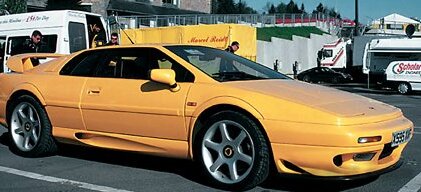
The Lotus Esprit 2.2 i 16V Turbo S4s, produced between 1996 and 1999, represents the final evolution of the iconic Esprit model line. Positioned as the flagship performance variant, the S4s aimed to deliver a thrilling driving experience while incorporating refinements made throughout the Esprit’s long production run. It was the culmination of years of development, building upon the foundations laid by the earlier turbocharged Esprit models. The S4s was a relatively low-volume production car, aimed at enthusiasts seeking a high-performance, exotic sports car. It sat at the top of the Esprit range, above the naturally aspirated variants and earlier turbocharged models.
Technical Specifications
| Brand | Lotus |
| Model | Esprit |
| Generation | Esprit |
| Type (Engine) | 2.2 i 16V Turbo S4s (288 Hp) |
| Start of production | 1996 |
| End of production | 1999 |
| Powertrain Architecture | Internal Combustion engine |
| Body type | Coupe |
| Seats | 2 |
| Doors | 2 |
| Fuel consumption (combined) | 11.2 l/100 km |
| Fuel consumption (US mpg) | 21 US mpg |
| Fuel consumption (UK mpg) | 25.2 UK mpg |
| Fuel consumption (km/l) | 8.9 km/l |
| Fuel Type | Petrol (Gasoline) |
| Acceleration 0 – 100 km/h | 4.9 sec |
| Acceleration 0 – 62 mph | 4.9 sec |
| Acceleration 0 – 60 mph | 4.7 sec |
| Maximum speed | 260 km/h (161.56 mph) |
| Weight-to-power ratio | 4.5 kg/Hp, 220.7 Hp/tonne |
| Weight-to-torque ratio | 3.5 kg/Nm, 287.4 Nm/tonne |
| Power | 288 Hp @ 6400 rpm |
| Power per litre | 132.5 Hp/l |
| Torque | 375 Nm @ 4100 rpm (276.59 lb.-ft. @ 4100 rpm) |
| Engine layout | Rear, Longitudinal |
| Engine Model/Code | Lotus 910S |
| Engine displacement | 2174 cm3 (132.67 cu. in.) |
| Number of cylinders | 4 |
| Engine configuration | Inline |
| Cylinder Bore | 95.4 mm (3.76 in.) |
| Piston Stroke | 76.2 mm (3 in.) |
| Compression ratio | 8:1 |
| Number of valves per cylinder | 4 |
| Fuel injection system | Multi-port manifold injection |
| Engine aspiration | Turbocharger |
| Valvetrain | DOHC |
| Kerb Weight | 1305 kg (2877.03 lbs.) |
| Max. weight | 1566 kg (3452.44 lbs.) |
| Max load | 261 kg (575.41 lbs.) |
| Trunk (boot) space – minimum | 200 l (7.06 cu. ft.) |
| Fuel tank capacity | 73 l (19.28 US gal | 16.06 UK gal) |
| Length | 4411 mm (173.66 in.) |
| Width | 1883 mm (74.13 in.) |
| Height | 1150 mm (45.28 in.) |
| Wheelbase | 2420 mm (95.28 in.) |
| Front track | 1520 mm (59.84 in.) |
| Rear (Back) track | 1520 mm (59.84 in.) |
| Drivetrain Architecture | Rear wheel drive |
| Number of gears and type of gearbox | 5 gears, manual transmission |
| Front suspension | Coil spring |
| Rear suspension | Coil spring |
| Front brakes | Ventilated discs |
| Rear brakes | Ventilated discs |
| Assisting systems | ABS (Anti-lock braking system) |
| Steering type | Steering rack and pinion |
| Power steering | Hydraulic Steering |
| Tires size | 285/35 ZR18 |
| Wheel rims size | 18 |
Powertrain & Engine Architecture
The heart of the Esprit S4s is the Lotus 910S engine, a 2.2-liter turbocharged inline-four. This engine represents a significant upgrade over the earlier 2.0-liter versions. The 910S featured a Garrett T28 turbocharger, intercooler, and revised engine management system to produce 288 horsepower and 276.59 lb-ft of torque. The engine utilized multi-port fuel injection and a double overhead camshaft (DOHC) valvetrain with four valves per cylinder, contributing to its high specific output. The compression ratio was set at 8:1 to accommodate the turbocharging. The engine was mounted longitudinally in the rear of the chassis, driving the rear wheels. The S4s exclusively came with a 5-speed manual transmission, known for its robust construction and precise shift feel.
Driving Characteristics
The Esprit S4s delivered a raw and engaging driving experience. The turbocharged engine provided a substantial surge of power, particularly in the mid-range, making for exhilarating acceleration. The 0-60 mph sprint was achievable in around 4.7 seconds, and the car could reach a top speed of 161.56 mph. The manual transmission allowed for complete driver control, and the rear-wheel-drive layout contributed to a balanced and responsive chassis. Compared to earlier Esprit models, the S4s offered improved refinement and usability, but it still retained the characteristic Lotus focus on handling and driver involvement. The turbo lag was noticeable, but manageable, and the power delivery became more linear as the engine reached higher RPMs. The relatively lightweight construction (around 2877 lbs) further enhanced the car’s agility.
Equipment & Trim Levels
The Esprit S4s was relatively well-equipped for a supercar of its era, though luxury wasn’t its primary focus. Standard features included leather upholstery, power windows, central locking, and an upgraded sound system. Air conditioning was also standard. The interior design was functional and driver-focused, with a clear instrument cluster and well-placed controls. Optional extras included a premium audio system, upgraded wheels, and various cosmetic enhancements. The interior trim was generally consistent across S4s models, with a focus on providing a sporty and comfortable environment for the driver and passenger.
Chassis & Braking
The Esprit S4s utilized a steel backbone chassis, a design that had been a hallmark of the Esprit since its inception. This provided a rigid and lightweight platform for the suspension and powertrain. The suspension consisted of coil springs and double wishbones all around, offering a good balance between ride comfort and handling precision. Braking duties were handled by ventilated discs on all four wheels, assisted by an anti-lock braking system (ABS). The braking system provided ample stopping power, although it lacked the sophistication of more modern systems. The car’s relatively low weight contributed to its excellent braking performance.
Market Reception & Comparison
The Esprit S4s was generally well-received by automotive critics, who praised its performance, handling, and exotic appeal. However, it was also noted that the car’s build quality could be inconsistent, and its maintenance costs were relatively high. Compared to other supercars of the time, such as the Porsche 911 and Ferrari 348, the Esprit S4s offered a unique combination of performance and value. It was often seen as a more accessible alternative to the Italian exotics, while still providing a thrilling driving experience. Fuel economy, while not a priority for this type of vehicle, was reasonable for its performance, averaging around 21 US mpg.
Legacy
The Lotus Esprit S4s represents the final chapter in the Esprit story, a car that captivated enthusiasts for nearly three decades. The 910S engine, while not without its quirks, proved to be a reliable and potent powerplant when properly maintained. Today, the Esprit S4s is a sought-after classic car, appreciated for its rarity, performance, and iconic design. The car’s values have been steadily increasing in recent years, reflecting its growing desirability among collectors. While maintenance can be challenging due to the car’s age and complexity, the Esprit S4s continues to offer a unique and rewarding driving experience for those willing to invest the time and effort.
