
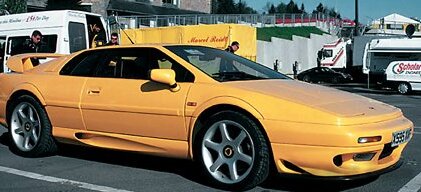
The Lotus Esprit 2.2 i 16V Turbo Sport 300, produced between 1991 and 1996, represents a high-performance iteration of the iconic Esprit model. Positioned as the flagship variant during its production run, the Sport 300 was the most powerful factory Esprit, building upon the already respected reputation of the Giugiaro-designed wedge shape. It was a final flourish for the Esprit before its eventual discontinuation, embodying Lotus’s commitment to lightweight construction and exhilarating driving dynamics. The Sport 300 was primarily sold in European and Asian markets, with limited numbers reaching North America.
Technical Specifications
| Brand | Lotus |
| Model | Esprit |
| Generation | Esprit |
| Type (Engine) | 2.2 i 16V Turbo Sport 300 (304 Hp) |
| Start of production | 1991 |
| End of production | 1996 |
| Powertrain Architecture | Internal Combustion engine |
| Body type | Coupe |
| Seats | 2 |
| Doors | 2 |
| Fuel consumption (combined) | 11.2 l/100 km |
| Fuel consumption (US mpg) | 21 |
| Fuel consumption (UK mpg) | 25.2 |
| Fuel consumption (km/l) | 8.9 |
| Fuel Type | Petrol (Gasoline) |
| Acceleration 0 – 100 km/h | 4.5 sec |
| Acceleration 0 – 62 mph | 4.5 sec |
| Acceleration 0 – 60 mph | 4.3 sec |
| Maximum speed | 270 km/h (167.77 mph) |
| Weight-to-power ratio | 4 kg/Hp |
| Weight-to-torque ratio | 3.1 kg/Nm |
| Power | 304 Hp @ 6500 rpm |
| Power per litre | 139.8 Hp/l |
| Torque | 389 Nm @ 4400 rpm (286.91 lb.-ft. @ 4400 rpm) |
| Engine layout | Middle, Longitudinal |
| Engine Model/Code | Lotus 910S |
| Engine displacement | 2174 cm3 (132.67 cu. in.) |
| Number of cylinders | 4 |
| Engine configuration | Inline |
| Cylinder Bore | 95.3 mm (3.75 in.) |
| Piston Stroke | 76.2 mm (3 in.) |
| Compression ratio | 8:1 |
| Number of valves per cylinder | 4 |
| Fuel injection system | Multi-port manifold injection |
| Engine aspiration | Turbocharger |
| Valvetrain | DOHC |
| Kerb Weight | 1215 kg (2678.62 lbs.) |
| Trunk (boot) space | 200 l (7.06 cu. ft.) |
| Fuel tank capacity | 73 l (19.28 US gal | 16.06 UK gal) |
| Length | 4390 mm (172.83 in.) |
| Width | 1900 mm (74.8 in.) |
| Height | 1165 mm (45.87 in.) |
| Wheelbase | 2440 mm (96.06 in.) |
| Front track | 1525 mm (60.04 in.) |
| Rear track | 1555 mm (61.22 in.) |
| Drivetrain Architecture | Rear wheel drive |
| Drive wheel | Rear wheel drive |
| Number of gears | 5 |
| Gearbox type | Manual transmission |
| Front suspension | Double wishbone |
| Rear suspension | Double wishbone |
| Front brakes | Ventilated discs |
| Rear brakes | Disc |
| Assisting systems | ABS (Anti-lock braking system) |
| Steering type | Steering rack and pinion |
| Power steering | Hydraulic |
| Tires size | 315/35 ZR17 |
| Wheel rims size | 17 |
Powertrain & Engine Architecture
The heart of the Sport 300 is the Lotus 910S engine, a 2.2-liter turbocharged inline-four. This engine represents a significant evolution of the earlier 2.2-liter units found in other Esprit models. The 910S featured a Garrett T28 turbocharger, intercooler, and revised engine management system to deliver its impressive 304 horsepower. The engine utilized multi-port fuel injection and a double overhead camshaft (DOHC) valvetrain, contributing to its high specific output. The compression ratio was set at 8:1 to accommodate the turbocharging. The engine’s longitudinal mid-engine layout, coupled with the rear-wheel-drive configuration, provided excellent weight distribution and handling characteristics. The five-speed manual transmission was specifically chosen for its robustness and ability to handle the engine’s substantial torque output.
Driving Characteristics
The Sport 300 offered a truly visceral driving experience. Acceleration was rapid, with 0-60 mph times consistently recorded in the low 4-second range. The turbocharger provided a noticeable surge of power, delivering strong acceleration throughout the rev range. The manual transmission, while requiring skill to operate smoothly, allowed for precise control and engagement. Compared to earlier, naturally aspirated Esprit models, the Sport 300 felt significantly more potent. While the 1.9-liter turbocharged versions offered good performance, the larger 2.2-liter engine in the Sport 300 provided a broader powerband and more substantial torque. The car’s relatively lightweight construction (around 2679 lbs) further enhanced its agility and responsiveness. However, the turbo lag was present, requiring drivers to anticipate power delivery for optimal performance.
Equipment & Trim Levels
The Sport 300 was relatively sparsely equipped by modern standards, reflecting Lotus’s focus on performance over luxury. Standard features included leather sports seats, power windows, and central locking. Air conditioning was often an optional extra. The interior was functional and driver-focused, with a minimalist dashboard layout. The steering wheel was leather-wrapped, and the instrument cluster featured prominent gauges for speed, RPM, oil pressure, and coolant temperature. Optional extras included upgraded audio systems and various cosmetic enhancements. The interior trim was typically black leather, although other colors were available on request.
Chassis & Braking
The Esprit chassis was a lightweight, all-aluminum monocoque construction, a hallmark of Lotus engineering. The suspension utilized double wishbones at both the front and rear, providing excellent handling and ride quality. The Sport 300 featured upgraded springs and dampers compared to earlier models, further enhancing its handling capabilities. Braking was provided by ventilated discs at the front and solid discs at the rear, assisted by an anti-lock braking system (ABS). The ABS system helped to maintain stability during hard braking. The car’s wide tires (315/35 ZR17) provided ample grip, contributing to its impressive cornering ability.
Market Reception & Comparison
The Lotus Esprit Sport 300 was generally well-received by automotive critics, who praised its performance, handling, and exclusivity. It was often compared favorably to contemporary sports cars such as the Porsche 911 and Ferrari 348. However, its relatively high price and limited availability restricted its sales volume. Fuel economy was not a strong point, with combined fuel consumption around 21 mpg. Reliability could be a concern, as with many exotic sports cars of the era, requiring diligent maintenance. Compared to the less powerful Esprit variants, the Sport 300 commanded a significant premium in the used car market.
Legacy
The Lotus Esprit Sport 300 remains a highly sought-after collector’s car today. Its combination of performance, rarity, and iconic design has ensured its enduring appeal. The 910S engine, while not without its quirks, is considered a robust and capable powerplant when properly maintained. Finding well-maintained examples can be challenging, and parts availability can be limited. However, the Sport 300 represents a pinnacle of Lotus engineering and a fitting end to the Esprit lineage. Its influence can be seen in subsequent Lotus models, and it continues to inspire enthusiasts around the world.
