
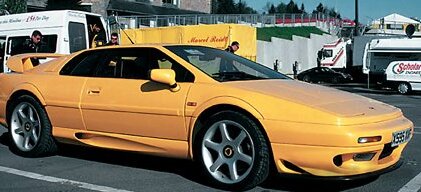
The Lotus Esprit 2.2 i Turbo, produced between 1985 and 1991, represented a significant evolution of the iconic Esprit model line. Falling within the Giugiaro-designed bodywork of the Esprit generation, the 2.2 i Turbo was positioned as the performance flagship, offering a substantial increase in power over the naturally aspirated versions. It built upon the foundation laid by the earlier Esprit Turbo models, refining the turbocharged four-cylinder engine and offering a more sophisticated driving experience. The Esprit, throughout its history, was a symbol of British sports car engineering, known for its lightweight construction, striking design, and exceptional handling. This variant played a crucial role in maintaining that reputation during the mid-to-late 1980s.
Technical Specifications
| Brand | Lotus |
| Model | Esprit |
| Generation | Esprit |
| Type (Engine) | 2.2 i Turbo (231 Hp) |
| Start of production | 1985 |
| End of production | 1991 |
| Powertrain Architecture | Internal Combustion engine |
| Body type | Coupe |
| Seats | 2 |
| Doors | 2 |
| Fuel consumption (economy) – urban | 15.7 l/100 km (15 US mpg, 18 UK mpg, 6.4 km/l) |
| Fuel consumption (economy) – extra urban | 8.3 l/100 km (28.3 US mpg, 34 UK mpg, 12 km/l) |
| Fuel consumption (economy) – combined | 9.9 l/100 km (23.8 US mpg, 28.5 UK mpg, 10.1 km/l) |
| Fuel Type | Petrol (Gasoline) |
| Acceleration 0 – 100 km/h | 5.5 sec |
| Acceleration 0 – 62 mph | 5.5 sec |
| Acceleration 0 – 60 mph | 5.2 sec |
| Maximum speed | 250 km/h (155.34 mph) |
| Weight-to-power ratio | 5.5 kg/Hp, 181.9 Hp/tonne |
| Weight-to-torque ratio | 4.3 kg/Nm, 232.3 Nm/tonne |
| Power | 231 Hp @ 6500 rpm |
| Power per litre | 106.3 Hp/l |
| Torque | 295 Nm @ 4000 rpm (217.58 lb.-ft. @ 4000 rpm) |
| Engine layout | Rear, Longitudinal |
| Engine Model/Code | Lotus 910, Lotus 910S |
| Engine displacement | 2174 cm3 (132.67 cu. in.) |
| Number of cylinders | 4 |
| Engine configuration | Inline |
| Cylinder Bore | 95.29 mm (3.75 in.) |
| Piston Stroke | 76.2 mm (3 in.) |
| Compression ratio | 8:1 |
| Number of valves per cylinder | 4 |
| Fuel injection system | Single-point injection |
| Engine aspiration | Turbocharger |
| Valvetrain | DOHC |
| Engine oil capacity | 6.5 l (6.87 US qt | 5.72 UK qt) |
| Coolant | 8.5 l (8.98 US qt | 7.48 UK qt) |
| Kerb Weight | 1270 kg (2799.87 lbs.) |
| Trunk (boot) space – minimum | 200 l (7.06 cu. ft.) |
| Fuel tank capacity | 73 l (19.28 US gal | 16.06 UK gal) |
| Length | 4330 mm (170.47 in.) |
| Width | 1860 mm (73.23 in.) |
| Height | 1150 mm (45.28 in.) |
| Wheelbase | 2440 mm (96.06 in.) |
| Front track | 1525 mm (60.04 in.) |
| Rear (Back) track | 1555 mm (61.22 in.) |
| Drivetrain Architecture | The Internal combustion engine (ICE) drives the rear wheels of the vehicle. |
| Drive wheel | Rear wheel drive |
| Number of gears and type of gearbox | 5 gears, manual transmission |
| Front suspension | Coil spring |
| Rear suspension | Coil spring |
| Front brakes | Ventilated discs |
| Rear brakes | Ventilated discs |
| Assisting systems | ABS (Anti-lock braking system) |
| Steering type | Steering rack and pinion |
| Tires size | 215/50 R15; 245/50 R16 |
| Wheel rims size | 15; 16 |
Powertrain & Engine Architecture
The heart of the Esprit 2.2 i Turbo was the Lotus 910 engine, a 2.2-liter (2174 cc) inline-four cylinder engine. This engine was a development of the earlier 2.1-liter unit, featuring a Garrett AiResearch T25 turbocharger and Bosch K-Jetronic fuel injection. The single-point injection system, while not as sophisticated as multi-point injection found in later cars, provided reliable fuel delivery. The engine boasted a compression ratio of 8:1 and utilized a double overhead camshaft (DOHC) valvetrain with four valves per cylinder, contributing to its impressive power output. The engine was mounted longitudinally in the rear of the chassis, driving the rear wheels. The five-speed manual transmission was the only gearbox option available, providing a direct connection between the engine and the drivetrain.
Driving Characteristics
The 2.2 i Turbo offered a thrilling driving experience. The turbocharger provided a noticeable boost in power, delivering strong acceleration. While turbo lag was present, it was manageable, and the engine responded well once on boost. The 0-60 mph time of around 5.2 seconds was quick for the era. The car’s lightweight construction and well-tuned suspension contributed to its exceptional handling. The steering was precise and communicative, providing the driver with a good feel for the road. Compared to the naturally aspirated Esprit models, the 2.2 i Turbo offered a significantly more potent performance, but it also demanded more skill and attention from the driver. The gear ratios were well-matched to the engine’s powerband, allowing for brisk acceleration in all gears.
Equipment & Trim Levels
The Esprit 2.2 i Turbo was relatively well-equipped for a sports car of its time. Standard features included leather upholstery, power windows, central locking, and an upgraded sound system. Air conditioning was often included, though it could be an optional extra depending on the market. The interior design was functional and driver-focused, with a clean dashboard layout and well-placed controls. Optional extras included a sunroof, upgraded wheels, and metallic paint finishes. The interior trim was generally consistent across the 2.2 i Turbo models, with a focus on providing a comfortable and sporty environment for the driver and passenger.
Chassis & Braking
The Esprit’s chassis was a steel backbone design, providing a rigid and lightweight platform. The suspension consisted of coil springs and double wishbones all around, offering excellent handling and ride quality. The 2.2 i Turbo featured ventilated disc brakes on all four wheels, providing ample stopping power. An anti-lock braking system (ABS) was also included as standard, enhancing safety. The car’s relatively low weight contributed to its impressive braking performance. The suspension was tuned to provide a balance between comfort and handling, making the Esprit a capable performer on both the road and the track.
Market Reception & Comparison
The Esprit 2.2 i Turbo was generally well-received by automotive critics. It was praised for its performance, handling, and striking design. However, some critics noted the presence of turbo lag and the relatively high price tag. Compared to other sports cars of the era, such as the Porsche 911, the Esprit offered a more exotic and visually striking package. Fuel economy was reasonable for a turbocharged sports car, averaging around 23.8 US mpg in combined driving. Reliability was generally good, although the turbocharger and fuel injection system required regular maintenance. The 2.2 i Turbo represented a significant step up in performance compared to the earlier naturally aspirated Esprit models, making it the preferred choice for enthusiasts seeking a more thrilling driving experience.
Legacy
The Lotus Esprit 2.2 i Turbo remains a highly sought-after classic sports car. The Lotus 910 engine, while not without its quirks, proved to be a durable and reliable unit when properly maintained. Today, these cars are prized by collectors and enthusiasts for their performance, design, and rarity. The 2.2 i Turbo’s legacy is secure as one of the most iconic and desirable models in the Esprit lineage. Finding well-maintained examples can be challenging, and parts availability can be limited, but the rewards for owning and preserving one of these cars are significant. The Esprit 2.2 i Turbo continues to represent the best of British sports car engineering, offering a unique and unforgettable driving experience.
