
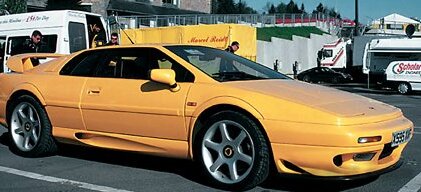
The Lotus Esprit 2.2 Turbo, produced between 1980 and 1991, represents a significant evolution of the iconic Esprit model. Positioned as the performance flagship of the Esprit range during its production run, the 2.2 Turbo offered a substantial increase in power and sophistication compared to the naturally aspirated versions. It was a key model in cementing the Esprit’s reputation as a genuine supercar, competing with the likes of Ferrari and Lamborghini, while maintaining a distinctly British character. The Esprit, overall, was built on the Type 79 chassis, and the 2.2 Turbo specifically benefited from ongoing refinements to the platform, enhancing its handling and overall driving experience. This variant was primarily aimed at the enthusiast driver seeking exhilarating performance and distinctive styling.
Technical Specifications
| Brand | Lotus |
| Model | Esprit |
| Generation | Esprit |
| Type (Engine) | 2.2 Turbo (218 Hp) |
| Start of production | 1980 year |
| End of production | 1991 year |
| Powertrain Architecture | Internal Combustion engine |
| Body type | Coupe |
| Seats | 2 |
| Doors | 2 |
| Fuel consumption (economy) – urban | 17.2 l/100 km (13.7 US mpg, 16.4 UK mpg, 5.8 km/l) |
| Fuel consumption (economy) – extra urban | 8.3 l/100 km (28.3 US mpg, 34 UK mpg, 12 km/l) |
| Fuel consumption (economy) – combined | 10.6 l/100 km (22.2 US mpg, 26.6 UK mpg, 9.4 km/l) |
| Fuel Type | Petrol (Gasoline) |
| Acceleration 0 – 100 km/h | 5.6 sec |
| Acceleration 0 – 62 mph | 5.6 sec |
| Acceleration 0 – 60 mph | 5.3 sec |
| Maximum speed | 241 km/h (149.75 mph) |
| Weight-to-power ratio | 6.3 kg/Hp, 159.1 Hp/tonne |
| Weight-to-torque ratio | 4.6 kg/Nm, 217.5 Nm/tonne |
| Power | 218 Hp @ 6000 rpm |
| Power per litre | 100.3 Hp/l |
| Torque | 298 Nm @ 4250 rpm (219.79 lb.-ft. @ 4250 rpm) |
| Engine layout | Rear, Longitudinal |
| Engine Model/Code | Lotus 910, Lotus 910S |
| Engine displacement | 2174 cm3 (132.67 cu. in.) |
| Number of cylinders | 4 |
| Engine configuration | Inline |
| Cylinder Bore | 95.29 mm (3.75 in.) |
| Piston Stroke | 76.2 mm (3 in.) |
| Compression ratio | 8:1 |
| Number of valves per cylinder | 4 |
| Fuel injection system | Carburettor |
| Engine aspiration | Turbocharger |
| Valvetrain | DOHC |
| Engine oil capacity | 6.5 l (6.87 US qt | 5.72 UK qt) |
| Coolant | 8.5 l (8.98 US qt | 7.48 UK qt) |
| Kerb Weight | 1370 kg (3020.33 lbs.) |
| Trunk (boot) space – minimum | 200 l (7.06 cu. ft.) |
| Fuel tank capacity | 73 l (19.28 US gal | 16.06 UK gal) |
| Length | 4330 mm (170.47 in.) |
| Width | 1860 mm (73.23 in.) |
| Height | 1150 mm (45.28 in.) |
| Wheelbase | 2440 mm (96.06 in.) |
| Front track | 1525 mm (60.04 in.) |
| Rear (Back) track | 1555 mm (61.22 in.) |
| Drivetrain Architecture | The Internal combustion engine (ICE) drives the rear wheels of the vehicle. |
| Drive wheel | Rear wheel drive |
| Number of gears and type of gearbox | 5 gears, manual transmission |
| Front suspension | Coil spring |
| Rear suspension | Coil spring |
| Front brakes | Ventilated discs |
| Rear brakes | Ventilated discs |
| Assisting systems | ABS (Anti-lock braking system) |
| Steering type | Steering rack and pinion |
| Tires size | 215/50 R15; 245/50 R16 |
| Wheel rims size | 15; 16 |
INTRODUCTION
The Lotus Esprit 2.2 Turbo, launched in 1980, represented a significant leap forward for the model line. Building upon the already successful Giugiaro-designed wedge shape, the 2.2 Turbo aimed to deliver supercar performance with the Lotus philosophy of lightweight construction and exceptional handling. It was produced through 1991, undergoing several revisions and updates during its lifespan. The 2.2 Turbo was a direct response to the growing demand for more power and refinement in the sports car market. It occupied the top spot in the Esprit range, offering a more potent alternative to the naturally aspirated 2.0-liter models. The car’s distinctive styling, combined with its turbocharged engine, made it a desirable and recognizable vehicle, even appearing in several James Bond films, further solidifying its iconic status.
Powertrain & Engine Architecture
At the heart of the Esprit 2.2 Turbo lies the Lotus 910 engine, a 2.2-liter (2174 cc) inline-four cylinder unit. The engine was initially available in two versions, the 910 and the later 910S, with the ‘S’ version featuring slight improvements to the turbocharger and fuel management. The engine utilized a single overhead camshaft (SOHC) design, later upgraded to a double overhead camshaft (DOHC) in some later iterations. Fuel delivery was managed by a carburetor system, a somewhat unusual choice for a turbocharged engine of this era, but it was a design decision made to balance performance and cost. The turbocharger itself was a Garrett unit, providing significant boost to increase power output. The engine’s longitudinal rear-mid engine layout contributed to the car’s excellent balance and handling characteristics. The 2.2 Turbo was exclusively paired with a five-speed manual transmission, designed to handle the increased torque output. The gearbox was known for its precise shift action, further enhancing the driving experience.
Driving Characteristics
The Esprit 2.2 Turbo offered a dramatically different driving experience compared to the naturally aspirated models. The turbocharger provided a noticeable surge of power, delivering strong acceleration in the mid-range and beyond. While not without a degree of turbo lag, the power delivery was exhilarating once the boost came on. The 0-60 mph time of around 5.3 seconds was impressive for the early 1980s, placing it firmly in supercar territory. The car’s lightweight construction, combined with its well-tuned suspension, resulted in exceptional handling. The steering was precise and communicative, providing the driver with a strong sense of connection to the road. Compared to the manual transmission versions, the 2.2 Turbo offered a more engaging and direct driving experience, allowing the driver to fully exploit the engine’s power potential. The manual gearbox, while requiring more skill to operate, provided greater control and responsiveness.
Equipment & Trim Levels
The Esprit 2.2 Turbo was generally well-equipped for its time, although luxury was not its primary focus. Standard features included leather upholstery, power windows, and central locking. Air conditioning was often an optional extra. The interior design was functional and driver-focused, with a minimalist dashboard layout. The seats were supportive and comfortable, providing adequate cushioning for long journeys. Optional extras included a premium sound system, upgraded wheels, and various cosmetic enhancements. The trim levels were relatively simple, with most variations revolving around color choices and optional equipment packages. The emphasis was on performance and driving experience rather than lavish luxury.
Chassis & Braking
The Esprit 2.2 Turbo utilized a steel backbone chassis, a design pioneered by Lotus founder Colin Chapman. This construction method provided a high degree of rigidity while minimizing weight. The suspension consisted of independent double wishbones at all four corners, with coil springs and anti-roll bars. This setup provided excellent handling and ride comfort. Braking duties were handled by ventilated disc brakes on all four wheels, providing ample stopping power. An anti-lock braking system (ABS) was available as an option, further enhancing safety. The car’s relatively low weight contributed to its impressive braking performance. The chassis and suspension were carefully tuned to work in harmony with the turbocharged engine, resulting in a balanced and responsive driving experience.
Market Reception & Comparison
The Lotus Esprit 2.2 Turbo was generally well-received by automotive critics, who praised its performance, handling, and distinctive styling. However, some criticisms were leveled at its reliability and the complexity of its turbocharged engine. Compared to the naturally aspirated Esprit models, the 2.2 Turbo offered a significant performance upgrade, but it also came with a higher price tag and potentially higher maintenance costs. Compared to its rivals, such as the Porsche 911 and Ferrari 308, the Esprit 2.2 Turbo offered a unique combination of British engineering, exotic styling, and competitive performance. Fuel economy, while not a primary concern for supercar buyers, was reasonable for a turbocharged engine of this era, averaging around 22.2 US mpg in combined driving.
Legacy
The Lotus Esprit 2.2 Turbo remains a highly sought-after classic sports car today. Its iconic styling, exhilarating performance, and relative rarity have made it a collectible vehicle. While the turbocharged engine can require specialized maintenance, the car’s overall reliability is generally considered to be good, especially for well-maintained examples. The Esprit 2.2 Turbo played a significant role in establishing Lotus as a manufacturer of world-class sports cars. Its legacy continues to inspire Lotus engineers and enthusiasts alike. In the used car market, prices for well-preserved examples of the 2.2 Turbo have been steadily increasing, reflecting its growing desirability and iconic status.
