
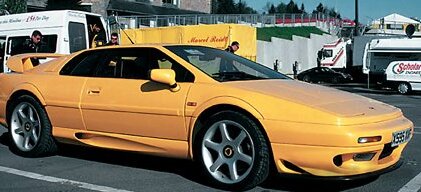
The Lotus Esprit 3.5 i V8 32V Turbo, produced between 1996 and 1998, represents the culmination of the Esprit lineage, a sports car renowned for its striking design and impressive performance. This final iteration of the Esprit, built upon the successful foundations of the earlier turbocharged models, aimed to deliver a truly world-class grand touring experience. It was positioned as the flagship model, offering the highest levels of performance and refinement within the Esprit range. The 3.5 i V8 Turbo was a relatively short-lived model, marking the end of production for the Esprit after 28 years, and remains a highly sought-after vehicle among collectors and enthusiasts.
Technical Specifications
| Brand | Lotus |
| Model | Esprit |
| Generation | Esprit |
| Type (Engine) | 3.5 i V8 32V Turbo (354 Hp) |
| Start of production | 1996 |
| End of production | 1998 |
| Powertrain Architecture | Internal Combustion engine |
| Body type | Coupe |
| Seats | 2 |
| Doors | 2 |
| Fuel consumption (economy) – urban | 20 l/100 km (11.8 US mpg) |
| Fuel consumption (economy) – extra urban | 9.3 l/100 km (25.3 US mpg) |
| Fuel Type | Petrol (Gasoline) |
| Acceleration 0 – 100 km/h | 4.9 sec |
| Acceleration 0 – 62 mph | 4.9 sec |
| Acceleration 0 – 60 mph | 4.7 sec |
| Maximum speed | 282 km/h (175.23 mph) |
| Weight-to-power ratio | 3.9 kg/Hp |
| Weight-to-torque ratio | 3.5 kg/Nm |
| Power | 354 Hp @ 6500 rpm |
| Power per litre | 101 Hp/l |
| Torque | 400 Nm @ 4250 rpm (295.02 lb.-ft. @ 4250 rpm) |
| Engine layout | Rear, Longitudinal |
| Engine Model/Code | Lotus 918 |
| Engine displacement | 3506 cm3 (213.95 cu. in.) |
| Number of cylinders | 8 |
| Engine configuration | V-engine |
| Cylinder Bore | 83 mm (3.27 in.) |
| Piston Stroke | 81 mm (3.19 in.) |
| Compression ratio | 8.1:1 |
| Number of valves per cylinder | 4 |
| Fuel injection system | Multi-port manifold injection |
| Engine aspiration | Turbocharger |
| Valvetrain | DOHC |
| Engine oil capacity | 6.5 l (6.87 US qt | 5.72 UK qt) |
| Coolant | 15 l (15.85 US qt | 13.2 UK qt) |
| Kerb Weight | 1380 kg (3042.38 lbs.) |
| Max. weight | 1630 kg (3593.53 lbs.) |
| Max load | 250 kg (551.16 lbs.) |
| Trunk (boot) space – minimum | 200 l (7.06 cu. ft.) |
| Fuel tank capacity | 73 l (19.28 US gal | 16.06 UK gal) |
| Length | 4370 mm (172.05 in.) |
| Width | 1880 mm (74.02 in.) |
| Height | 1150 mm (45.28 in.) |
| Wheelbase | 2420 mm (95.28 in.) |
| Front track | 1530 mm (60.24 in.) |
| Rear (Back) track | 1545 mm (60.83 in.) |
| Drivetrain Architecture | Rear wheel drive |
| Number of gears and type of gearbox | 5 gears, manual transmission |
| Front suspension | Coil spring |
| Rear suspension | Coil spring |
| Front brakes | Ventilated discs |
| Rear brakes | Ventilated discs |
| Assisting systems | ABS (Anti-lock braking system) |
| Steering type | Steering rack and pinion |
| Tires size | 235/40 R17; 285/35 R18 |
| Wheel rims size | 17; 18 |
INTRODUCTION
The Lotus Esprit 3.5 i V8 32V Turbo, produced from 1996 to 1998, marked the final chapter in the storied history of the Esprit. This model represented a significant evolution of the Giugiaro-designed wedge shape that had defined the Esprit since its introduction in 1976. The 3.5-liter twin-turbocharged V8 engine, developed in collaboration with Renault, was the centerpiece of this final iteration. It was built on the Type 84 chassis, a steel backbone structure that had been continuously refined over the years. The Esprit 3.5 i V8 Turbo was aimed at the high-end sports car market, competing with models like the Porsche 911 and Ferrari 348, offering a unique blend of British engineering, Italian styling, and French power.
Powertrain & Engine Architecture
The heart of the Esprit 3.5 i V8 Turbo is the Lotus 918 engine, a 3.5-liter, 32-valve, twin-turbocharged V8. This engine, a collaboration between Lotus and Renault, produced 354 horsepower at 6500 rpm and 400 Nm (295 lb-ft) of torque at 4250 rpm. The engine utilized multi-port fuel injection and a sophisticated engine management system to optimize performance and efficiency. The twin turbochargers, carefully matched to the engine’s displacement, provided a broad and usable powerband. The engine is mounted longitudinally in the rear of the chassis, contributing to the car’s balanced handling characteristics. The Esprit 3.5 i V8 Turbo exclusively came with a 5-speed manual transmission, chosen for its direct connection and driver engagement. This transmission was known for its robust construction and precise shift feel.
Driving Characteristics
The Esprit 3.5 i V8 Turbo delivered exhilarating performance. Acceleration from 0 to 60 mph was achieved in approximately 4.7 seconds, and it could reach a top speed of 175 mph. The twin-turbocharged engine provided strong acceleration throughout the rev range, with minimal turbo lag. The rear-wheel-drive layout and well-tuned suspension contributed to excellent handling and cornering ability. The car felt planted and stable at high speeds, inspiring confidence in the driver. Compared to earlier Esprit models with smaller engines, the 3.5 i V8 Turbo offered a significant increase in power and torque, resulting in a more refined and effortless driving experience. While the manual transmission demanded skill and precision, it rewarded the driver with a direct and engaging connection to the car.
Equipment & Trim Levels
The Esprit 3.5 i V8 Turbo was generously equipped, reflecting its status as the flagship model. Standard features included leather upholstery, power windows, power steering, air conditioning, and an upgraded sound system. The interior was designed with a focus on driver comfort and functionality. Optional extras included a premium audio system, upgraded wheels, and various cosmetic enhancements. The interior trim was typically finished in leather, with options for different colors and materials. The dashboard layout was clean and straightforward, with easily accessible controls. The Esprit 3.5 i V8 Turbo was not offered in multiple trim levels; it was essentially a fully equipped model with limited customization options.
Chassis & Braking
The Esprit 3.5 i V8 Turbo utilized a steel backbone chassis, a design that had been a hallmark of the Esprit since its inception. This chassis provided a rigid and lightweight platform for the car’s components. The suspension consisted of independent coil springs and dampers at all four corners, providing a comfortable yet controlled ride. Ventilated disc brakes were fitted to all four wheels, providing ample stopping power. An anti-lock braking system (ABS) was standard, enhancing safety and stability. The car’s suspension geometry was carefully tuned to optimize handling and minimize body roll. The Esprit 3.5 i V8 Turbo’s chassis and braking systems were designed to handle the car’s high performance capabilities.
Market Reception & Comparison
The Lotus Esprit 3.5 i V8 Turbo was generally well-received by automotive critics. It was praised for its stunning performance, striking design, and engaging driving experience. However, some critics noted that the car’s interior was somewhat dated compared to its rivals. Compared to other models in the Esprit lineup, the 3.5 i V8 Turbo represented a significant step up in terms of performance and refinement. It offered a more luxurious and powerful driving experience than the earlier 4-cylinder and V6 models. Fuel economy was reasonable for a high-performance sports car, but it was not a primary focus. Reliability was generally good, but maintenance costs could be high due to the car’s complex engine and specialized components.
Legacy
The Lotus Esprit 3.5 i V8 Turbo holds a special place in automotive history as the final iteration of a truly iconic sports car. Its twin-turbocharged V8 engine and striking design continue to captivate enthusiasts today. The Esprit 3.5 i V8 Turbo is a highly sought-after vehicle in the used car market, with prices steadily increasing as its rarity and collectibility become more apparent. The powertrain, while complex, has proven to be relatively durable when properly maintained. The Esprit 3.5 i V8 Turbo represents the pinnacle of Lotus engineering and design, and it remains a testament to the company’s commitment to building exceptional sports cars.
