
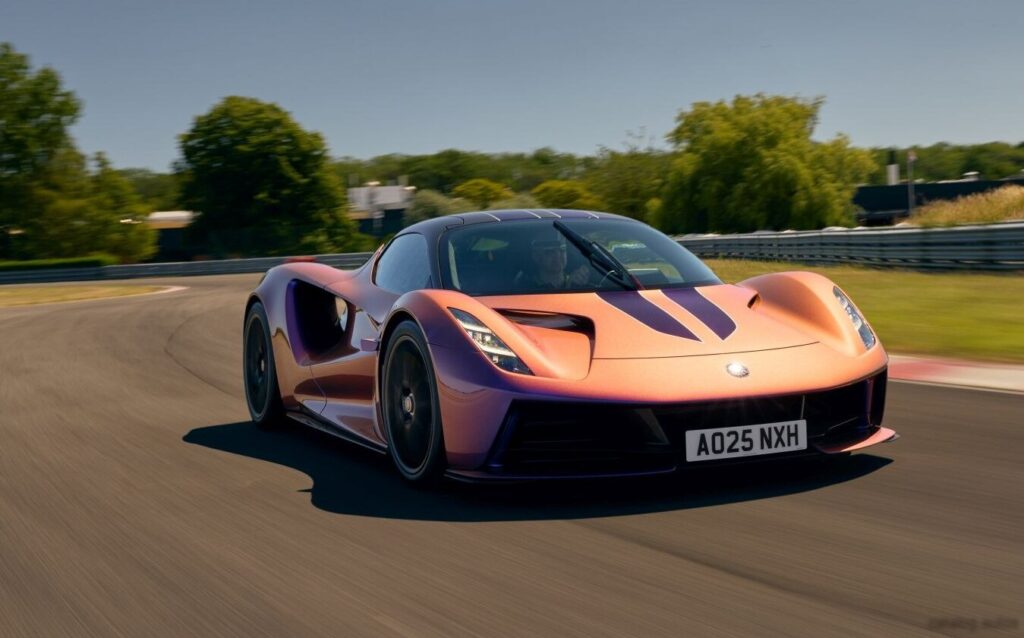
The Lotus Evija (Type 130) represents a radical departure for the British sports car manufacturer, marking its entry into the hypercar segment and, more significantly, the all-electric vehicle market. Production commenced in 2022, and the Evija is positioned as a halo vehicle, showcasing Lotus’s engineering prowess and commitment to a future defined by sustainable performance. It’s the first fully electric hypercar from Lotus, and a significant step away from the brand’s traditional focus on lightweight, combustion-engined sports cars. The Evija is built around a bonded carbon-fiber monocoque chassis and features a unique powertrain configuration with four independent electric motors.
Technical Specifications
| Brand | Lotus |
| Model | Evija |
| Generation | Evija (Type 130) |
| Type (Engine) | 91 kWh (2040 Hp) 4WD Electric |
| Start of production | 2022 |
| Powertrain Architecture | BEV (Electric Vehicle) |
| Body type | Coupe |
| Seats | 2 |
| Doors | 2 |
| Fuel Type | Electricity |
| Acceleration 0 – 60 mph | 2.9 sec |
| Maximum speed | 217.48 mph (350 km/h, electronically limited) |
| Weight-to-power ratio | 0.9 kg/Hp, 1077.1 Hp/tonne |
| Weight-to-torque ratio | 1.1 kg/Nm, 899.7 Nm/tonne |
| Gross battery capacity | 91 kWh |
| Battery technology | Lithium-ion (Li-Ion) |
| Battery location | Behind the back wall of the passenger cabin |
| All-electric range (WLTP) | 195.11 mi (314 km) |
| Electric motor power (each) | 510 Hp |
| Electric motor Torque (each) | 314.2 lb.-ft. (426 Nm) |
| Electric motor location | Wheel hub motor |
| System power | 2040 Hp |
| System torque | 1256.81 lb.-ft. (1704 Nm) |
| Kerb Weight | 4175.56 lbs. (1894 kg) |
| Length | 175.55 in. (4459 mm) |
| Width | 78.74 in. (2000 mm) |
| Height | 44.17 in. (1122 mm) |
| Drivetrain Architecture | Four electric motors drive each wheel individually. |
| Drive wheel | All wheel drive (4×4) |
| Number of gears and type of gearbox | 1 gears, automatic transmission |
| Front brakes | Ventilated discs, 390×34 mm |
| Rear brakes | Ventilated discs, 390×34 mm |
| Front wheel rims | 20 |
| Rear wheel rims | 21 |
Powertrain & Engine Architecture
The Evija’s powertrain is its defining feature. It utilizes a 91 kWh lithium-ion battery pack, positioned centrally behind the passenger compartment to optimize weight distribution. This battery powers four independent electric motors – one for each wheel. Each motor produces approximately 510 horsepower, resulting in a combined system output of 2040 horsepower and 1256.81 lb.-ft. of torque. This makes the Evija one of the most powerful production cars ever created. The motors are integrated directly into the wheel hubs, eliminating the need for a traditional differential and driveshafts, further reducing weight and improving efficiency. The single-speed automatic transmission is essentially a reduction gear, optimized for maximizing torque delivery and acceleration. The battery pack employs a sophisticated thermal management system to maintain optimal operating temperatures during both charging and discharge.
Driving Characteristics
The Evija’s performance is, unsurprisingly, breathtaking. The instant torque delivery from the four electric motors provides phenomenal acceleration, with a claimed 0-60 mph time of just 2.9 seconds. Top speed is electronically limited to 217.48 mph. The all-wheel-drive system, coupled with the individual motor control, allows for incredibly precise torque vectoring, enhancing cornering agility and stability. Unlike traditional combustion-engined hypercars, the Evija offers a remarkably smooth and refined driving experience, with minimal noise and vibration. The low center of gravity, thanks to the battery pack’s placement, contributes to exceptional handling balance. While the focus is on performance, the Evija also offers selectable driving modes to tailor the power delivery and suspension settings to suit different conditions and driver preferences.
Equipment & Trim Levels
Given its limited production run and hypercar status, the Evija is not offered with traditional trim levels. However, Lotus provides a high degree of customization, allowing buyers to personalize the exterior and interior to their specifications. Standard features include a fully digital instrument cluster, a minimalist interior design focused on driver engagement, and advanced aerodynamic elements. The interior is trimmed with premium materials, including leather, Alcantara, and carbon fiber. Optional extras include bespoke paint finishes, unique interior color schemes, and advanced driver-assistance systems. The focus is on creating a luxurious and technologically advanced cabin that complements the car’s extreme performance.
Chassis & Braking
The Evija’s chassis is a masterpiece of engineering. It’s constructed from a bonded carbon-fiber monocoque, providing exceptional rigidity and minimizing weight. The suspension system utilizes fully adjustable dampers and springs, allowing for precise tuning to optimize handling characteristics. The braking system features ventilated discs on all four wheels, measuring 390×34 mm, and is designed to provide exceptional stopping power. The ABS (Anti-lock braking system) is calibrated to work in conjunction with the all-wheel-drive system and torque vectoring to maximize braking performance and stability. The steering system is a hydraulic rack and pinion setup, providing precise and responsive steering feel.
Market Reception & Comparison
The Lotus Evija has been met with widespread acclaim from automotive journalists and enthusiasts. Critics have praised its groundbreaking powertrain, exceptional performance, and stunning design. Its all-electric nature positions it as a direct competitor to other emerging electric hypercars, such as the Rimac Nevera and the Pininfarina Battista. Compared to traditional combustion-engined hypercars, the Evija offers a unique driving experience characterized by instant torque, smooth acceleration, and minimal noise. While the initial purchase price is substantial, the Evija’s running costs are expected to be lower than those of its gasoline-powered rivals, due to the lower maintenance requirements of an electric powertrain.
Legacy
The Lotus Evija represents a pivotal moment in the company’s history. It demonstrates Lotus’s ability to innovate and adapt to the changing automotive landscape. The Evija’s powertrain technology and lightweight construction techniques are likely to influence future Lotus models. As a limited-production hypercar, the Evija is expected to become a highly sought-after collectible in the years to come. Its long-term reliability remains to be seen, but Lotus has invested heavily in ensuring the durability and performance of the Evija’s electric powertrain. The Evija has already established Lotus as a serious contender in the electric hypercar segment and has paved the way for a new era of sustainable performance.
