
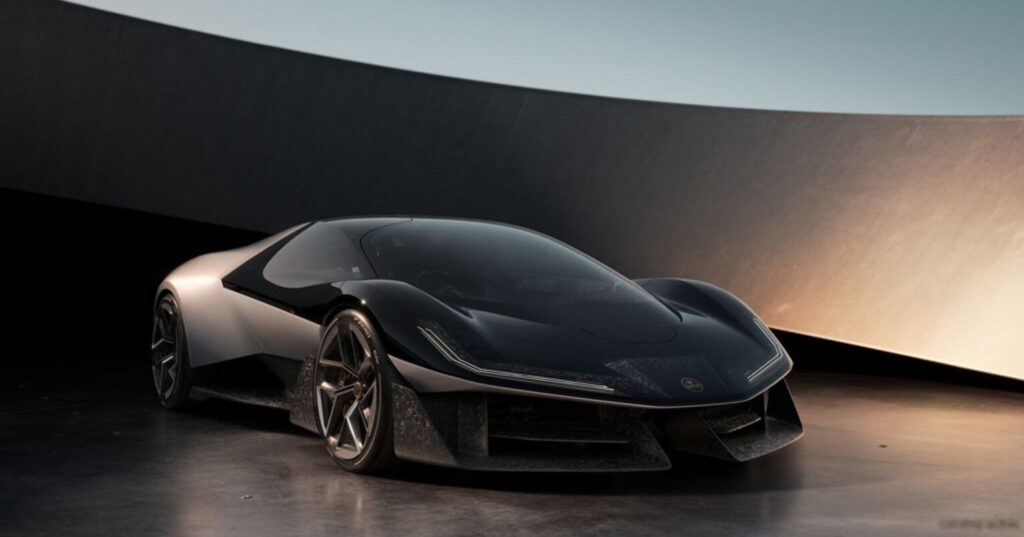
The Lotus Theory 1, launched in September 2024, represents a bold step for the British manufacturer into the realm of high-performance electric vehicles. This all-electric coupe is positioned as a flagship model, showcasing Lotus’s commitment to innovation and driving exhilaration in a sustainable package. The Theory 1 is not merely an electric adaptation of existing Lotus principles; it’s a ground-up design intended to redefine the grand touring experience. It’s a two-door, two-seater coupe built around a dedicated electric vehicle architecture, aiming to deliver supercar performance with a usable all-electric range.
Technical Specifications
| Brand | Lotus |
| Model | Theory 1 |
| Generation | Theory 1 |
| Type (Engine) | 70 kWh (1000 Hp) AWD Electric |
| Start of production | September, 2024 |
| Powertrain Architecture | BEV (Electric Vehicle) |
| Body type | Coupe |
| Seats | 2 |
| Doors | 2 |
| Fuel Type | Electricity |
| Acceleration 0 – 100 km/h | 2.5 sec |
| Acceleration 0 – 62 mph | 2.5 sec |
| Acceleration 0 – 60 mph | 2.4 sec |
| Maximum speed | 320 km/h (198.84 mph) |
| Weight-to-power ratio | 1.6 kg/Hp, 625 Hp/tonne |
| Gross battery capacity | 70 kWh |
| Battery location | Below the floor |
| All-electric range (WLTP) | 402 km (249.79 mi) |
| Electric motor | 1 |
| Electric motor location (Front) | Front axle, Transverse |
| Electric motor location (Rear) | Rear axle, Transverse |
| System power | 1000 Hp |
| Kerb Weight | 1600 kg (3527.4 lbs) |
| Length | 4490 mm (176.77 in) |
| Width | 2000 mm (78.74 in) |
| Height | 1140 mm (44.88 in) |
| Wheelbase | 2650 mm (104.33 in) |
| Front track | 1720 mm (67.72 in) |
| Rear track | 1700 mm (66.93 in) |
| Front overhang | 1052 mm (41.42 in) |
| Rear overhang | 790 mm (31.1 in) |
| Drivetrain Architecture | One electric motor drives the front wheels, one electric motor drives the rear wheels. |
| Drive wheel | All wheel drive (4×4) |
| Number of gears | 1 |
| Type of gearbox | automatic transmission |
| Front suspension | Double wishbone |
| Rear suspension | Double wishbone |
| Front brakes | Ventilated discs, 390×36 mm |
| Rear brakes | Ventilated discs, 390×36 mm |
| Power steering | Electric Steering |
| Front wheel tires | 265/35 R20 |
| Rear wheel tires | 325/30 R21 |
| Front wheel rims | 9.5J x 20 |
| Rear wheel rims | 11.5J x 21 |
Powertrain & Engine Architecture
The Lotus Theory 1 utilizes a dual-motor all-electric powertrain. Each motor is transversely mounted – one driving the front axle and the other the rear – creating a true all-wheel-drive system. The combined output of these motors is a staggering 1000 horsepower. The powertrain operates on a 70 kWh battery pack, strategically positioned low in the chassis to optimize the car’s center of gravity. The battery employs advanced thermal management to ensure consistent performance and longevity. The single-speed automatic transmission is a direct-drive system, typical of electric vehicles, maximizing efficiency and delivering instant torque. The electric motors themselves are permanent magnet synchronous motors, chosen for their high power density and efficiency. The vehicle’s electrical architecture is a high-voltage system, enabling rapid charging capabilities.
Driving Characteristics
The Theory 1’s performance is, unsurprisingly, its defining characteristic. The 0-60 mph sprint is dispatched in a mere 2.4 seconds, and it boasts a top speed of 198.84 mph. The dual-motor setup provides exceptional traction and control, allowing for confident acceleration in all conditions. The low center of gravity, thanks to the underfloor battery pack, contributes to remarkably flat cornering. While the single-speed transmission lacks the gear changes of a traditional gearbox, the instant torque delivery of the electric motors more than compensates. The driving experience is characterized by seamless acceleration and a near-silent operation, punctuated only by the subtle whine of the electric motors under hard acceleration. Compared to a potential internal combustion engine Lotus, the Theory 1 offers a fundamentally different driving experience – one focused on immediate response and effortless power.
Equipment & Trim Levels
As a flagship model, the Theory 1 is expected to come generously equipped. Standard features include a premium interior with high-quality materials, a state-of-the-art infotainment system with a large touchscreen display, advanced driver-assistance systems (ADAS), and a comprehensive suite of safety features. The interior is designed with a minimalist aesthetic, emphasizing driver focus and a sense of spaciousness. Optional extras are likely to include bespoke interior trim options, upgraded audio systems, and advanced connectivity features. Given Lotus’s heritage, a focus on lightweight materials and aerodynamic efficiency is evident throughout the vehicle’s design and construction.
Chassis & Braking
The Theory 1 utilizes a lightweight chassis construction, employing aluminum and composite materials to minimize weight and maximize rigidity. The suspension system features double wishbones at both the front and rear, a configuration favored by Lotus for its superior handling characteristics. The braking system consists of ventilated discs with 390×36 mm rotors at all four corners, providing ample stopping power. Electric power steering is standard, offering precise and responsive steering feel. The vehicle is equipped with high-performance tires – 265/35 R20 at the front and 325/30 R21 at the rear – to maximize grip and handling performance.
Market Reception & Comparison
The Lotus Theory 1 enters a rapidly expanding market of high-performance electric vehicles. Initial reception has been overwhelmingly positive, with critics praising its stunning design, exceptional performance, and commitment to the Lotus driving experience. Compared to rivals such as the Porsche Taycan and Tesla Model S Plaid, the Theory 1 aims to offer a more focused and engaging driving experience, prioritizing handling and driver involvement. While the Taycan emphasizes luxury and refinement, and the Tesla prioritizes technology and range, the Theory 1 seeks to strike a balance between performance, handling, and sustainability. The 402 km (249.79 mi) WLTP range is competitive within its segment, though slightly less than some rivals.
Legacy
The Lotus Theory 1 represents a pivotal moment for the brand, signaling its transition into the electric era. The long-term reliability of the powertrain remains to be seen, but Lotus has invested heavily in battery technology and thermal management to ensure durability. The Theory 1’s innovative design and high-performance capabilities are likely to establish it as a desirable and collectible vehicle in the future. Its success will be crucial in shaping Lotus’s future direction and solidifying its position as a leading manufacturer of high-performance electric vehicles. The vehicle’s impact on the used car market will depend on factors such as battery degradation and the availability of charging infrastructure, but its unique combination of performance and style is likely to maintain its value over time.
