
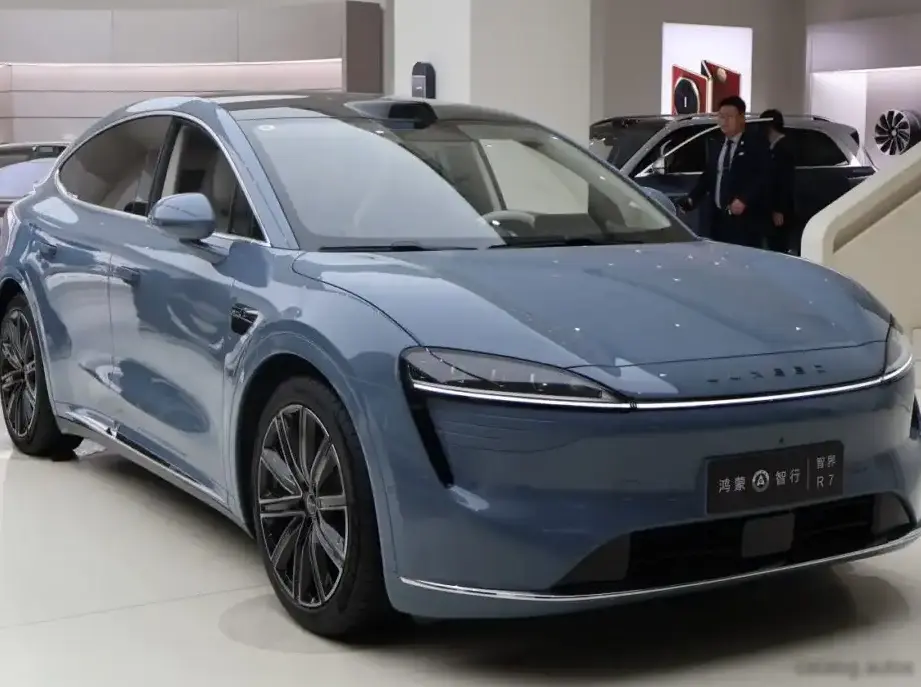
The Luxeed R7 1.5T 53.4 kWh (309 Hp) Extended Range is a plug-in hybrid electric vehicle (PHEV) produced by Luxeed, a joint venture between BAIC Group and Huawei. Introduced in April 2025 and discontinued in August of the same year, this variant occupied a significant position within the R7 model range, offering an extended electric range and a combined system output aimed at consumers seeking both efficiency and performance. The R7 is categorized as a coupe SUV, blending sporty aesthetics with the practicality of a five-seater, five-door body style. It represents Luxeed’s early foray into the rapidly expanding Chinese new energy vehicle (NEV) market.
Technical Specifications
| Brand | Luxeed |
| Model | R7 |
| Generation | R7 |
| Type (Engine) | 1.5T 53.4 kWh (309 Hp) Extended Range |
| Start of production | April, 2025 |
| End of production | August, 2025 |
| Powertrain Architecture | PHEV (Plug-in Hybrid Electric Vehicle) |
| Body type | Coupe, SUV |
| Seats | 5 |
| Doors | 5 |
| Fuel consumption (economy) – combined (WLTC) | 0.24-5.75 l/100 km (980.1 – 40.9 US mpg, 1177 – 49.1 UK mpg, 416.7 – 17.4 km/l) |
| Fuel Type | Petrol / electricity |
| Acceleration 0 – 100 km/h | 7.4 sec |
| Acceleration 0 – 62 mph | 7.4 sec |
| Acceleration 0 – 60 mph | 7 sec |
| Maximum speed | 200 km/h (124.27 mph) |
| Emission standard | China VI b |
| Weight-to-power ratio | 7.5 kg/Hp, 133.9 Hp/tonne |
| Weight-to-torque ratio | 7.2 kg/Nm, 138.6 Nm/tonne |
| Gross battery capacity | 53.4 kWh |
| Battery voltage | 400 V |
| Battery technology | Lithium nickel manganese cobalt oxides (Li-NMC) |
| Battery location | Below the floor |
| All-electric range | 284-360 km (176.47 – 223.69 mi) |
| Average Energy consumption | 18.7 kWh/100 km (30.09 kWh/100 mi, 112 MPGe, 5.3 km/kWh, 3.3 mi/kWh) |
| Electric motor power | 309 Hp |
| Electric motor Torque | 320 Nm (236.02 lb.-ft.) |
| Electric motor model/code | TZ210XYAP4 |
| Electric motor location | Rear axle, Transverse |
| Electric motor type | Synchronous |
| System power | 309 Hp |
| System torque | 320 Nm (236.02 lb.-ft.) |
| Power | 156 Hp |
| Power per litre | 104.1 Hp/l |
| Torque | 220 Nm (162.26 lb.-ft.) |
| Engine layout | Front, Transverse |
| Engine Model/Code | SQRH4J15 |
| Engine displacement | 1499 cm3 (91.47 cu. in.) |
| Number of cylinders | 4 |
| Engine configuration | Inline |
| Cylinder Bore | 74.5 mm (2.93 in.) |
| Piston Stroke | 85.9 mm (3.38 in.) |
| Number of valves per cylinder | 4 |
| Fuel injection system | Direct injection |
| Engine aspiration | Turbocharger, Intercooler |
| Valvetrain | DOHC |
| Kerb Weight | 2308 kg (5088.27 lbs.) |
| Max. weight | 2745 kg (6051.69 lbs.) |
| Max load | 437 kg (963.42 lbs.) |
| Trunk (boot) space – minimum | 796 l (28.11 cu. ft.) |
| Trunk (boot) space – maximum | 2089 l (73.77 cu. ft.) |
| Fuel tank capacity | 67 l (17.7 US gal | 14.74 UK gal) |
| Length | 4956 mm (195.12 in.) |
| Width | 1981 mm (77.99 in.) |
| Height | 1634 mm (64.33 in.) |
| Wheelbase | 2950 mm (116.14 in.) |
| Front track | 1692 mm (66.61 in.) |
| Rear (Back) track | 1695 mm (66.73 in.) |
| Drag coefficient (Cd) | 0.247 |
| Minimum turning circle (turning diameter) | 11.34 m (37.2 ft.) |
| Approach angle | 16° |
| Departure angle | 18° |
| Drivetrain Architecture | The Internal combustion engine (ICE) drives the generator only, with no mechanical connection to the drive. An electric motor drives the rear wheels. |
| Drive wheel | Rear wheel drive |
| Number of gears and type of gearbox | 1 gears, automatic transmission |
| Front suspension | Double wishbone, Transverse stabilizer, Air suspension |
| Rear suspension | Independent multi-link suspension, Air suspension, Transverse stabilizer |
| Front brakes | Ventilated discs |
| Rear brakes | Ventilated discs |
| Assisting systems | ABS (Anti-lock braking system) |
| Steering type | Steering rack and pinion |
| Power steering | Electric Steering |
| Tires size | 255/50 R20; 255/45 R21 |
| Wheel rims size | 20; 21 |
Powertrain & Engine Architecture
The Luxeed R7 1.5T Extended Range employs a sophisticated PHEV powertrain. The core of the system is a 1.5-liter turbocharged inline-four cylinder gasoline engine (code SQRH4J15) producing 156 horsepower and 220 Nm (162.26 lb.-ft.) of torque. This engine doesn’t directly drive the wheels; instead, it functions as a generator to charge the 53.4 kWh lithium nickel manganese cobalt oxide (Li-NMC) battery pack. The primary motive force comes from a rear-mounted synchronous electric motor delivering 309 horsepower and 320 Nm (236.02 lb.-ft.) of torque. This configuration results in a combined system output of 309 horsepower. The single-speed automatic transmission efficiently delivers power to the rear wheels. The engine utilizes direct fuel injection and a turbocharger with intercooling to optimize efficiency and power output. The battery pack, located under the floor, provides an all-electric range of 284-360 km (176.47 – 223.69 mi).
Driving Characteristics
The R7 1.5T Extended Range offers a driving experience focused on smoothness and efficiency. The electric motor provides instant torque, resulting in brisk acceleration – 0 to 100 km/h in 7.4 seconds. The single-speed automatic transmission ensures seamless power delivery. In electric mode, the vehicle operates silently and responsively, ideal for urban driving. When the battery is depleted, the gasoline engine seamlessly kicks in to provide additional range, operating as a generator. Compared to potential higher-output versions (if offered), this variant prioritizes fuel economy and a refined driving experience over outright performance. The rear-wheel-drive configuration contributes to balanced handling, although it may not offer the same level of all-weather capability as an all-wheel-drive system.
Equipment & Trim Levels
The Luxeed R7 1.5T Extended Range was generally well-equipped, reflecting its positioning as a premium PHEV. Standard features typically included a large touchscreen infotainment system powered by Huawei’s HarmonyOS, advanced driver-assistance systems (ADAS) such as adaptive cruise control and lane-keeping assist, a panoramic sunroof, and premium interior materials. Interior upholstery was typically a combination of leatherette and fabric, with options for full leather upgrades. Available options included a premium sound system, ventilated and heated seats, and a head-up display. The overall interior design emphasized a minimalist aesthetic with a focus on technology integration.
Chassis & Braking
The R7 utilizes a double wishbone suspension setup at the front and an independent multi-link suspension at the rear, both incorporating air suspension for a comfortable ride. Stabilizer bars are present on both axles to minimize body roll during cornering. The braking system consists of ventilated discs on all four wheels, coupled with an anti-lock braking system (ABS) for enhanced safety. The vehicle’s relatively high curb weight of 2308 kg (5088.27 lbs.) necessitates a robust braking system to ensure adequate stopping power.
Market Reception & Comparison
The Luxeed R7 1.5T Extended Range received generally positive reviews for its stylish design, advanced technology, and impressive electric range. Critics praised the seamless integration of the PHEV powertrain and the comfortable ride quality. However, some noted the relatively short production run and limited availability. Compared to other PHEV SUVs in the Chinese market, the R7 offered a competitive combination of performance, range, and features. Its fuel economy, ranging from 0.24-5.75 l/100 km, was a key selling point, appealing to environmentally conscious consumers.
Legacy
Due to its brief production run, the Luxeed R7 1.5T Extended Range remains a relatively rare vehicle. Its long-term reliability is still being assessed, but the combination of a proven gasoline engine and a modern electric powertrain suggests good potential durability. In the used car market, these models are likely to appeal to tech enthusiasts and those seeking a stylish and efficient PHEV. The R7 represents an early example of the collaboration between BAIC and Huawei in the NEV space, paving the way for future electric vehicle development.

