
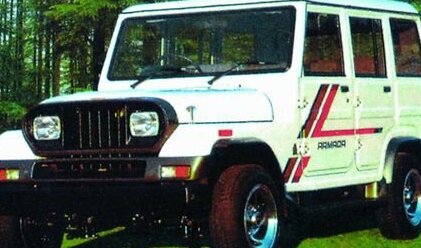
The Mahindra Armada (CJ7) 2.1 D 4WD, produced from 1990 to 2001, represents a significant chapter in Mahindra’s history of rugged, utilitarian vehicles. Derived from the Jeep CJ-7, the Armada was specifically tailored for the Indian market, offering a robust and affordable four-wheel-drive option for rural and semi-urban customers. This particular variant, equipped with the 2.1-liter diesel engine producing 62 horsepower, served as a workhorse, prioritizing durability and low-cost operation over outright performance. It occupied the entry-level position within the Armada lineup, appealing to buyers needing a dependable vehicle for agricultural, commercial, or family transport where paved roads were not always guaranteed.
Technical Specifications
| Brand | Mahindra |
| Model | Armada |
| Generation | Armada (CJ7) |
| Type (Engine) | 2.1 D (62 Hp) 4WD |
| Start of production | 1990 |
| End of production | 2001 |
| Powertrain Architecture | Internal Combustion engine |
| Body type | Off-road vehicle |
| Seats | 8 |
| Doors | 5 |
| Fuel Type | Diesel |
| Maximum speed | 105 km/h (65.24 mph) |
| Weight-to-power ratio | 27.4 kg/Hp, 36.5 Hp/tonne |
| Weight-to-torque ratio | 14 kg/Nm, 71.2 Nm/tonne |
| Power | 62 Hp @ 4500 rpm |
| Power per litre | 29.2 Hp/l |
| Torque | 121 Nm @ 4500 rpm (89.25 lb.-ft. @ 4500 rpm) |
| Engine layout | Front, Longitudinal |
| Engine displacement | 2121 cm3 (129.43 cu. in.) |
| Number of cylinders | 4 |
| Engine configuration | Inline |
| Cylinder Bore | 90 mm (3.54 in.) |
| Piston Stroke | 83.5 mm (3.29 in.) |
| Compression ratio | 22.4:1 |
| Number of valves per cylinder | 2 |
| Fuel injection system | Precombustion chamber injection |
| Engine aspiration | Naturally aspirated engine |
| Kerb Weight | 1700 kg (3747.86 lbs.) |
| Max. weight | 2280 kg (5026.54 lbs.) |
| Max load | 580 kg (1278.68 lbs.) |
| Fuel tank capacity | 60 l (15.85 US gal | 13.2 UK gal) |
| Length | 4305 mm (169.49 in.) |
| Width | 1680 mm (66.14 in.) |
| Height | 1738 mm (68.43 in.) |
| Wheelbase | 2680 mm (105.51 in.) |
| Front track | 1346 mm (52.99 in.) |
| Rear (Back) track | 1346 mm (52.99 in.) |
| Drive wheel | All wheel drive (4×4) |
| Number of gears and type of gearbox | 4 gears, manual transmission |
| Front suspension | Independent coil spring |
| Rear suspension | Independent coil spring |
| Front brakes | Disc |
| Rear brakes | Drum |
| Assisting systems | ABS (Anti-lock braking system) |
| Tires size | 215/75 R15 |
| Wheel rims size | 15 |
Powertrain & Engine Architecture
The heart of the Armada 2.1 D was a 2.1-liter inline-four diesel engine. This engine, while relatively simple in design, was known for its robustness and ability to operate reliably under harsh conditions. It utilized a precombustion chamber injection system, a common technology for diesel engines of the era, which improved combustion efficiency and reduced engine noise compared to direct injection systems. The engine produced 62 horsepower at 4500 rpm and 121 Nm (89.25 lb-ft) of torque at the same engine speed. The relatively low compression ratio of 22.4:1, while high for modern standards, was typical for diesel engines of the time and contributed to its durability. The engine was mounted longitudinally in the front of the vehicle. The four-speed manual transmission was a standard feature, chosen for its simplicity and durability, and geared towards providing sufficient torque for off-road and load-carrying applications.
Driving Characteristics
The Armada 2.1 D 4WD was not designed for speed or sporty handling. Its driving characteristics were defined by its utilitarian purpose. Acceleration was modest, and the vehicle felt underpowered when fully loaded or tackling steep inclines. However, the engine’s torque delivery was relatively flat, providing adequate pulling power at lower engine speeds. The four-speed manual transmission, while not offering the refinement of more modern gearboxes, was robust and allowed the driver to maintain control in challenging terrain. The 4WD system, typically engaged via a lever, provided enhanced traction on loose surfaces, making it suitable for agricultural work and navigating unpaved roads. Compared to potential higher-output versions (which were not commonly available in this configuration), the 2.1 D prioritized fuel efficiency and longevity over performance.
Equipment & Trim Levels
The Armada 2.1 D 4WD was generally sparsely equipped, reflecting its focus on affordability and practicality. Standard features typically included basic steel wheels, vinyl or cloth upholstery, and a simple dashboard layout. Power steering and air conditioning were often optional extras, adding to the vehicle’s cost. The interior was designed for functionality rather than luxury, with durable materials chosen to withstand heavy use. Trim levels were minimal, with most variations stemming from optional equipment choices rather than distinct packages.
Chassis & Braking
The Armada’s chassis was based on the Jeep CJ-7 design, featuring a ladder frame construction known for its strength and durability. The suspension utilized independent coil springs on both the front and rear axles, providing a reasonable level of ride comfort considering the vehicle’s off-road capabilities. Braking was accomplished via disc brakes on the front axle and drum brakes on the rear. An Anti-lock Braking System (ABS) was included, a relatively advanced feature for a vehicle of this type and price point in the Indian market. The tires, typically 215/75 R15, were chosen for their durability and all-terrain capability.
Market Reception & Comparison
The Mahindra Armada 2.1 D 4WD was well-received in the Indian market as a dependable and affordable four-wheel-drive vehicle. Critics praised its ruggedness and ability to handle rough terrain, but noted its lack of refinement and modest performance. Compared to other vehicles in its class, such as the Tata Sumo, the Armada offered a more robust and capable 4WD system, but at the expense of interior space and comfort. Its fuel economy was considered reasonable for a diesel vehicle of its size and capability. The Armada’s simplicity also meant lower maintenance costs, a significant advantage for owners in rural areas.
Legacy
The Mahindra Armada (CJ7) 2.1 D 4WD holds a significant place in the history of Indian automotive manufacturing. It established Mahindra as a leading producer of rugged, utilitarian vehicles and paved the way for future models. While no longer in production, the Armada remains a popular choice among enthusiasts and collectors, particularly those seeking a classic off-road vehicle. The 2.1-liter diesel engine, while now outdated, was known for its longevity and relative simplicity, making it a relatively easy engine to maintain and repair even today. In the used car market, well-maintained examples of the Armada 2.1 D 4WD command a reasonable price, reflecting its enduring appeal and reputation for reliability.
