
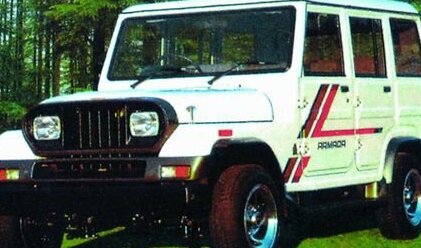
The Mahindra Armada (CJ7) 2.5 D 4WD Grand, producing 72 horsepower, was a significant vehicle in the Indian automotive landscape from 1992 to 2001. Derived from the iconic Jeep CJ-7, the Armada was locally manufactured by Mahindra & Mahindra, becoming a popular choice for both rural and urban customers seeking a rugged, utilitarian vehicle. This particular 2.5-liter diesel variant, positioned as a mid-range offering within the Armada lineup, aimed to balance affordability with capability, offering four-wheel drive and a spacious interior. It represented a key step in Mahindra’s development of indigenous automotive technology and its expansion into the utility vehicle segment.
Technical Specifications
| Brand | Mahindra |
| Model | Armada |
| Generation | Armada (CJ7) |
| Type | 2.5 D 4WD Grand (72 Hp) |
| Start of production | 1992 |
| End of production | 2001 |
| Powertrain Architecture | Internal Combustion engine |
| Body type | Off-road vehicle |
| Seats | 8 |
| Doors | 5 |
| Fuel Type | Diesel |
| Maximum speed | 113 km/h (70.21 mph) |
| Weight-to-power ratio | 24 kg/Hp, 41.6 Hp/tonne |
| Weight-to-torque ratio | 11.4 kg/Nm, 87.9 Nm/tonne |
| Power | 72 Hp @ 4000 rpm |
| Power per litre | 28.8 Hp/l |
| Torque | 152 Nm @ 2000 rpm (112.11 lb.-ft. @ 2000 rpm) |
| Engine layout | Front, Longitudinal |
| Engine displacement | 2498 cm3 (152.44 cu. in.) |
| Number of cylinders | 4 |
| Engine configuration | Inline |
| Cylinder Bore | 94 mm (3.7 in.) |
| Piston Stroke | 90 mm (3.54 in.) |
| Compression ratio | 23:1 |
| Number of valves per cylinder | 2 |
| Fuel injection system | Precombustion chamber injection |
| Engine aspiration | Naturally aspirated engine |
| Kerb Weight | 1730 kg (3814 lbs.) |
| Max. weight | 2280 kg (5026.54 lbs.) |
| Max load | 550 kg (1212.54 lbs.) |
| Fuel tank capacity | 60 l (15.85 US gal | 13.2 UK gal) |
| Length | 4360 mm (171.65 in.) |
| Width | 1800 mm (70.87 in.) |
| Height | 1738 mm (68.43 in.) |
| Wheelbase | 2680 mm (105.51 in.) |
| Front track | 1443 mm (56.81 in.) |
| Rear track | 1443 mm (56.81 in.) |
| Drive wheel | All wheel drive (4×4) |
| Number of gears and type of gearbox | 5 gears, manual transmission |
| Front suspension | Leaf spring |
| Rear suspension | Leaf spring |
| Front brakes | Disc |
| Rear brakes | Drum |
| Assisting systems | ABS (Anti-lock braking system) |
| Power steering | Hydraulic Steering |
| Tires size | 215/75 R15 |
| Wheel rims size | 15 |
Powertrain & Engine Architecture
The heart of the Armada 2.5 D 4WD Grand was a 2.5-liter inline-four diesel engine. This engine, often referred to by its internal codes, utilized a precombustion chamber injection system – a common technology for diesel engines of that era. This system involved injecting fuel into a precombustion chamber, which then ignited the main combustion chamber, improving cold-starting performance and combustion efficiency. The engine produced 72 horsepower at 4000 rpm and 152 Nm (112.11 lb.-ft.) of torque at 2000 rpm. The engine’s longitudinal mounting and the robust five-speed manual transmission were designed to handle the demands of off-road driving and heavy loads. The relatively low compression ratio of 23:1, while typical for the time, contributed to the engine’s durability and ability to run on lower-quality diesel fuel, a significant factor in the Indian market.
Driving Characteristics
The Armada 2.5 D 4WD Grand, with its 72 horsepower and relatively high kerb weight of 1730 kg, wasn’t designed for rapid acceleration. Performance was best described as adequate, with a focus on low-end torque for tackling challenging terrain. The five-speed manual transmission allowed drivers to select appropriate gear ratios for varying conditions, but the gear lever action was often described as notchy. Compared to potential higher-output versions (which were not commonly available), this variant prioritized fuel efficiency and reliability over outright speed. The four-wheel-drive system, engaged manually, provided excellent traction in off-road situations, making it a popular choice for agricultural and rural applications. The power delivery was linear, but required careful gear selection, especially when fully loaded.
Equipment & Trim Levels
The Armada 2.5 D 4WD Grand was positioned as a fairly well-equipped vehicle for its time and price point. Standard features typically included basic instrumentation, vinyl or cloth upholstery, and a functional dashboard layout. While not luxurious, the interior was designed for practicality and durability. Optional extras could include features like power steering (a significant upgrade), upgraded seating materials, and basic audio systems. The “Grand” designation often indicated a slightly higher level of trim, potentially including features like a more comprehensive instrument cluster or improved interior finishes. The vehicle’s focus was on functionality rather than lavish appointments.
Chassis & Braking
The Armada’s chassis was a body-on-frame construction, derived from the original Jeep CJ-7 design, providing a robust and durable platform for off-road use. Suspension consisted of leaf springs at both the front and rear, offering a comfortable ride on rough surfaces, albeit with some body roll during cornering. The braking system featured disc brakes on the front wheels and drum brakes on the rear, which was typical for vehicles in this class during the 1990s. The inclusion of an Anti-lock Braking System (ABS) was a notable feature, enhancing safety, particularly on slippery surfaces. The relatively simple suspension and braking systems were chosen for their reliability and ease of maintenance.
Market Reception & Comparison
The Mahindra Armada 2.5 D 4WD Grand was generally well-received in the Indian market. Critics praised its ruggedness, spaciousness, and affordability. Compared to other vehicles in its class, such as the Tata Sumo, the Armada offered a more refined driving experience and a reputation for greater reliability. However, its fuel economy was not exceptional, and its performance was modest. The Armada’s strength lay in its ability to handle rough terrain and carry heavy loads, making it a popular choice for farmers, rural businesses, and those needing a versatile utility vehicle. Its relatively simple mechanical design also made it easier and cheaper to maintain.
Legacy
The Mahindra Armada (CJ7) 2.5 D 4WD Grand holds a significant place in Indian automotive history. It helped establish Mahindra & Mahindra as a leading manufacturer of utility vehicles and demonstrated the company’s ability to produce durable and capable vehicles locally. While production ceased in 2001, many examples of the Armada remain in use today, testament to their robust construction and reliability. In the used car market, these vehicles are often sought after by enthusiasts and those needing a dependable workhorse. The Armada’s legacy continues to influence Mahindra’s current lineup of SUVs and utility vehicles, embodying a tradition of ruggedness and practicality.
