
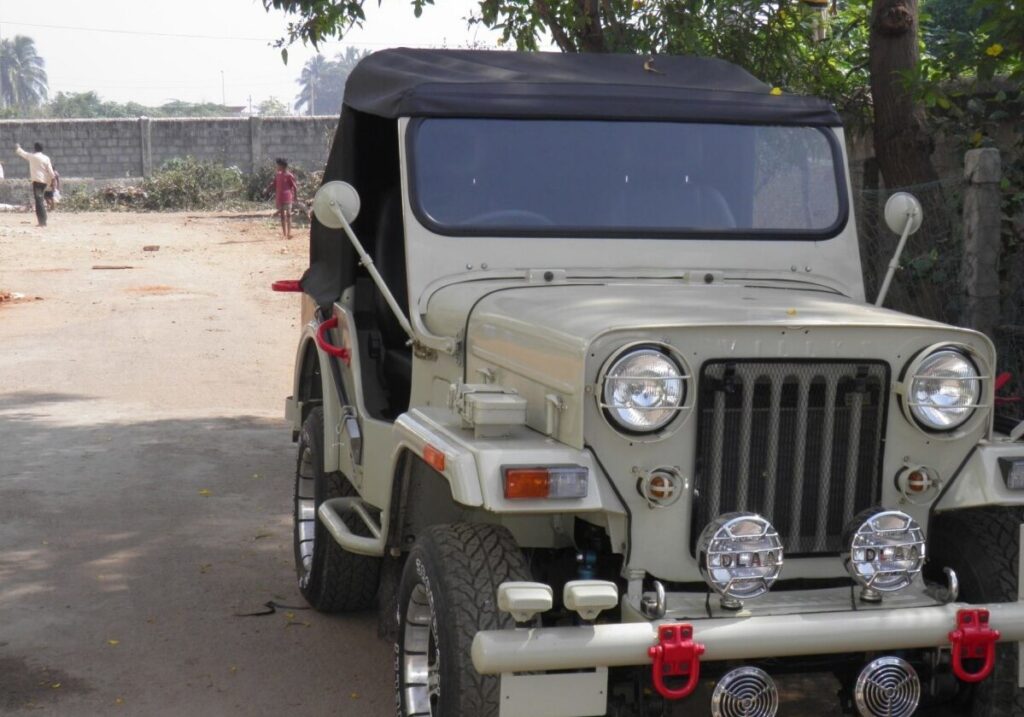
The Mahindra CJ 3 2.5 D, produced between 1988 and 1992, represents a significant iteration of the iconic CJ (Civilian Jeep) series adapted for the Indian market. This variant, powered by a 2.5-liter diesel engine producing 39 horsepower, served as a workhorse vehicle, primarily aimed at agricultural and utility applications. It built upon the foundation of the original Willys Jeep design, heavily localized and modified by Mahindra & Mahindra to suit the demands and economic realities of India during that period. The CJ 3 2.5 D occupied a crucial position in Mahindra’s lineup, offering a relatively affordable and robust off-road solution for rural customers.
Technical Specifications
| Brand | Mahindra |
| Model | CJ 3 |
| Generation | CJ 3 |
| Type (Engine) | 2.5 D (39 Hp) |
| Start of Production | 1988 |
| End of Production | 1992 |
| Powertrain Architecture | Internal Combustion Engine |
| Body Type | Off-road Vehicle |
| Fuel Type | Diesel |
| Power | 39 Hp |
| Engine Aspiration | Naturally Aspirated |
Powertrain & Engine Architecture
The heart of the CJ 3 2.5 D is its 2.5-liter, naturally aspirated diesel engine. This engine, while relatively simple in design, was chosen for its durability, fuel efficiency, and ability to operate reliably in harsh conditions with minimal maintenance. It’s a direct-injection diesel, meaning fuel is injected directly into the combustion chamber under high pressure. The engine utilizes a mechanical fuel injection pump, a common feature in diesel engines of this era, and lacks sophisticated electronic controls. The engine’s low horsepower output (39 hp) is a result of its relatively low compression ratio and modest injection pressures, prioritizing longevity over outright performance. The engine is a four-cylinder configuration, and the valvetrain consists of a simple overhead valve (OHV) setup. The transmission is a typically robust, but unsophisticated, four-speed manual gearbox. The drivetrain is a part-time four-wheel drive system, with high and low range gearing, essential for tackling challenging terrain. The transfer case allows the driver to switch between two-wheel drive (rear-wheel drive) for on-road use and four-wheel drive for off-road capability.
Driving Characteristics
The driving experience of the CJ 3 2.5 D is decidedly utilitarian. With only 39 horsepower on tap, acceleration is slow, and hill climbing requires careful gear selection and momentum. The four-speed manual transmission has widely spaced gear ratios, meaning frequent shifting is necessary to maintain optimal engine speed. The vehicle’s relatively light weight helps to mitigate the lack of power, but it’s not a vehicle designed for speed or highway cruising. The suspension is basic, consisting of leaf springs front and rear, providing a firm and somewhat bumpy ride, especially on uneven surfaces. Steering is also manual, requiring considerable effort at low speeds. However, the CJ 3 2.5 D excels in off-road situations. The four-wheel drive system, combined with its short wheelbase and high ground clearance, allows it to navigate rough terrain with surprising ease. The low-range gearing provides ample torque for crawling over obstacles and traversing steep inclines.
Equipment & Trim Levels
The CJ 3 2.5 D was intentionally spartan in its equipment levels, reflecting its target market and price point. It was designed to be a functional work vehicle, not a luxury item. Standard features were minimal, typically including basic steel wheels, a simple bench seat, and a rudimentary dashboard with essential gauges (speedometer, fuel gauge, and temperature gauge). Doors were often equipped with simple fabric or canvas coverings, and a basic folding windshield was standard. Options were limited, but could include a hardtop, a winch, and additional lighting. Interior trim was virtually non-existent, with exposed metal surfaces and durable, easy-to-clean materials. The focus was on practicality and durability, rather than comfort or aesthetics.
Chassis & Braking
The chassis of the CJ 3 2.5 D is a ladder frame construction, providing a robust and durable foundation for the vehicle. The suspension, as mentioned previously, utilizes leaf springs front and rear. The front axle is a solid axle, providing strength and articulation for off-road use. The rear axle is also a solid axle. Braking is accomplished via drum brakes on all four wheels. The braking system is mechanically operated, lacking power assistance, and provides adequate stopping power for the vehicle’s weight and performance capabilities. Steering is a recirculating ball type, manual steering system. The vehicle’s relatively simple construction and robust components contribute to its legendary reliability and ease of maintenance.
Market Reception & Comparison
The Mahindra CJ 3 2.5 D was well-received in the Indian market, particularly among farmers, landowners, and those requiring a rugged and reliable off-road vehicle for work purposes. It filled a niche that few other vehicles could match at its price point. Compared to other Mahindra offerings of the time, such as the CJ 4 and the Armada, the CJ 3 2.5 D was the most affordable and basic option. The CJ 4 offered more power and refinement, while the Armada was a larger, more family-oriented vehicle. The CJ 3 2.5 D’s fuel economy was a significant advantage, especially in a market where fuel costs were a major concern. While its performance was modest, its durability and low running costs made it a popular choice. Critics generally praised its robustness and simplicity, but noted its lack of comfort and refinement.
Legacy
The Mahindra CJ 3 2.5 D holds a significant place in the history of Indian automotive manufacturing. It represents a successful adaptation of the classic Willys Jeep design to the specific needs of the Indian market. The 2.5-liter diesel engine, while relatively primitive by modern standards, proved to be exceptionally durable and reliable, earning a reputation for longevity. Today, the CJ 3 2.5 D is a sought-after vehicle among collectors and enthusiasts, particularly those interested in classic off-road vehicles. Parts availability remains relatively good, thanks to the vehicle’s simple construction and the continued production of some components. While it may not offer the comfort or performance of modern vehicles, the CJ 3 2.5 D continues to embody the spirit of ruggedness, reliability, and simplicity that defined the original Willys Jeep.

