
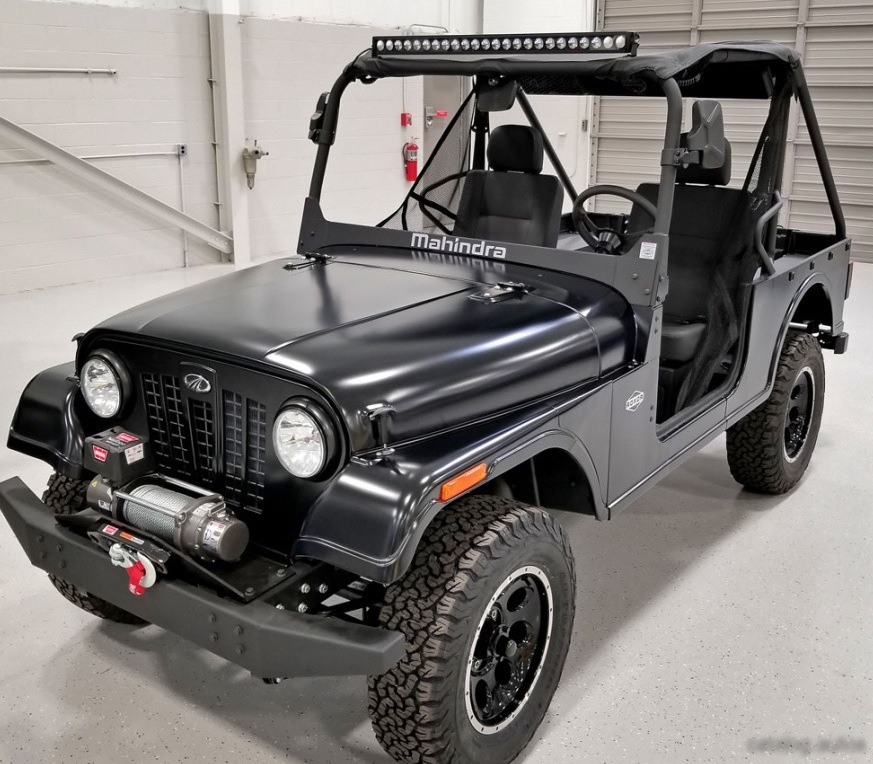
The Mahindra Roxor 2.5 m2DiCR (62 Hp) 4WD is a utilitarian off-road vehicle introduced by Mahindra & Mahindra Limited in 2018. Designed primarily for agricultural, industrial, and recreational use, the Roxor quickly gained a niche following, particularly in the United States, due to its rugged construction and resemblance to the original Jeep design. It’s important to note the Roxor’s origins stem from the Mahindra Scorpio Getaway, a popular pickup truck in India and other international markets. The Roxor was specifically engineered for the North American market, adapting the Scorpio’s chassis and powertrain into a purpose-built off-road machine. Production was temporarily halted in 2020 due to intellectual property disputes, but resumed in 2023 with design modifications.
Technical Specifications
| Brand | Mahindra |
| Model | Roxor |
| Type (Engine) | 2.5 m2DiCR (62 Hp) 4WD |
| Start of production | 2018 |
| Powertrain Architecture | Internal Combustion engine |
| Body type | Off-road vehicle |
| Seats | 2 |
| Fuel Type | Diesel |
| Maximum speed | 88 km/h (54.68 mph) |
| Weight-to-power ratio | 22.2 kg/Hp, 45 Hp/tonne |
| Weight-to-torque ratio | 7.1 kg/Nm, 141.6 Nm/tonne |
| Power | 62 Hp @ 3200 rpm |
| Power per litre | 24.6 Hp/l |
| Torque | 195 Nm @ 1400-2200 rpm (143.82 lb.-ft. @ 1400-2200 rpm) |
| Engine layout | Front, Transverse |
| Engine Model/Code | m2DiCR |
| Engine displacement | 2523 cm3 (153.96 cu. in.) |
| Number of cylinders | 4 |
| Engine configuration | Inline |
| Cylinder Bore | 88.9 mm (3.5 in.) |
| Piston Stroke | 101.6 mm (4 in.) |
| Compression ratio | 18.6:1 |
| Number of valves per cylinder | 4 |
| Fuel injection system | Diesel Commonrail |
| Engine aspiration | Turbocharger, Intercooler |
| Engine oil capacity | 7 l (7.4 US qt | 6.16 UK qt) |
| Coolant | 8 l (8.45 US qt | 7.04 UK qt) |
| Kerb Weight | 1377 kg (3035.77 lbs.) |
| Fuel tank capacity | 45 l (11.89 US gal | 9.9 UK gal) |
| Permitted trailer load with brakes (12%) | 1583 kg (3489.92 lbs.) |
| Length | 3759 mm (147.99 in.) |
| Width | 1575 mm (62.01 in.) |
| Height | 1905 mm (75 in.) |
| Wheelbase | 2438 mm (95.98 in.) |
| Ride height (ground clearance) | 229 mm (9.02 in.) |
| Drive wheel | All wheel drive (4×4) |
| Number of gears and type of gearbox | 5 gears, manual transmission |
| Front suspension | Leaf spring |
| Rear suspension | Leaf spring |
| Front brakes | Disc |
| Rear brakes | Drum |
| Tires size | 235/70 R16 |
| Wheel rims size | 5.5J x 16 |
Powertrain & Engine Architecture
The Roxor is powered by Mahindra’s 2.5-liter m2DiCR four-cylinder diesel engine. This engine, while relatively simple in design, is known for its durability and low-end torque. The ‘m2DiCR’ designation signifies a common-rail direct injection system, which improves fuel efficiency and reduces emissions compared to older diesel technologies. The engine utilizes a turbocharger with an intercooler to boost power output. The 62 horsepower peak is reached at 3200 rpm, but the engine’s 195 Nm (143.82 lb-ft) of torque is available from a low 1400-2200 rpm, making it well-suited for off-road applications. The engine is transversely mounted within the chassis. The Roxor utilizes a five-speed manual transmission, chosen for its robustness and simplicity. It’s a non-synchronized gearbox, contributing to the vehicle’s rugged, utilitarian feel.
Driving Characteristics
The Roxor’s driving experience is distinctly utilitarian. The 62 horsepower engine, coupled with the five-speed manual transmission, provides adequate power for off-road tasks, but acceleration is modest. The emphasis is on low-end torque, allowing the Roxor to crawl over obstacles and navigate challenging terrain with relative ease. The gear ratios are optimized for off-road performance, prioritizing pulling power over top-end speed. Compared to potential higher-output versions (which were considered but never officially offered), this configuration prioritizes fuel efficiency and mechanical simplicity. The manual transmission requires a deliberate and engaged driving style, lacking the convenience of automatic shifting but offering greater control in off-road situations.
Equipment & Trim Levels
The Roxor was intentionally kept spartan in terms of equipment. Mahindra focused on providing a durable and functional vehicle rather than luxury features. Standard equipment included basic steel wheels, vinyl seats, a simple dashboard with essential gauges, and a roll cage for added safety. Power steering was not standard, contributing to the vehicle’s raw, mechanical feel. Optional extras were limited but included a hardtop, windshield, doors, and a winch. The interior was designed to be easily washable, reflecting the Roxor’s intended use in harsh environments. There wasn’t a traditional trim level structure; customization was largely achieved through the addition of optional accessories.
Chassis & Braking
The Roxor’s chassis is a body-on-frame construction, providing exceptional strength and durability. It’s based on the Mahindra Scorpio Getaway platform, but significantly reinforced for off-road use. The suspension utilizes leaf springs at both the front and rear, offering a robust and simple design capable of handling heavy loads and rough terrain. The front brakes are discs, while the rear brakes are drums. This configuration is typical for vehicles in this weight class and prioritizes cost-effectiveness and simplicity. Ground clearance is a generous 229 mm (9.02 inches), allowing the Roxor to navigate obstacles with ease. The Roxor’s relatively narrow width enhances its maneuverability in tight spaces.
Market Reception & Comparison
The Mahindra Roxor received mixed reviews. Critics praised its rugged construction, off-road capability, and affordable price point. However, the lack of creature comforts and its relatively slow speed were points of criticism. Compared to other side-by-sides and UTVs in the market, the Roxor offered a unique blend of automotive-style construction and off-road performance. Its fuel economy was reasonable for a diesel vehicle, and its simple mechanical design promised relatively low maintenance costs. However, the intellectual property dispute with Jeep cast a shadow over its initial market reception. The Roxor appealed to a niche audience of farmers, ranchers, outdoor enthusiasts, and those seeking a unique and capable off-road vehicle.
Legacy
The Mahindra Roxor, despite its relatively short production run and legal challenges, has established a dedicated following. Its unique design and rugged capabilities have made it a popular choice for those seeking a durable and capable off-road vehicle. The 2.5 m2DiCR engine, while not particularly powerful, has proven to be reliable and long-lasting. On the used car market, Roxors in good condition hold their value reasonably well, reflecting their desirability among enthusiasts. The resumption of production in 2023, with design modifications, suggests that Mahindra remains committed to the Roxor’s unique position in the off-road vehicle market. The Roxor’s legacy is one of a simple, rugged, and capable machine that defied conventional automotive norms.
