
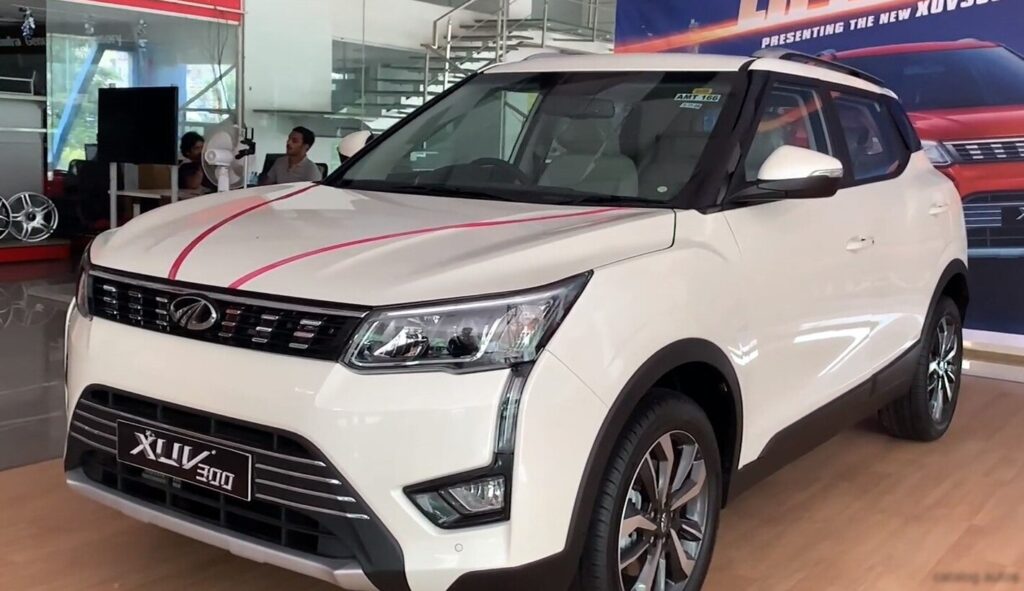
The Mahindra XUV300 1.2 TCMPFI, producing 110 horsepower, was a subcompact SUV manufactured by the Indian automaker Mahindra & Mahindra from February 2019 to April 2024. Positioned as an entry-level to mid-range offering within the XUV300 lineup, it aimed to provide a balance of fuel efficiency, affordability, and modern features in a competitive segment. The XUV300 was Mahindra’s attempt to gain a foothold in the rapidly growing sub-4 meter SUV market, primarily targeting urban consumers in India. It was built upon a modified version of the SsangYong X100 platform, reflecting Mahindra’s ownership of the South Korean automaker at the time.
Technical Specifications
| Brand | Mahindra |
| Model | XUV300 |
| Generation | XUV300 |
| Type (Engine) | 1.2 TCMPFI (110 Hp) |
| Start of production | February, 2019 |
| End of production | April, 2024 |
| Powertrain Architecture | Internal Combustion engine |
| Body type | SUV |
| Seats | 5 |
| Doors | 5 |
| Fuel Type | Petrol (Gasoline) |
| Emission standard | BS-VI |
| Power | 110 Hp @ 5000 rpm |
| Power per litre | 91.9 Hp/l |
| Torque | 200 Nm @ 2000-3500 rpm (147.51 lb.-ft. @ 2000-3500 rpm) |
| Engine layout | Front, Transverse |
| Engine Model/Code | mStallion |
| Engine displacement | 1197 cm3 (73.05 cu. in.) |
| Number of cylinders | 3 |
| Engine configuration | Inline |
| Number of valves per cylinder | 4 |
| Fuel injection system | Multi-port manifold injection |
| Engine aspiration | Turbocharger, Intercooler |
| Engine oil capacity | 4 l (4.23 US qt | 3.52 UK qt) |
| Fuel tank capacity | 42 l (11.1 US gal | 9.24 UK gal) |
| Length | 3995 mm (157.28 in.) |
| Width | 1821 mm (71.69 in.) |
| Height | 1627 mm (64.06 in.) |
| Wheelbase | 2600 mm (102.36 in.) |
| Minimum turning circle | 10.6 m (34.78 ft.) |
| Drivetrain Architecture | Front wheel drive, Internal Combustion engine (ICE) |
| Drive wheel | Front wheel drive |
| Number of gears | 6 |
| Gearbox type | Manual transmission |
| Front suspension | Independent type McPherson, Transverse stabilizer |
| Rear suspension | Coil spring, Torsion |
| Front brakes | Disc |
| Rear brakes | Disc |
| Assisting systems | ABS (Anti-lock braking system) |
| Steering type | Steering rack and pinion |
| Power steering | Electric Steering |
| Tires size | 205/65 R16 |
| Wheel rims size | 16 |
Powertrain & Engine Architecture
The heart of the XUV300 1.2 TCMPFI is Mahindra’s mStallion series 1.2-liter, three-cylinder turbocharged gasoline engine. This engine utilizes a multi-port fuel injection (MPFI) system, providing a balance between fuel efficiency and performance. The engine features four valves per cylinder and an intercooled turbocharger to boost power output. The engine code signifies a focus on turbocharging and direct petrol injection. The 110 horsepower peak is achieved at 5000 rpm, while the 200 Nm (147.51 lb-ft) of torque is available across a broad range of 2000-3500 rpm, making it relatively drivable in urban conditions. The engine is transversely mounted at the front of the vehicle. The XUV300 1.2 TCMPFI was exclusively offered with a 6-speed manual transmission, prioritizing driver engagement and fuel economy over the convenience of an automatic.
Driving Characteristics
The 1.2-liter engine, paired with the manual transmission, provided adequate performance for city driving and occasional highway use. Acceleration was not its strong suit, with a 0-60 mph time estimated to be around 11-12 seconds. The gear ratios were tuned for fuel efficiency, meaning the engine needed to be revved to access its full power potential. Compared to potential future higher-output variants, the 110 hp version felt less responsive, particularly when fully loaded or climbing inclines. The manual transmission offered precise shifts, but the clutch pedal could feel slightly heavier than some competitors. The turbocharger did provide a noticeable boost in power once spooled up, but some turbo lag was present at lower engine speeds.
Equipment & Trim Levels
The XUV300 1.2 TCMPFI was available in several trim levels, typically designated as W4, W6, and W8. The base W4 trim included essential features like air conditioning, power windows, and central locking. The W6 trim added features such as a 7-inch touchscreen infotainment system with Android Auto and Apple CarPlay compatibility, steering-mounted audio controls, and rear parking sensors. The top-end W8 trim offered additional features like alloy wheels, LED daytime running lights, a rear wiper and washer, and cruise control. Interior upholstery was typically cloth, with higher trims offering premium fabric options. Optional extras included a sunroof and a more advanced sound system.
Chassis & Braking
The XUV300 utilized a McPherson strut suspension setup at the front and a coil spring torsion beam suspension at the rear. This configuration provided a comfortable ride quality, absorbing bumps and imperfections in the road reasonably well. The front brakes were ventilated discs, while the rear brakes were also discs, offering adequate stopping power for the vehicle’s weight class. An Anti-lock Braking System (ABS) was standard across all trims, enhancing safety. The electric power steering provided light and easy steering feel, making it maneuverable in tight spaces. The vehicle’s relatively short wheelbase contributed to its agility in urban environments.
Market Reception & Comparison
The Mahindra XUV300 1.2 TCMPFI received mixed reviews from automotive critics. While praised for its spacious interior, robust build quality, and comprehensive feature list, the engine was often criticized for its lack of refinement and relatively low power output compared to some competitors like the Maruti Suzuki Vitara Brezza and Hyundai Venue. Fuel economy was generally considered to be competitive, averaging around 17-20 kmpl (kilometers per liter) in real-world driving conditions. The XUV300’s three-cylinder engine, while efficient, lacked the smoothness of four-cylinder engines found in some rival models. Reliability reports were generally positive, with few major issues reported during its production run.
Legacy
The Mahindra XUV300 1.2 TCMPFI played a significant role in establishing Mahindra as a serious contender in the subcompact SUV segment. While the model has been discontinued, it remains a popular choice in the used car market, particularly for buyers seeking a value-for-money SUV with a spacious interior and a decent feature set. The mStallion engine family continues to be used in other Mahindra vehicles, with ongoing development aimed at improving performance and refinement. The XUV300’s success paved the way for Mahindra to introduce more sophisticated and technologically advanced SUVs in subsequent years, solidifying its position as a major player in the Indian automotive industry.
