
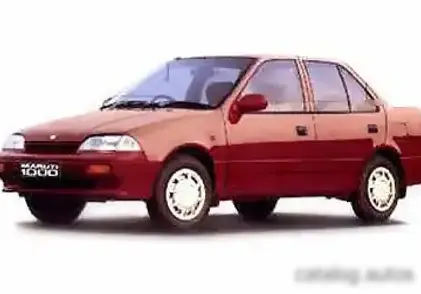
The Maruti 1000 1.0, producing 46 horsepower, was a pivotal model in the Indian automotive landscape, manufactured from 1990 to 2000. It represented a significant step towards affordable personal transportation for the burgeoning Indian middle class. Based on the second-generation Suzuki Cultus (known internationally as the Suzuki Swift), the Maruti 1000 was locally produced by Maruti Udyog, a joint venture between Suzuki Motor Corporation and the Indian government. This variant, with its 1.0-liter engine and carburetor fuel system, served as the entry point into the Maruti 1000 range, offering a balance of economy and practicality. It was a key player in the compact sedan segment during its production run.
Technical Specifications
| Brand | Maruti |
| Model | 1000 |
| Generation | 1000 |
| Type (Engine) | 1.0 (46 Hp) |
| Start of production | 1990 |
| End of production | 2000 |
| Powertrain Architecture | Internal Combustion engine |
| Body type | Sedan |
| Seats | 5 |
| Doors | 4 |
| Fuel Type | Petrol (Gasoline) |
| Maximum speed | 100 km/h (62.14 mph) |
| Weight-to-power ratio | 17.9 kg/Hp, 55.8 Hp/tonne |
| Weight-to-torque ratio | 11.6 kg/Nm, 86.1 Nm/tonne |
| Power | 46 Hp @ 5500 rpm |
| Power per litre | 47.4 Hp/l |
| Torque | 71 Nm @ 3500 rpm (52.37 lb.-ft. @ 3500 rpm) |
| Engine layout | Front, Transverse |
| Engine displacement | 970 cm3 (59.19 cu. in.) |
| Number of cylinders | 4 |
| Engine configuration | Inline |
| Cylinder Bore | 65.5 mm (2.58 in.) |
| Piston Stroke | 72 mm (2.83 in.) |
| Number of valves per cylinder | 2 |
| Fuel injection system | Carburettor |
| Engine aspiration | Naturally aspirated engine |
| Valvetrain | OHC |
| Kerb Weight | 825 kg (1818.81 lbs.) |
| Max. weight | 1240 kg (2733.73 lbs.) |
| Max load | 415 kg (914.92 lbs.) |
| Fuel tank capacity | 40 l (10.57 US gal | 8.8 UK gal) |
| Length | 4075 mm (160.43 in.) |
| Width | 1575 mm (62.01 in.) |
| Height | 1395 mm (54.92 in.) |
| Wheelbase | 2365 mm (93.11 in.) |
| Front track | 1365 mm (53.74 in.) |
| Rear (Back) track | 1340 mm (52.76 in.) |
| Drivetrain Architecture | The Internal combustion engine (ICE) drives the front wheels of the vehicle. |
| Drive wheel | Front wheel drive |
| Number of gears and type of gearbox | 5 gears, manual transmission |
| Front suspension | Spring Strut |
| Rear suspension | Coil spring |
| Front brakes | Disc |
| Rear brakes | Drum |
| Assisting systems | ABS (Anti-lock braking system) |
| Tires size | 155/80 R13 S |
| Wheel rims size | 13 |
Powertrain & Engine Architecture
The heart of the Maruti 1000 1.0 was the F10D engine, a 970cc inline-four cylinder petrol engine. This engine, derived from Suzuki’s G series, featured a single overhead camshaft (OHC) valvetrain with two valves per cylinder. Crucially, this variant utilized a carburetor for fuel delivery, a common feature for vehicles of this era and price point. The carburetor system, while simpler and less expensive than fuel injection, resulted in slightly lower fuel efficiency and emissions. The engine produced 46 horsepower at 5500 rpm and 71 Nm (52.37 lb-ft) of torque at 3500 rpm. The engine was transversely mounted, driving the front wheels. The standard transmission was a five-speed manual gearbox, optimized for fuel economy and everyday driving.
Driving Characteristics
The Maruti 1000 1.0, with its modest power output, was not designed for spirited performance. Acceleration was leisurely, and overtaking required careful planning. However, the light weight of the vehicle (825 kg / 1818.81 lbs) helped to mitigate the lack of horsepower. The five-speed manual transmission allowed drivers to keep the engine in its optimal power band, although the gear ratios were fairly widely spaced. Compared to later, more powerful versions of the Maruti 1000 (such as those with fuel injection or larger engines), the 1.0-liter model prioritized fuel efficiency and ease of driving in urban environments. The steering was light and responsive, making it easy to maneuver in congested city streets.
Equipment & Trim Levels
The Maruti 1000 1.0 was typically offered in a fairly basic trim level, reflecting its position as the entry-level model. Standard features included black vinyl upholstery, a simple dashboard layout with basic instrumentation, and manual windows and door locks. Air conditioning was often an optional extra, as were features like a radio/cassette player. The interior was functional and durable, designed to withstand the rigors of Indian road conditions. Exterior features were equally straightforward, with steel wheels, basic bumpers, and minimal chrome trim.
Chassis & Braking
The Maruti 1000 1.0 utilized a relatively simple chassis design. The front suspension consisted of MacPherson strut coil springs, while the rear suspension employed a coil spring setup. The braking system featured disc brakes on the front wheels and drum brakes on the rear. ABS (Anti-lock braking system) was available on some later models, but was not standard equipment on the earlier 1.0-liter variants. The tires were typically 155/80 R13 size, providing adequate grip for everyday driving. The suspension was tuned for comfort rather than sporty handling, absorbing bumps and imperfections in the road surface reasonably well.
Market Reception & Comparison
The Maruti 1000 1.0 was well-received in the Indian market, primarily due to its affordability and reliability. It provided a significant upgrade over the older, less refined vehicles that were prevalent at the time. Critics praised its fuel efficiency and ease of maintenance. Compared to other vehicles in its class, such as the Ambassador and the Premier Padmini, the Maruti 1000 offered a more modern driving experience and better build quality. However, its limited power and basic features meant that it was not a direct competitor to more expensive and better-equipped vehicles. The 1.0-liter version was particularly popular with first-time car buyers and families seeking a practical and economical mode of transportation.
Legacy
The Maruti 1000 1.0 played a crucial role in shaping the Indian automotive industry. It helped to introduce modern automotive technology and manufacturing practices to the country. The F10D engine proved to be remarkably durable and reliable, and many examples are still on the road today. In the used car market, the Maruti 1000 1.0 remains a popular choice for those seeking an affordable and easy-to-maintain vehicle. Its simple design and readily available spare parts make it a relatively inexpensive car to own and operate. While it may not offer the performance or features of modern vehicles, the Maruti 1000 1.0 holds a special place in the hearts of many Indian car enthusiasts as a symbol of a bygone era.
