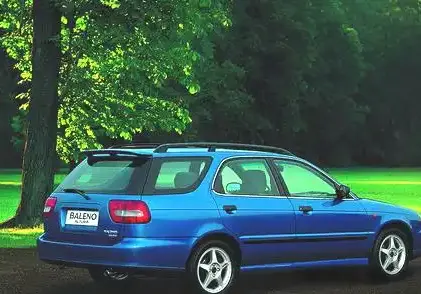
The Maruti Baleno (EG) 1.6 i 16V, manufactured between 2001 and 2007, marked a notable advancement for Maruti Suzuki within the Indian automotive landscape. This variant, powered by a 1.6-liter, 16-valve gasoline engine producing 94 horsepower, was positioned as a mid-range offering in the Baleno sedan lineup. It aimed to strike a balance between performance, fuel economy, and affordability, appealing to a growing segment of Indian consumers seeking a comfortable and dependable family vehicle. The Baleno (EG) itself was based on the General Motors’ 1994 Opel Astra platform, a result of a collaborative partnership between Suzuki and GM, and was assembled locally in India.
Technical Specifications
| Brand | Maruti |
| Model | Baleno |
| Generation | Baleno (EG) |
| Type (Engine) | 1.6 i 16V (94 Hp) |
| Start of production | 2001 |
| End of production | 2007 |
| Powertrain Architecture | Internal Combustion engine |
| Body type | Sedan |
| Seats | 5 |
| Doors | 4 |
| Fuel consumption (urban) | 8.6 l/100 km (27.4 US mpg) |
| Fuel consumption (extra urban) | 5.8 l/100 km (40.6 US mpg) |
| Fuel Type | Petrol (Gasoline) |
| Acceleration 0 – 100 km/h | 11.2 sec |
| Acceleration 0 – 62 mph | 11.2 sec |
| Acceleration 0 – 60 mph | 10.6 sec |
| Maximum speed | 175 km/h (108.74 mph) |
| Weight-to-power ratio | 10.4 kg/Hp |
| Weight-to-torque ratio | 7.5 kg/Nm |
| Power | 94 Hp @ 6000 rpm |
| Power per litre | 59.1 Hp/l |
| Torque | 130 Nm @ 3000 rpm (95.88 lb.-ft. @ 3000 rpm) |
| Engine layout | Front, Transverse |
| Engine displacement | 1590 cm3 (97.03 cu. in.) |
| Number of cylinders | 4 |
| Engine configuration | Inline |
| Cylinder Bore | 75 mm (2.95 in.) |
| Piston Stroke | 90 mm (3.54 in.) |
| Compression ratio | 9.2:1 |
| Number of valves per cylinder | 4 |
| Fuel injection system | Multi-port manifold injection |
| Engine aspiration | Naturally aspirated engine |
| Valvetrain | OHC |
| Kerb Weight | 975 kg (2149.51 lbs.) |
| Max. weight | 1500 kg (3306.93 lbs.) |
| Max load | 525 kg (1157.43 lbs.) |
| Trunk (boot) space – minimum | 346 l (12.22 cu. ft.) |
| Trunk (boot) space – maximum | 840 l (29.66 cu. ft.) |
| Fuel tank capacity | 51 l (13.47 US gal) |
| Length | 4225 mm (166.34 in.) |
| Width | 1690 mm (66.54 in.) |
| Height | 1390 mm (54.72 in.) |
| Wheelbase | 2480 mm (97.64 in.) |
| Front track | 1440 mm (56.69 in.) |
| Rear (Back) track | 1435 mm (56.5 in.) |
| Drivetrain Architecture | Front wheel drive |
| Number of gears and type of gearbox | 5 gears, manual transmission |
| Front suspension | Coil spring |
| Rear suspension | Coil spring |
| Front brakes | Disc |
| Rear brakes | Drum |
| Assisting systems | ABS (Anti-lock braking system) |
| Steering type | Steering rack and pinion |
| Power steering | Hydraulic Steering |
| Tires size | 175/70 R13 |
| Wheel rims size | 13 |
Powertrain & Engine Architecture
The core of the Baleno 1.6 i 16V was the G16B engine, a 1.6-liter inline-four cylinder gasoline engine. This engine featured a single overhead camshaft (SOHC) valvetrain with four valves per cylinder, contributing to its relatively high output for its displacement. The engine utilized a multi-point fuel injection system, which improved fuel atomization and combustion efficiency. The G16B engine was known for its robust construction and relative simplicity, making it easier to maintain and repair within the Indian automotive service environment. A 5-speed manual transmission was the sole gearbox option available with this engine, providing a direct connection between the engine and the front wheels. This transmission was selected for its durability and cost-effectiveness, aligning with the Baleno’s overall value proposition.
Driving Characteristics
The 94 horsepower and 130 Nm of torque generated by the 1.6-liter engine provided adequate performance for typical driving scenarios. Acceleration from 0 to 100 km/h took approximately 11.2 seconds, which was competitive for its class at the time. While not designed as a performance sedan, the Baleno 1.6 i 16V offered a noticeable improvement in responsiveness compared to the lower-displacement 1.3-liter models. The five-speed manual transmission allowed drivers to effectively utilize the engine’s powerband, although the gear ratios were somewhat widely spaced. Power delivery was linear, making it easy to modulate throttle inputs. The suspension provided a comfortable ride, effectively absorbing bumps and road imperfections. However, the handling wasn’t particularly sporty, exhibiting noticeable body roll during cornering.
Equipment & Trim Levels
The Baleno 1.6 i 16V generally included features considered standard for a mid-range sedan in the early 2000s. These included power steering, air conditioning, and basic instrumentation. Interior upholstery was typically cloth, with a functional and durable design. Higher trim levels offered optional extras such as power windows, central locking, and an upgraded audio system. The dashboard layout was straightforward and user-friendly, prioritizing practicality over aesthetics. Safety features were relatively basic, primarily consisting of an anti-lock braking system (ABS) on select models.
Chassis & Braking
The Baleno (EG) employed a front-engine, front-wheel-drive layout. The suspension system consisted of coil springs and shock absorbers on all four wheels. The front suspension featured independent MacPherson struts, while the rear suspension utilized a torsion beam setup. The braking system incorporated disc brakes on the front wheels and drum brakes on the rear wheels. The ABS system, when equipped, helped prevent wheel lockup during hard braking, enhancing stability and control. The chassis was engineered to balance ride comfort and handling stability, prioritizing comfort for the typical Indian road conditions.
Market Reception & Comparison
The Maruti Baleno 1.6 i 16V was generally well-received by Indian car buyers. Reviewers praised its comfortable ride, spacious interior, and relatively fuel-efficient engine. Compared to the 1.3-liter variants, the 1.6-liter model offered a significant performance boost, making it more suitable for highway driving and carrying a full passenger load. However, some critics noted that the handling wasn’t as sharp as some of its competitors. In terms of fuel economy, the 1.6-liter engine consumed slightly more fuel than the 1.3-liter versions, but the performance gains were considered worthwhile by many buyers. The Baleno 1.6 i 16V competed with other mid-size sedans such as the Honda City and Hyundai Accent.
Legacy
The Maruti Baleno (EG) 1.6 i 16V has earned a reputation for reliability and durability in the Indian used car market. The G16B engine is known for its longevity and relatively low maintenance costs. Parts availability remains good, making it relatively easy and affordable to maintain these vehicles. While not a particularly sought-after collectible car, the Baleno 1.6 i 16V is still appreciated by enthusiasts for its simple design, robust construction, and enjoyable driving experience. It represents a significant milestone in Maruti Suzuki’s history, demonstrating the company’s ability to produce a competitive and reliable sedan for the Indian market.