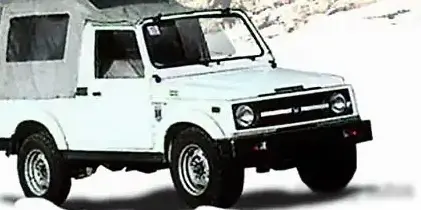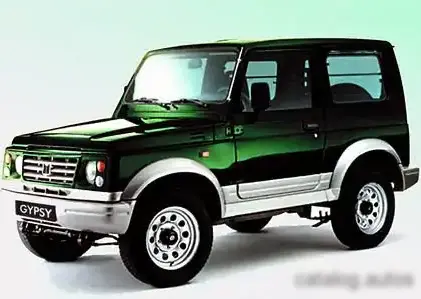
The Maruti Gypsy 1.3 Gypsy King (60 hp) was a variant of the long-running Maruti Gypsy, a popular off-road vehicle produced in India from 1981 to 2019. This specific iteration, produced between 1996 and 2000, represented an entry-level offering within the Gypsy lineup, known for its rugged simplicity and affordability. The Gypsy itself was based on the second-generation Suzuki LJ80, adapted for the Indian market and built under license by Maruti Suzuki. It quickly became a mainstay for both civilian and military use, prized for its go-anywhere capability and ease of maintenance. The 1.3 Gypsy King, while not the most powerful version, offered a balance of practicality and accessibility for a wide range of buyers.
Technical Specifications
| Brand | Maruti |
| Model | Gypsy |
| Type (Engine) | 1.3 Gypsy King (60 Hp) |
| Start of production | 1996 |
| End of production | 2000 |
| Powertrain Architecture | Internal Combustion engine |
| Body type | Off-road vehicle |
| Seats | 5 |
| Doors | 3 |
| Fuel Type | Petrol (Gasoline) |
| Acceleration 0 – 100 km/h | 26.5 sec |
| Acceleration 0 – 62 mph | 26.5 sec |
| Acceleration 0 – 60 mph | 25.2 sec |
| Maximum speed | 120 km/h (74.56 mph) |
| Weight-to-power ratio | 16.4 kg/Hp, 60.9 Hp/tonne |
| Weight-to-torque ratio | 9.9 kg/Nm, 101.5 Nm/tonne |
| Power | 60 Hp @ 5500 rpm |
| Power per litre | 46.2 Hp/l |
| Torque | 100 Nm @ 3500 rpm (73.76 lb.-ft. @ 3500 rpm) |
| Engine layout | Front, Longitudinal |
| Engine displacement | 1298 cm3 (79.21 cu. in.) |
| Number of cylinders | 4 |
| Engine configuration | Inline |
| Cylinder Bore | 74 mm (2.91 in.) |
| Piston Stroke | 75.5 mm (2.97 in.) |
| Compression ratio | 9:1 |
| Number of valves per cylinder | 2 |
| Fuel injection system | Carburettor |
| Engine aspiration | Naturally aspirated engine |
| Kerb Weight | 985 kg (2171.55 lbs.) |
| Max. weight | 1465 kg (3229.77 lbs.) |
| Max load | 480 kg (1058.22 lbs.) |
| Fuel tank capacity | 40 l (10.57 US gal | 8.8 UK gal) |
| Length | 4100 mm (161.42 in.) |
| Width | 1540 mm (60.63 in.) |
| Height | 1875 mm (73.82 in.) |
| Wheelbase | 2375 mm (93.5 in.) |
| Front track | 1300 mm (51.18 in.) |
| Rear (Back) track | 1310 mm (51.57 in.) |
| Drive wheel | All wheel drive (4×4) |
| Number of gears and type of gearbox | 5 gears, manual transmission |
| Front suspension | Leaf spring |
| Rear suspension | Leaf spring |
| Front brakes | Disc |
| Rear brakes | Drum |
| Assisting systems | ABS (Anti-lock braking system) |
| Tires size | 195/75 R15 |
Powertrain & Engine Architecture
The 1.3 Gypsy King was powered by the F10D engine, a 1298cc inline-four cylinder petrol engine. This engine, while relatively simple in design, was known for its durability and ease of repair. It utilized a carburettor fuel injection system, a common feature for vehicles of this era and market segment. The engine featured a single overhead camshaft (SOHC) valvetrain with two valves per cylinder. The engine’s longitudinal mounting and rear-wheel-drive configuration, coupled with a selectable four-wheel-drive system, contributed to the Gypsy’s off-road prowess. The five-speed manual transmission was the only gearbox option available for this variant, providing a reasonable spread of gears for both on-road and off-road driving. The transmission was chosen for its robustness and simplicity, aligning with the overall character of the vehicle.
Driving Characteristics
The 60 hp output of the 1.3 Gypsy King translated to modest performance. Acceleration was slow, with 0-60 mph times around 25-26 seconds. However, the engine’s torque characteristics, peaking at 100 Nm (73.76 lb-ft) at 3500 rpm, provided adequate pulling power for off-road situations. The manual transmission allowed for precise control, and the four-wheel-drive system, when engaged, significantly enhanced traction on loose surfaces. Compared to the later 1.6-liter versions, the 1.3 Gypsy King felt noticeably underpowered, especially when fully loaded or tackling steep inclines. The gear ratios were optimized for low-speed crawling rather than outright speed, making it well-suited for navigating challenging terrain. The leaf spring suspension, while providing a comfortable ride on rough roads, could feel bouncy on smoother surfaces.
Equipment & Trim Levels
The 1.3 Gypsy King was a fairly basic vehicle, reflecting its position as an entry-level model. Standard equipment typically included steel wheels, vinyl upholstery, and a simple dashboard layout. Power steering and air conditioning were generally not standard features, though they could be added as optional extras. The interior was functional and utilitarian, designed for durability rather than luxury. The exterior featured minimal chrome trim and a rugged, purposeful appearance. Optional extras included a hard top, winch, and upgraded suspension components for more serious off-road enthusiasts.
Chassis & Braking
The Gypsy’s chassis was a body-on-frame construction, providing excellent strength and durability. The front suspension utilized leaf springs, while the rear suspension also employed leaf springs, contributing to the vehicle’s robust character. The braking system consisted of disc brakes on the front wheels and drum brakes on the rear wheels. An Anti-lock Braking System (ABS) was included as a safety feature. The relatively simple braking system was adequate for the vehicle’s weight and performance, but lacked the sophistication of more modern braking systems. The tires, typically 195/75 R15, were chosen for their durability and off-road grip.
Market Reception & Comparison
The Maruti Gypsy 1.3 Gypsy King was well-received in the Indian market for its affordability, ruggedness, and off-road capability. Critics praised its simplicity and ease of maintenance, making it a popular choice for rural areas and for those who needed a reliable vehicle for challenging conditions. Compared to the higher-spec 1.6-liter versions, the 1.3 Gypsy King offered a more economical option, but at the expense of performance. The 1.6-liter models were favored by those who needed more power for highway driving or for carrying heavier loads. Fuel economy was reasonable for a vehicle of its type, but not exceptional. Reliability was generally good, with the F10D engine proving to be a durable and long-lasting unit.
Legacy
The Maruti Gypsy, and specifically the 1.3 Gypsy King, holds a significant place in Indian automotive history. It became an icon for its ruggedness and versatility. Even today, well-maintained examples are highly sought after by enthusiasts and collectors. The F10D engine, while now outdated, is still regarded as a reliable and relatively easy-to-repair powerplant. The Gypsy’s simple design and robust construction have contributed to its longevity, with many examples still in use today. In the used car market, the 1.3 Gypsy King represents an affordable entry point into the world of classic off-road vehicles, offering a unique driving experience and a connection to a bygone era of automotive simplicity.