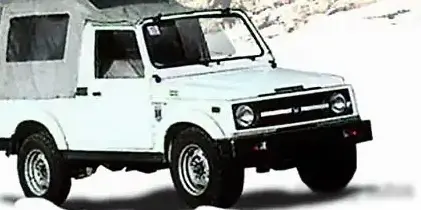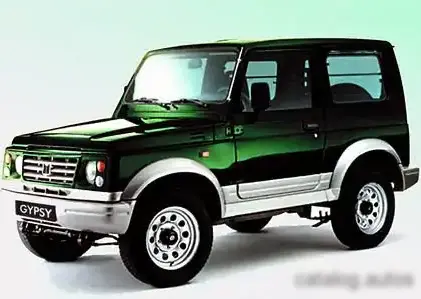
The Maruti Gypsy 1.3 i Gypsy King, produced between 1996 and 2000, represents a significant iteration of India’s long-running and iconic off-road vehicle. Derived from the second-generation Suzuki Jimny (SJ30/SJ40 series), the Gypsy was specifically adapted for the Indian market, prioritizing ruggedness, simplicity, and affordability. The 1.3 i Gypsy King, powered by a 66 horsepower engine, occupied a key position in the Gypsy lineup, offering a balance between capability and cost, making it accessible to a wider range of buyers. It was a mainstay for both private enthusiasts and institutional users like the Indian Army and police forces.
Technical Specifications
| Brand | Maruti |
| Model | Gypsy |
| Type | 1.3 i Gypsy King (66 Hp) |
| Start of production | 1996 |
| End of production | 2000 |
| Powertrain Architecture | Internal Combustion engine |
| Body type | Off-road vehicle |
| Seats | 5 |
| Doors | 3 |
| Maximum speed | 134 km/h (83.26 mph) |
| Weight-to-power ratio | 15.2 kg/Hp, 66 Hp/tonne |
| Weight-to-torque ratio | 9.7 kg/Nm, 103 Nm/tonne |
| Power | 66 Hp @ 6000 rpm |
| Power per litre | 50.8 Hp/l |
| Torque | 103 Nm @ 3500 rpm (75.97 lb.-ft. @ 3500 rpm) |
| Engine layout | Front, Longitudinal |
| Engine displacement | 1298 cm3 (79.21 cu. in.) |
| Number of cylinders | 4 |
| Engine configuration | Inline |
| Cylinder Bore | 74 mm (2.91 in.) |
| Piston Stroke | 75.5 mm (2.97 in.) |
| Compression ratio | 9.5:1 |
| Number of valves per cylinder | 2 |
| Fuel injection system | Multi-port manifold injection |
| Engine aspiration | Naturally aspirated engine |
| Kerb Weight | 1000 kg (2204.62 lbs.) |
| Max. weight | 1600 kg (3527.4 lbs.) |
| Max load | 600 kg (1322.77 lbs.) |
| Fuel tank capacity | 40 l (10.57 US gal | 8.8 UK gal) |
| Length | 4100 mm (161.42 in.) |
| Width | 1540 mm (60.63 in.) |
| Height | 1875 mm (73.82 in.) |
| Wheelbase | 2375 mm (93.5 in.) |
| Front track | 1300 mm (51.18 in.) |
| Rear track | 1310 mm (51.57 in.) |
| Drive wheel | All wheel drive (4×4) |
| Number of gears and type of gearbox | 5 gears, manual transmission |
| Front suspension | Leaf spring |
| Rear suspension | Leaf spring |
| Front brakes | Disc |
| Rear brakes | Drum |
| Assisting systems | ABS (Anti-lock braking system) |
| Tires size | 195/75 R15 |
Powertrain & Engine Architecture
The heart of the 1.3 i Gypsy King is the G13BB engine, a 1.3-liter, inline-four cylinder gasoline engine. This engine, a descendant of Suzuki’s long-running G-series, is known for its durability and relative simplicity. The G13BB utilizes a multi-point fuel injection system, a significant upgrade from the carbureted engines found in earlier Gypsy models, improving fuel efficiency and emissions. The engine features a single overhead camshaft (SOHC) operating two valves per cylinder. While not a powerhouse, the G13BB delivers a usable 66 horsepower at 6000 rpm and 103 Nm (75.97 lb-ft) of torque at 3500 rpm. The engine’s longitudinal mounting and the robust four-wheel-drive system contribute to the Gypsy’s off-road prowess. The transmission is a five-speed manual, chosen for its reliability and direct connection to the drivetrain.
Driving Characteristics
The 1.3 i Gypsy King’s driving experience is defined by its utilitarian nature. The 66 horsepower engine, while adequate, doesn’t provide brisk acceleration. The vehicle feels most comfortable at lower speeds, particularly when navigating rough terrain. The five-speed manual transmission offers a reasonable spread of gears, allowing the driver to maintain engine speed in various conditions. Compared to later, more powerful Gypsy variants, the 1.3 i feels noticeably slower, especially when fully loaded. However, its lighter weight compared to some of the larger engine options contributes to its agility off-road. The leaf spring suspension, while providing a comfortable ride on paved roads, is most effective when absorbing large bumps and obstacles during off-road excursions.
Equipment & Trim Levels
The Gypsy King trim level, even in its 1.3 i configuration, was considered relatively well-equipped for its time and market segment. Standard features typically included basic steel wheels, vinyl or cloth upholstery, a simple dashboard layout with essential gauges, and a functional, no-frills interior. The Gypsy King often featured a more robust front grille and sometimes included additional protective elements like brush guards. Optional extras were limited but could include features like a basic audio system, upgraded seats, and a hardtop roof in place of the standard soft top. The focus remained on functionality and durability rather than luxury.
Chassis & Braking
The Gypsy’s chassis is a body-on-frame construction, a design choice that prioritizes strength and durability. This construction method allows for significant articulation, crucial for off-road performance. The suspension utilizes leaf springs at both the front and rear, providing a robust and reliable system capable of handling rough terrain and heavy loads. Braking is handled by disc brakes on the front wheels and drum brakes on the rear. While adequate for the vehicle’s weight and performance, the braking system isn’t particularly sophisticated. The inclusion of an Anti-lock Braking System (ABS) was a notable feature for the time, enhancing safety, particularly on slippery surfaces.
Market Reception & Comparison
The Maruti Gypsy 1.3 i Gypsy King was well-received in the Indian market, particularly among those seeking a rugged and affordable off-road vehicle. Critics praised its durability, simplicity, and off-road capability. Compared to other Gypsy variants, such as those equipped with the 1.0-liter engine, the 1.3 i offered a noticeable performance improvement. However, it lagged behind the more powerful 1.6-liter versions in terms of outright speed and towing capacity. Fuel economy was reasonable for its class, but not exceptional. The Gypsy’s main competitors included other utility vehicles like the Mahindra Armada and Tata Sumo, but the Gypsy distinguished itself with its lighter weight, more nimble handling, and Suzuki’s reputation for reliability.
Legacy
The Maruti Gypsy, and specifically the 1.3 i Gypsy King, has achieved a legendary status in India. Its robust powertrain, while not technologically advanced, proved remarkably reliable over the years. The G13BB engine is known for its longevity and relatively low maintenance costs. Today, the Gypsy remains a popular choice among off-road enthusiasts and collectors. Well-maintained examples command a premium in the used car market. The Gypsy’s enduring appeal is a testament to its simple, rugged design and its ability to conquer challenging terrain. It remains a symbol of adventure and practicality for a generation of Indian drivers.