
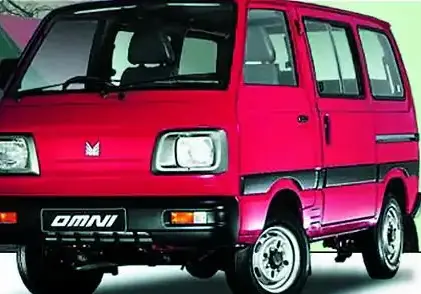
The Maruti Omni 0.8i (37 hp) was a mainstay of the Indian automotive market from 1998 to 2005, representing a practical and affordable transportation solution for families and commercial users. Part of the larger Omni line, this variant occupied the entry-level position, offering basic mobility with a focus on maximizing value. The Omni, in general, was a rebadged and heavily modified version of the Suzuki Super Carry, originally designed as a light commercial vehicle. The 0.8i model specifically catered to buyers seeking a no-frills, economical vehicle for everyday use within urban and rural environments.
Technical Specifications
| Brand | Maruti |
| Model | Omni |
| Generation | Omni |
| Type (Engine) | 0.8 i (37 Hp) |
| Start of production | 1998 |
| End of production | 2005 |
| Powertrain Architecture | Internal Combustion engine |
| Body type | Minivan |
| Seats | 4 |
| Doors | 4 |
| Fuel Type | Petrol (Gasoline) |
| Maximum speed | 110 km/h (68.35 mph) |
| Weight-to-power ratio | 20 kg/Hp, 50 Hp/tonne |
| Weight-to-torque ratio | 12.1 kg/Nm, 82.4 Nm/tonne |
| Power | 37 Hp @ 5000 rpm |
| Power per litre | 46.5 Hp/l |
| Torque | 61 Nm @ 3000 rpm (44.99 lb.-ft. @ 3000 rpm) |
| Engine layout | Front, Longitudinal |
| Engine displacement | 796 cm3 (48.57 cu. in.) |
| Number of cylinders | 3 |
| Engine configuration | Inline |
| Cylinder Bore | 68.5 mm (2.7 in.) |
| Piston Stroke | 72 mm (2.83 in.) |
| Compression ratio | 8.7:1 |
| Number of valves per cylinder | 2 |
| Fuel injection system | Single-point injection |
| Engine aspiration | Naturally aspirated engine |
| Kerb Weight | 740 kg (1631.42 lbs.) |
| Fuel tank capacity | 36 l (9.51 US gal | 7.92 UK gal) |
| Length | 3370 mm (132.68 in.) |
| Width | 1410 mm (55.51 in.) |
| Height | 1640 mm (64.57 in.) |
| Wheelbase | 1840 mm (72.44 in.) |
| Front track | 1220 mm (48.03 in.) |
| Rear track | 1200 mm (47.24 in.) |
| Drivetrain Architecture | The Internal combustion engine (ICE) drives the front wheels of the vehicle. |
| Drive wheel | Front wheel drive |
| Number of gears and type of gearbox | 4 gears, manual transmission |
| Front suspension | Spring Strut |
| Rear suspension | Torsion |
| Front brakes | Disc |
| Rear brakes | Drum |
| Steering type | Steering rack and pinion |
| Tires size | 155/80 R13 |
| Wheel rims size | 13 |
Powertrain & Engine Architecture
The heart of the Omni 0.8i was the F8B engine, a 796cc inline-three cylinder petrol engine. This engine, derived from Suzuki’s G series, was known for its simplicity and durability, rather than outright performance. It featured a single overhead camshaft (SOHC) operating two valves per cylinder. Fuel delivery was managed by a single-point fuel injection system, a relatively basic setup for the late 1990s, but contributing to the vehicle’s affordability. The engine’s longitudinal front-engine layout was a cost-saving measure, simplifying the drivetrain configuration. The 4-speed manual transmission was the only gearbox option available with this engine, prioritizing fuel efficiency and ease of maintenance over sporty driving dynamics. The engine’s relatively low compression ratio of 8.7:1 further emphasized reliability and the ability to run on lower-quality fuel, a significant factor in the Indian market.
Driving Characteristics
The 37 hp output of the 0.8i engine translated to modest performance. Acceleration was slow, particularly when fully loaded, and highway overtaking required careful planning. The four-speed gearbox was geared for economy, with relatively tall ratios. This meant that the engine often felt strained when climbing hills or carrying a full passenger load. Compared to the later 1.0L and 1.3L variants of the Omni, the 0.8i offered significantly less power and torque. While the larger engines provided a more relaxed driving experience, the 0.8i prioritized fuel economy and affordability. The front-wheel-drive configuration provided adequate traction for most road conditions, but the vehicle lacked the all-weather capability of a four-wheel-drive system.
Equipment & Trim Levels
The Maruti Omni 0.8i was deliberately spartan in its equipment levels. It was designed as a utilitarian vehicle, and as such, comfort and convenience features were minimized. Standard equipment typically included basic vinyl upholstery, a simple dashboard with minimal instrumentation, and manually operated windows and door locks. Air conditioning was often an optional extra, and power steering was not available. The focus was on providing a functional and affordable vehicle, rather than a luxurious one. The interior was designed for practicality, with a flat floor and easily cleanable surfaces. Trim levels were minimal, with most variations relating to seating configurations (e.g., 5-seater, 7-seater) and the presence or absence of optional extras.
Chassis & Braking
The Omni’s chassis was a body-on-frame construction, a design common in light commercial vehicles. This provided a robust and durable platform, but also contributed to a somewhat harsh ride quality. The front suspension utilized a simple spring strut setup, while the rear suspension employed a torsion beam. This configuration prioritized load-carrying capacity over ride comfort. The braking system consisted of disc brakes on the front wheels and drum brakes on the rear. This setup was adequate for the vehicle’s weight and performance, but lacked the stopping power of more modern braking systems. Steering was via a rack and pinion system, providing reasonable maneuverability.
Market Reception & Comparison
The Maruti Omni 0.8i was widely accepted in the Indian market due to its affordability, practicality, and reliability. It was particularly popular among small business owners, families, and those living in rural areas. Critics often noted the vehicle’s lack of refinement and its modest performance, but acknowledged its value proposition. Compared to other vehicles in its price range, the Omni offered a spacious interior and a relatively durable powertrain. The 1.0L and 1.3L variants of the Omni offered improved performance and refinement, but at a higher price point. The 0.8i remained a popular choice for buyers seeking the most affordable option.
Legacy
The Maruti Omni, including the 0.8i variant, enjoyed a long production run and became an iconic vehicle in India. While it was eventually discontinued in 2019 due to stricter safety regulations, it remains a common sight on Indian roads. The F8B engine proved to be remarkably durable, and many examples are still in service today. The Omni’s simple design and readily available spare parts contribute to its continued viability. In the used car market, the 0.8i variant is typically the most affordable option, making it a popular choice for first-time car buyers or those seeking a basic and reliable vehicle for short-distance commuting.
