
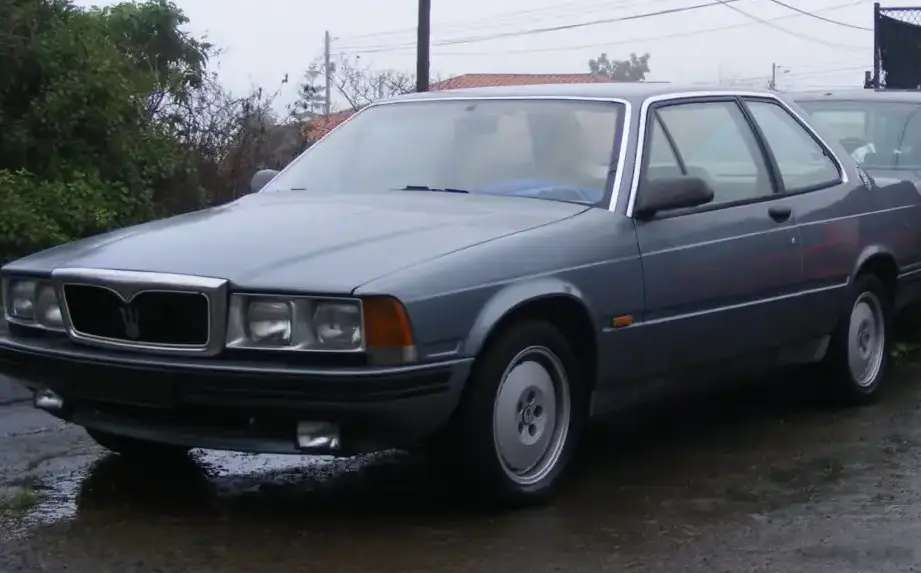
The Maserati 228, produced between 1986 and 1992, represented a significant evolution in the Italian manufacturer’s lineup. Positioned as a more accessible entry point into the Maserati world, the 228 aimed to broaden the brand’s appeal while retaining its core values of performance and luxury. This model was a direct successor to the Biturbo coupe, sharing its basic platform but offering a refined experience. The 2.8 i V6 Turbo CAT (225 Hp) variant, the focus of this article, was a key component of the 228 range, offering a compelling blend of power, style, and Italian flair. It was built on the 90 platform, a shortened version of the Deauville chassis, and served as a bridge between the more expensive and exclusive Maserati models and the broader luxury car market.
Technical Specifications
| Brand | Maserati |
| Model | 228 |
| Generation | 228 |
| Type (Engine) | 2.8 i V6 Turbo CAT (225 Hp) |
| Start of production | 1986 |
| End of production | 1992 |
| Powertrain Architecture | Internal Combustion engine |
| Body type | Coupe |
| Seats | 5 |
| Doors | 2 |
| Fuel consumption (urban) | 18.2 l/100 km (12.9 US mpg) |
| Fuel consumption (extra urban) | 9.2 l/100 km (25.6 US mpg) |
| Fuel consumption (combined) | 11.8 l/100 km (19.9 US mpg) |
| Fuel Type | Petrol (Gasoline) |
| Acceleration 0 – 100 km/h | 5.8 sec |
| Acceleration 0 – 62 mph | 5.8 sec |
| Acceleration 0 – 60 mph | 6 sec |
| Maximum speed | 235 km/h (146.02 mph) |
| Weight-to-power ratio | 5.5 kg/Hp |
| Weight-to-torque ratio | 3.4 kg/Nm |
| Power | 225 Hp @ 5500 rpm |
| Torque | 370 Nm @ 3500 rpm (272.9 lb.-ft. @ 3500 rpm) |
| Engine Model/Code | AM334 |
| Engine displacement | 2790 cm3 (170.26 cu. in.) |
| Number of cylinders | 6 |
| Engine configuration | V-engine |
| Cylinder Bore | 94 mm (3.7 in.) |
| Piston Stroke | 67 mm (2.64 in.) |
| Compression ratio | 7.4:1 |
| Number of valves per cylinder | 3 |
| Fuel injection system | Multi-port manifold injection |
| Engine aspiration | Turbocharger |
| Kerb Weight | 1240 kg (2733.73 lbs.) |
| Max. weight | 1800 kg (3968.32 lbs.) |
| Max load | 560 kg (1234.59 lbs.) |
| Trunk (boot) space – minimum | 530 l (18.72 cu. ft.) |
| Fuel tank capacity | 82 l (21.66 US gal) |
| Length | 4460 mm (175.59 in.) |
| Width | 1865 mm (73.43 in.) |
| Height | 1330 mm (52.36 in.) |
| Wheelbase | 2600 mm (102.36 in.) |
| Front track | 1540 mm (60.63 in.) |
| Rear (Back) track | 1550 mm (61.02 in.) |
| Drivetrain Architecture | Rear wheel drive |
| Number of gears and type of gearbox | 5 gears, manual transmission |
| Front suspension | Coil spring |
| Rear suspension | Coil spring |
| Front brakes | Ventilated discs |
| Rear brakes | Disc |
| Power steering | Hydraulic Steering |
| Tires size | 205/55 R15 |
| Wheel rims size | 15 |
Powertrain & Engine Architecture
The heart of the 228 2.8 i V6 Turbo CAT was the AM334 engine, a 2.8-liter (2790 cc) V6. This engine was a significant development of the earlier Maserati V6 designs, incorporating a turbocharger and catalytic converter (hence the “CAT” designation) to meet increasingly stringent emissions regulations. The engine featured a 7.4:1 compression ratio and utilized multi-port fuel injection. The turbocharger provided a substantial boost in power, allowing the engine to produce 225 horsepower at 5500 rpm and 370 Nm (272.9 lb-ft) of torque at 3500 rpm. The engine’s architecture included three valves per cylinder, contributing to its smooth operation and relatively high specific output. The 228 was exclusively offered with a 5-speed manual transmission, designed to handle the engine’s torque and provide a sporty driving experience.
Driving Characteristics
The 228 2.8 i V6 Turbo CAT offered a distinctly Italian driving experience. The turbocharged V6 delivered strong acceleration, with a 0-60 mph time of around 6 seconds and a top speed of 146 mph. The manual transmission allowed for precise control, and the rear-wheel-drive configuration contributed to a balanced feel. While not as raw or visceral as some of its predecessors, the 228 provided a refined and engaging driving experience. The turbocharger did introduce a degree of turbo lag, but once spooled up, the engine provided a surge of power that was characteristic of turbocharged engines of the era. The suspension, while comfortable, was firm enough to provide good handling and stability.
Equipment & Trim Levels
The 228 was generally well-equipped for its time, offering a level of luxury commensurate with the Maserati brand. Standard features included leather upholstery, power windows, central locking, and an AM/FM radio. Air conditioning was typically standard, though some early models may have offered it as an option. The interior design was classic Italian, with a focus on comfort and style. Optional extras included a sunroof, upgraded audio systems, and metallic paint finishes. The trim level was relatively consistent across the 228 range, with most variations stemming from optional equipment choices.
Chassis & Braking
The 228 utilized a relatively simple chassis design, featuring coil spring suspension all around. The front suspension employed independent coil springs, while the rear suspension also used coil springs. Braking duties were handled by ventilated discs at the front and solid discs at the rear. Hydraulic power steering was standard, providing a reasonable level of assistance without sacrificing feel. The car rode on 15-inch wheels with 205/55 R15 tires. The chassis was designed to provide a balance between comfort and handling, and it generally succeeded in delivering a pleasant driving experience.
Market Reception & Comparison
The Maserati 228 was generally well-received by automotive critics, who praised its stylish design, strong performance, and relatively accessible price point. However, some critics noted the presence of turbo lag and the occasional reliability issues that plagued Italian cars of the era. Compared to its siblings, such as the Biturbo, the 228 offered a more refined and modern experience. It was also more affordable than the larger and more luxurious Maserati models. Fuel economy, at around 19.9 US mpg combined, was typical for a performance coupe of the late 1980s and early 1990s.
Legacy
The Maserati 228 played an important role in the brand’s history, helping to broaden its appeal and attract a new generation of customers. While not without its flaws, the 228 offered a compelling combination of performance, style, and luxury. Today, the 228 is a sought-after classic car, particularly the 2.8 i V6 Turbo CAT variant. The AM334 engine, while requiring careful maintenance, is known for its robust construction and potential for high performance. Finding well-maintained examples can be challenging, but the 228 remains a rewarding and enjoyable classic Italian coupe.
