
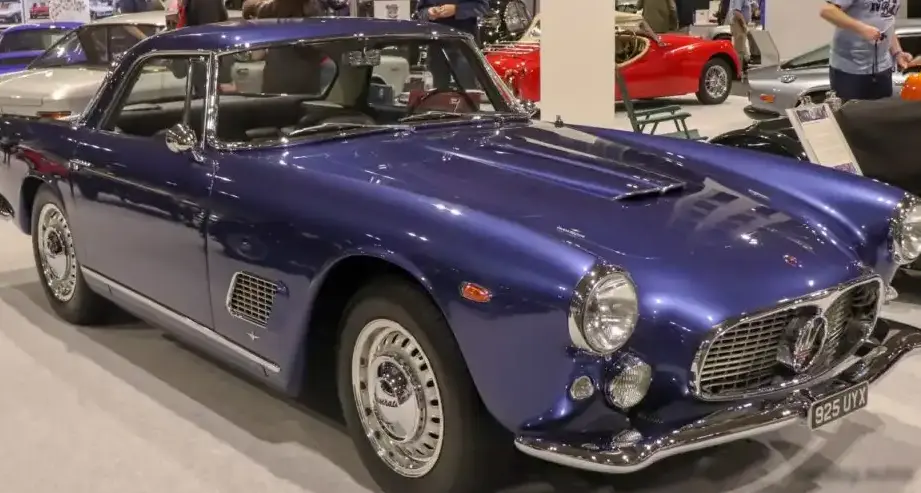
The Maserati 3500 GT 3.5, producing 230 horsepower, represents a pivotal moment in the storied Italian manufacturer’s history. Produced between 1957 and 1964, this grand touring coupe was Maserati’s first series-produced car, transitioning the company from primarily building racing machines and bespoke grand tourers to a more accessible, though still exclusive, market. The 3500 GT established Maserati as a serious competitor to Ferrari and other established GT car builders, and the 3.5-liter variant, introduced in 1961, refined the original design with increased power and subtle styling updates. It remains a highly sought-after classic, celebrated for its elegant design, robust engineering, and spirited driving experience.
Technical Specifications
| Brand | Maserati |
| Model | 3500 GT |
| Generation | 3500 GT |
| Type (Engine) | 3.5 (230 Hp) |
| Start of production | 1957 |
| End of production | 1964 |
| Powertrain Architecture | Internal Combustion engine |
| Body type | Coupe |
| Seats | 4 |
| Doors | 2 |
| Fuel Type | Petrol (Gasoline) |
| Maximum speed | 230 km/h (142.92 mph) |
| Power | 230 Hp @ 5500 rpm |
| Power per litre | 66 Hp/l |
| Torque | 314 Nm @ 4000 rpm (231.59 lb.-ft. @ 4000 rpm) |
| Engine layout | Front, Longitudinal |
| Engine Model/Code | AM101 |
| Engine displacement | 3485 cm3 (212.67 cu. in.) |
| Number of cylinders | 6 |
| Engine configuration | Inline |
| Cylinder Bore | 86 mm (3.39 in.) |
| Piston Stroke | 100 mm (3.94 in.) |
| Compression ratio | 8.5:1 |
| Number of valves per cylinder | 4 |
| Fuel injection system | Carburettor |
| Engine aspiration | Naturally aspirated engine |
| Valvetrain | DOHC |
| Engine oil capacity | 11 l (11.62 US qt | 9.68 UK qt) |
| Coolant | 14 l (14.79 US qt | 12.32 UK qt) |
| Trunk (boot) space – minimum | 510 l (18.01 cu. ft.) |
| Fuel tank capacity | 80 l (21.13 US gal | 17.6 UK gal) |
| Length | 4760 mm (187.4 in.) |
| Width | 1600 mm (62.99 in.) |
| Height | 1300 mm (51.18 in.) |
| Wheelbase | 2600 mm (102.36 in.) |
| Front track | 1390 mm (54.72 in.) |
| Rear (Back) track | 1360 mm (53.54 in.) |
| Drivetrain Architecture | The Internal combustion engine (ICE) drives the rear wheels of the vehicle. |
| Drive wheel | Rear wheel drive |
| Number of gears and type of gearbox | 5 gears, manual transmission |
| Front suspension | Independent coil spring |
| Rear suspension | Leaf spring |
| Front brakes | Disc |
| Rear brakes | Drum |
Powertrain & Engine Architecture
The heart of the 3500 GT 3.5 is the AM101 inline-six engine, a 3.5-liter (3485 cc) masterpiece designed by Vittorio De Nora. This engine represented a significant upgrade over the original 3.5-liter unit found in the earlier 3500 GT, boasting increased power output. The engine featured a dual overhead camshaft (DOHC) valvetrain operating four valves per cylinder, contributing to its impressive breathing and high-end performance. Fuel was delivered via three Weber 36 DCOE carburetors, a common setup for high-performance Italian engines of the era. The engine’s inline-six configuration provided a smooth and balanced power delivery, a characteristic highly valued by enthusiasts. The 3500 GT 3.5 was exclusively offered with a five-speed manual transmission, providing precise control over the engine’s power. The transmission was mounted in a rear-wheel-drive configuration, typical for grand touring cars of the period.
Driving Characteristics
The 3500 GT 3.5 offered a refined yet engaging driving experience. The 230 horsepower engine provided ample power for spirited driving, allowing for a 0-60 mph time of around 7.5 seconds and a top speed of 143 mph. The five-speed manual transmission allowed drivers to fully exploit the engine’s powerband, while the rear-wheel-drive layout provided a classic sports car feel. The suspension, featuring independent coil springs at the front and a leaf spring setup at the rear, offered a comfortable ride without sacrificing handling. While not as nimble as some contemporary sports cars, the 3500 GT 3.5 provided a stable and predictable platform for high-speed cruising and spirited cornering. The car’s relatively long wheelbase contributed to its stability, making it a confident grand tourer.
Equipment & Trim Levels
The 3500 GT 3.5 was a luxury grand tourer, and as such, it came equipped with a number of desirable features. Standard equipment included leather upholstery, wood trim, and a comprehensive instrument panel. Power windows were often included, and air conditioning was available as an option. The interior was designed to provide a comfortable and luxurious environment for both driver and passengers. The exterior styling was elegant and understated, with flowing lines and a long hood. The 3500 GT 3.5 was available in a variety of colors, and customers could also specify custom paint schemes. While trim levels were not formally designated, options such as a limited-slip differential and Borletti fog lights could be added to enhance the car’s performance and appearance.
Chassis & Braking
The 3500 GT 3.5 utilized a robust chassis construction, featuring a steel tube frame with aluminum alloy body panels. This construction method provided a good balance of strength and weight. The front suspension employed independent coil springs, while the rear suspension utilized a traditional leaf spring setup. This combination provided a comfortable ride and acceptable handling characteristics. Braking duties were handled by disc brakes at the front and drum brakes at the rear. While the braking system was adequate for the car’s performance, it was not as powerful or sophisticated as some contemporary systems. The steering was unassisted, providing a direct and engaging feel, but requiring some effort at low speeds.
Market Reception & Comparison
The Maserati 3500 GT 3.5 was well-received by critics and enthusiasts alike. It was praised for its elegant styling, powerful engine, and refined driving experience. It was often compared to the Ferrari 250 GT, and while the Ferrari was generally considered to be more focused on performance, the Maserati offered a more comfortable and luxurious experience. The 3500 GT 3.5 was also more affordable than the Ferrari, making it a more accessible option for those seeking a high-performance grand tourer. Fuel economy was typical for a large-displacement engine of the era, averaging around 15-18 mpg. Reliability was generally good, although maintenance could be expensive due to the car’s complex engineering and the need for specialized parts.
Legacy
The Maserati 3500 GT 3.5 remains a highly collectible and sought-after classic car. Its significance lies in its role as Maserati’s first series-produced car, establishing the company as a major player in the grand touring market. The AM101 engine is considered a masterpiece of Italian engineering, and the car’s elegant styling has stood the test of time. Today, well-maintained examples of the 3500 GT 3.5 can fetch significant prices at auction. The car’s robust construction and relatively simple mechanicals make it a viable option for classic car rallies and tours. While maintenance can be costly, the rewards of owning and driving a 3500 GT 3.5 are considerable, offering a unique and rewarding experience for enthusiasts of classic Italian automobiles.
