
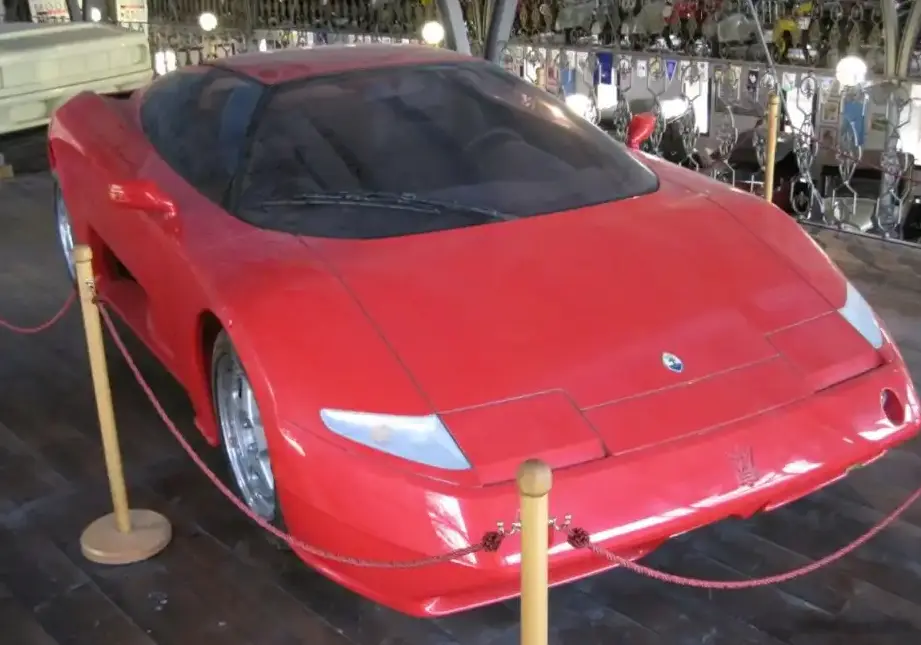
The Maserati Chubasco Concept, unveiled between 1990 and 1993, represented a bold design study from the Italian manufacturer. It wasn’t a production model, but rather a showcase of Maserati’s engineering and styling capabilities. The Chubasco aimed to blend the luxury and grand touring heritage of Maserati with a more aggressive, contemporary aesthetic. Powered by a potent 3.2-liter twin-turbocharged V8 engine, the concept car explored performance potential within the framework of a two-door coupe. It served as a design exercise, influencing future Maserati models, though never reaching full-scale production.
Technical Specifications
| Brand | Maserati |
| Model | Chubasco |
| Generation | Chubasco (Concept) |
| Type (Engine) | 3.2 i V8 32V Turbo (430 Hp) |
| Start of production | 1990 |
| End of production | 1993 |
| Powertrain Architecture | Internal Combustion engine |
| Body type | Coupe |
| Seats | 2 |
| Doors | 2 |
| Fuel Type | Petrol (Gasoline) |
| Weight-to-power ratio | 3.3 kg/Hp, 307.1 Hp/tonne |
| Power | 430 Hp @ 6500 rpm |
| Power per litre | 133.7 Hp/l |
| Engine displacement | 3217 cm3 / 196.31 cu. in. |
| Number of cylinders | 8 |
| Engine configuration | V-engine |
| Cylinder Bore | 80 mm / 3.15 in. |
| Piston Stroke | 80 mm / 3.15 in. |
| Number of valves per cylinder | 4 |
| Fuel injection system | Single-point injection |
| Engine aspiration | Turbocharger |
| Valvetrain | DOHC |
| Kerb Weight | 1400 kg / 3086.47 lbs |
| Length | 4365 mm / 171.85 in. |
| Width | 2015 mm / 79.33 in. |
| Height | 1125 mm / 44.29 in. |
| Wheelbase | 2650 mm / 104.33 in. |
| Front track | 1640 mm / 64.57 in. |
| Rear track | 1640 mm / 64.57 in. |
| Drivetrain Architecture | The Internal combustion engine (ICE) drives the rear wheels of the vehicle. |
| Drive wheel | Rear wheel drive |
| Number of gears and type of gearbox | 5 gears, manual transmission |
| Front suspension | Coil spring |
| Rear suspension | Coil spring |
| Front brakes | Ventilated discs |
| Rear brakes | Ventilated discs |
| Assisting systems | ABS (Anti-lock braking system) |
Powertrain & Engine Architecture
The heart of the Maserati Chubasco Concept was its 3.2-liter V8 engine. This engine, designated with twin turbochargers, produced a substantial 430 horsepower at 6500 rpm. The engine featured a 90-degree V8 configuration, a common layout for Maserati, known for its inherent balance and smooth operation. The 32-valve DOHC (Double Overhead Camshaft) cylinder head design maximized airflow into the combustion chambers, contributing to the engine’s high output. While specific details regarding the turbocharger setup are limited due to its concept status, it’s understood to have employed twin turbochargers to minimize turbo lag and provide a broad torque curve. The fuel injection system was a single-point injection system, a technology common for the era, delivering fuel to the intake ports. The engine’s 3217 cc displacement, combined with the turbocharging, resulted in a high specific output of 133.7 horsepower per liter. The Chubasco was equipped with a 5-speed manual transmission, chosen to provide the driver with maximum control over the engine’s power.
Driving Characteristics
As a concept car, the Chubasco wasn’t subjected to extensive road testing or performance evaluations. However, based on its specifications, it’s reasonable to assume that the driving experience would have been characterized by strong acceleration and responsive handling. The 430 horsepower output, coupled with the relatively lightweight construction (1400 kg), would have resulted in a power-to-weight ratio of 3.3 kg/Hp. The manual transmission would have allowed for precise gear changes, enabling the driver to fully exploit the engine’s power band. The rear-wheel-drive configuration would have contributed to a balanced chassis and engaging driving dynamics. Compared to potential future Maserati models with automatic transmissions, the Chubasco’s manual gearbox would have offered a more direct connection between driver and machine, prioritizing performance and driver involvement.
Equipment & Trim Levels
Given its status as a concept car, the Maserati Chubasco’s interior was primarily focused on showcasing design and technology rather than offering a comprehensive list of standard features. The interior was designed to be luxurious and driver-focused, featuring high-quality materials and a minimalist aesthetic. The seating arrangement was for two occupants, emphasizing the car’s grand touring nature. Details regarding specific interior upholstery or trim options are scarce, but it’s likely that Maserati would have offered a range of customization options had the car gone into production. The dashboard layout was clean and modern, with a focus on essential instrumentation. While specific optional extras are unknown, potential features could have included upgraded audio systems, leather upholstery, and advanced climate control systems.
Chassis & Braking
The Maserati Chubasco Concept utilized a traditional chassis layout with coil spring suspension at both the front and rear. This suspension setup was designed to provide a balance between ride comfort and handling performance. The use of ventilated disc brakes at all four corners ensured adequate stopping power, especially considering the car’s high performance potential. An ABS (Anti-lock Braking System) was included as a standard safety feature, enhancing braking stability and control. The track width of 1640 mm at both the front and rear contributed to the car’s stability and cornering ability. The Chubasco’s relatively short wheelbase of 2650 mm likely contributed to its agility and responsiveness.
Market Reception & Comparison
As a concept car, the Maserati Chubasco didn’t receive formal market reception in the same way as a production vehicle. However, it garnered significant attention from automotive enthusiasts and the media, who praised its striking design and powerful engine. The Chubasco was seen as a bold statement of intent from Maserati, demonstrating the brand’s commitment to performance and innovation. Compared to other Maserati models of the era, such as the Biturbo, the Chubasco represented a more radical and futuristic design direction. While the Biturbo focused on providing a more accessible entry point into the Maserati brand, the Chubasco aimed to showcase the brand’s ultimate performance potential.
Legacy
The Maserati Chubasco Concept, though never reaching production, left a lasting legacy as a design and engineering exercise. Its styling cues and performance aspirations influenced subsequent Maserati models, contributing to the brand’s evolution. The 3.2-liter V8 engine, in various iterations, continued to power Maserati vehicles for years to come, cementing its reputation as a potent and reliable powerplant. Today, the Chubasco remains a significant piece of Maserati history, representing a pivotal moment in the brand’s design and engineering development. Its rarity and unique design make it a highly sought-after collectible among automotive enthusiasts. While long-term reliability data is unavailable due to its concept status, the underlying engine architecture proved durable in production Maserati vehicles, suggesting a similar level of robustness for the Chubasco.
