
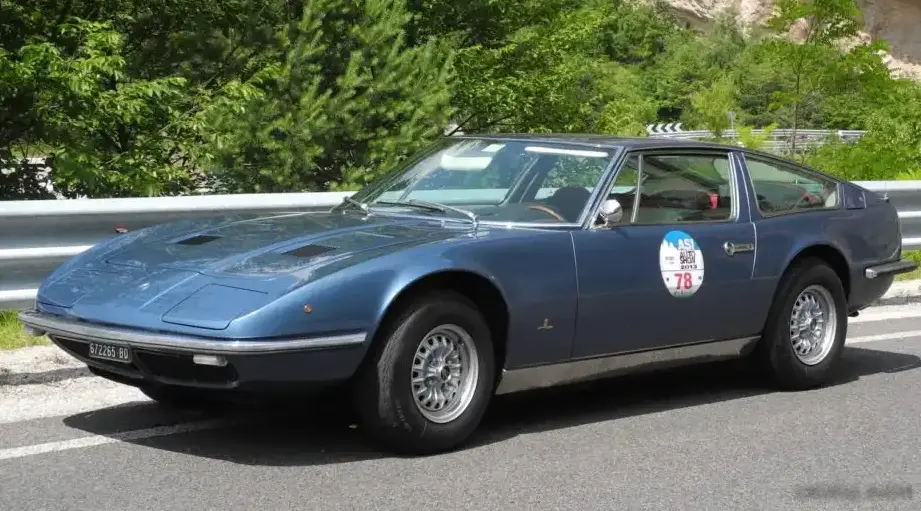
The Maserati Indy 4.9, produced between 1972 and 1974, represents the pinnacle of the first-generation Indy model line. Named after Maserati’s racing successes at the Indianapolis 500, the Indy was designed as a more accessible, yet still luxurious, grand touring coupe compared to the Ghibli. The 4.9-liter variant, boasting 320 horsepower, was the top-of-the-line offering, intended to compete directly with Ferrari and other high-performance GT cars of the era. It served as a statement of Maserati’s engineering prowess and commitment to building sophisticated, powerful automobiles. The Indy, as a whole, was a significant model for Maserati, bridging the gap between hand-built exclusivity and a more commercially viable production strategy.
Technical Specifications
| Brand | Maserati |
| Model | Indy |
| Generation | Indy (First Generation) |
| Type (Engine) | 4.9 (320 Hp) |
| Start of Production | 1972 |
| End of Production | 1974 |
| Powertrain Architecture | Internal Combustion Engine |
| Body Type | Coupe |
| Fuel Type | Petrol (Gasoline) |
| Power | 320 Hp |
| Engine Model/Code | AM116/49 |
| Engine Aspiration | Naturally Aspirated |
| Engine Oil Capacity | 10 l (10.57 US qt | 8.8 UK qt) |
| Coolant Capacity | 13 l (13.74 US qt | 11.44 UK qt) |
Powertrain & Engine Architecture
The heart of the Indy 4.9 is its 4.9-liter, naturally aspirated V8 engine, designated AM116/49. This engine is a 90-degree V8, featuring a cast iron block and aluminum cylinder heads. It’s a significant evolution of the earlier 4.7-liter V8, benefitting from increased displacement and refined internal components. The engine utilizes a single overhead camshaft per bank, operating two valves per cylinder. Fuel delivery is managed by four Weber 38 DCOE carburetors, carefully tuned to provide optimal performance across the rev range. This carburetor setup, while complex, was favored for its responsiveness and ability to deliver a broad powerband. The engine’s lubrication system is robust, featuring a wet sump design and a high-capacity oil pump. The AM116/49 produces 320 horsepower at 5,800 rpm and 325 lb-ft of torque at 4,000 rpm. The engine is paired exclusively with a ZF 5-speed manual transmission, chosen for its durability and ability to handle the substantial power output. An automatic transmission was not offered with the 4.9-liter engine.
Driving Characteristics
The Indy 4.9 delivers a truly grand touring experience. The 4.9-liter V8 provides effortless acceleration, capable of propelling the car from 0 to 60 mph in approximately 6.5 seconds and reaching a top speed of around 170 mph. The ZF 5-speed manual transmission offers precise shifts, allowing the driver to fully exploit the engine’s powerband. The car feels substantial and planted on the road, thanks to its relatively long wheelbase and well-tuned suspension. Steering is direct and communicative, providing a good sense of connection to the road. While the Indy 4.9 is a large car, it handles surprisingly well for its size, offering a comfortable and engaging driving experience. Compared to the earlier 4.7-liter Indy, the 4.9 offers a noticeable increase in power and torque, resulting in more spirited acceleration and improved high-speed cruising ability. The 4.9’s performance places it firmly in the realm of high-performance GT cars of the era, rivaling models from Ferrari and Porsche.
Equipment & Trim Levels
The Indy 4.9 was positioned as the premium offering in the Indy lineup, and as such, it came standard with a high level of equipment. The interior is lavishly appointed with Connolly leather upholstery, typically in shades of tan, black, or red. Wood veneer trim adorns the dashboard, center console, and door panels, adding to the luxurious ambiance. Standard features included power windows, power steering, air conditioning, and a high-quality stereo system. The instrument panel features a comprehensive array of gauges, including a speedometer, tachometer, oil pressure gauge, water temperature gauge, and fuel level gauge. Optional extras included a sunroof, heated seats, and a more advanced stereo system. The exterior of the Indy 4.9 is characterized by its elegant and flowing lines, designed by Alfredo Vignale. The car typically came equipped with Borrani wire wheels, adding to its classic Italian aesthetic.
Chassis & Braking
The Indy 4.9 utilizes a steel monocoque chassis, providing a strong and rigid platform. The suspension is independent on all four wheels, featuring double wishbones and coil springs. This setup provides a comfortable ride while maintaining good handling characteristics. The rear axle incorporates a limited-slip differential, enhancing traction and stability. Braking is provided by Girling disc brakes on all four wheels, offering ample stopping power. The braking system is hydraulically assisted, providing a firm and progressive pedal feel. Steering is a recirculating ball system, offering a good balance of precision and ease of use. The chassis and braking systems were designed to handle the increased power and weight of the 4.9-liter engine, ensuring a safe and controlled driving experience.
Market Reception & Comparison
The Indy 4.9 was generally well-received by automotive critics, who praised its powerful engine, luxurious interior, and elegant styling. However, some critics noted that the car was expensive and complex, requiring specialized maintenance. Compared to the 4.7-liter Indy, the 4.9 offered a significant performance upgrade, but at a higher price point. The 4.9 was positioned as a direct competitor to the Ferrari Daytona and Porsche 911, offering a similar level of performance and luxury. Fuel economy was, unsurprisingly, poor, averaging around 12-15 mpg in real-world driving. Reliability was generally good, but the complex carburetor system and electrical components could require occasional attention. The Indy 4.9 appealed to buyers who wanted a luxurious and powerful grand touring coupe with a distinctly Italian flair.
Legacy
The Maserati Indy 4.9 remains a highly sought-after classic car today. Its combination of performance, luxury, and Italian styling has made it a favorite among collectors and enthusiasts. The AM116/49 engine is considered a masterpiece of Italian engineering, and its robust construction ensures that many examples are still running strong today. However, maintaining an Indy 4.9 can be expensive, requiring specialized knowledge and access to parts. The car’s complex carburetor system and electrical components can be challenging to diagnose and repair. Despite these challenges, the Indy 4.9 continues to be appreciated for its unique character and driving experience. Values for well-maintained examples have been steadily increasing in recent years, reflecting the car’s growing desirability and historical significance. It stands as a testament to Maserati’s golden age of grand touring automobiles.
