
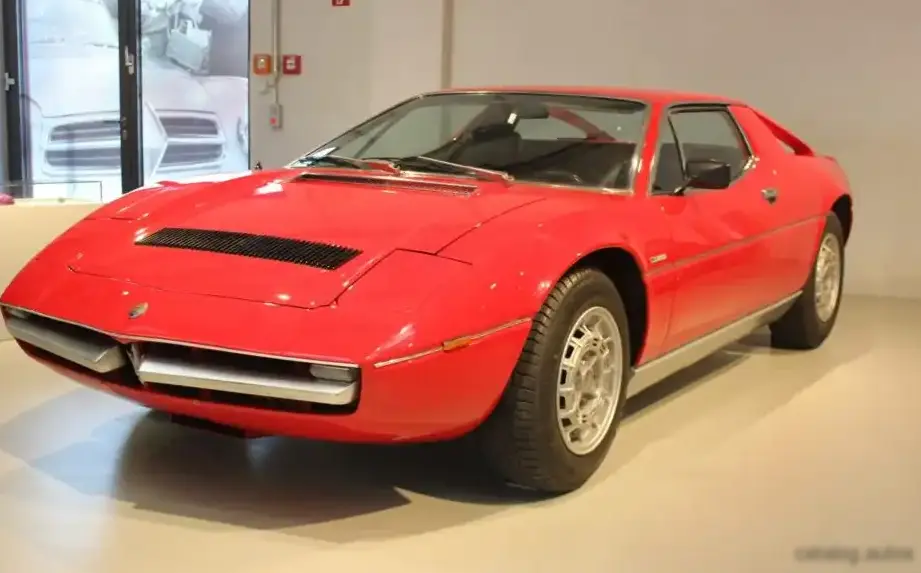
The Maserati Merak 3.0 SS, produced between 1975 and 1983, represents a pivotal point in the Italian manufacturer’s history. Positioned as a more accessible alternative to the Bora, the Merak offered a striking design penned by Giorgetto Giugiaro and a spirited driving experience. The “SS” designation denoted the highest performance variant of the Merak, featuring a 3.0-liter V6 engine producing 220 horsepower. It was a mid-engine, two-door coupe intended to broaden Maserati’s appeal while maintaining the brand’s reputation for luxury and performance. The Merak occupied a unique space in the market, competing with other exotic sports cars of the era, but offering a more practical, four-seat configuration.
Technical Specifications
| Brand | Maserati |
| Model | Merak |
| Generation | Merak |
| Type (Engine) | 3.0 SS (220 Hp) |
| Start of production | 1975 |
| End of production | 1983 |
| Powertrain Architecture | Internal Combustion engine |
| Body type | Coupe |
| Seats | 4 |
| Doors | 2 |
| Fuel Type | Petrol (Gasoline) |
| Power | 220 Hp |
| Engine Model/Code | AM 114.53.30 |
| Engine aspiration | Naturally aspirated engine |
| Engine oil capacity | 9 l / 9.51 US qt / 7.92 UK qt |
| Fuel tank capacity | 85 l / 22.45 US gal / 18.7 UK gal |
| Length | 4335 mm / 170.67 in. |
| Width including mirrors | 1768 mm / 69.61 in. |
| Height | 1134 mm / 44.65 in. |
| Wheelbase | 2600 mm / 102.36 in. |
Powertrain & Engine Architecture
The heart of the Merak 3.0 SS is the AM 114.53.30 engine, a 3.0-liter, 90-degree V6. This engine was a significant development for Maserati, utilizing a lightweight alloy block and heads. It featured a dual overhead camshaft design, with two valves per cylinder. Fuel delivery was managed by a Weber 38 DCOE carburetor system, providing a responsive throttle response. The engine produced 220 horsepower at 6500 rpm and 200 lb-ft of torque at 4000 rpm. The engine’s architecture was notable for its relatively compact size, allowing for a lower center of gravity and improved handling. The engine was mated to a five-speed manual transmission, providing precise gear changes and enhancing the driving experience. While an automatic transmission was offered in earlier Merak models, the SS variant was exclusively available with the manual gearbox, catering to enthusiasts seeking a more engaging drive.
Driving Characteristics
The Merak 3.0 SS offered a compelling blend of performance and handling. The 220 horsepower engine provided brisk acceleration, with a reported 0-60 mph time of around 5.5 seconds. The five-speed manual transmission allowed drivers to fully exploit the engine’s powerband. The mid-engine layout contributed to excellent balance and predictable handling characteristics. The car felt nimble and responsive, particularly on winding roads. Compared to the earlier 1.9 and 2.0-liter Merak models, the 3.0 SS offered a substantial performance upgrade. The larger engine provided more torque throughout the rev range, making it more tractable in everyday driving situations. While not as brutally fast as some of its contemporaries, such as the Porsche 911, the Merak 3.0 SS offered a unique and rewarding driving experience, characterized by its smooth engine, precise handling, and comfortable interior.
Equipment & Trim Levels
The Merak 3.0 SS was relatively well-equipped for its time, offering a comfortable and refined interior. Standard features included leather upholstery, power windows, and air conditioning. The dashboard layout was typically Italian, with a focus on style and functionality. The instrument panel featured a comprehensive array of gauges, including a speedometer, tachometer, oil pressure gauge, and water temperature gauge. Optional extras included a sunroof, upgraded audio system, and metallic paint finishes. The interior trim was generally understated, with a focus on quality materials and craftsmanship. The Merak 3.0 SS was positioned as the premium variant in the Merak lineup, and its equipment level reflected this status. It offered a more luxurious and refined experience compared to the base models.
Chassis & Braking
The Merak 3.0 SS utilized a steel monocoque chassis, providing a rigid and lightweight platform. The suspension system consisted of independent double wishbones at all four corners, with coil springs and hydraulic shock absorbers. This setup provided a comfortable ride while maintaining good handling characteristics. The braking system featured disc brakes on all four wheels, providing ample stopping power. The braking system was unassisted, requiring a firm pedal effort. The car rode on 15-inch alloy wheels, fitted with Pirelli CN36 tires. The chassis and braking system were designed to complement the car’s mid-engine layout and high performance capabilities. The suspension was tuned to provide a balance between comfort and handling, making the Merak 3.0 SS a capable and enjoyable car to drive on a variety of roads.
Market Reception & Comparison
The Maserati Merak 3.0 SS received generally positive reviews from automotive critics. It was praised for its striking design, spirited performance, and comfortable interior. However, some critics noted that the car’s build quality was not always consistent, and that maintenance costs could be high. Compared to the Bora, the Merak was considered to be a more practical and affordable alternative. The Merak’s four-seat configuration made it more versatile than the Bora’s two-seat layout. In terms of performance, the Merak 3.0 SS was comparable to other exotic sports cars of the era, such as the Porsche 911 and the Ferrari Dino. However, the Merak offered a unique combination of Italian style, performance, and practicality. Fuel economy was typical for a sports car of the 1970s, averaging around 15-18 mpg.
Legacy
The Maserati Merak 3.0 SS remains a desirable classic car today. Its striking design and spirited performance continue to appeal to enthusiasts. The AM 114.53.30 engine is generally considered to be a reliable unit, although regular maintenance is essential. Parts availability can be a challenge, but a dedicated network of specialists and suppliers exists to support Merak owners. The Merak 3.0 SS has become a collectible car, with prices steadily increasing in recent years. It represents a significant chapter in Maserati’s history, and a testament to the Italian manufacturer’s commitment to building beautiful and exciting sports cars. The car’s enduring appeal lies in its unique combination of style, performance, and practicality, making it a true icon of the 1970s.
