
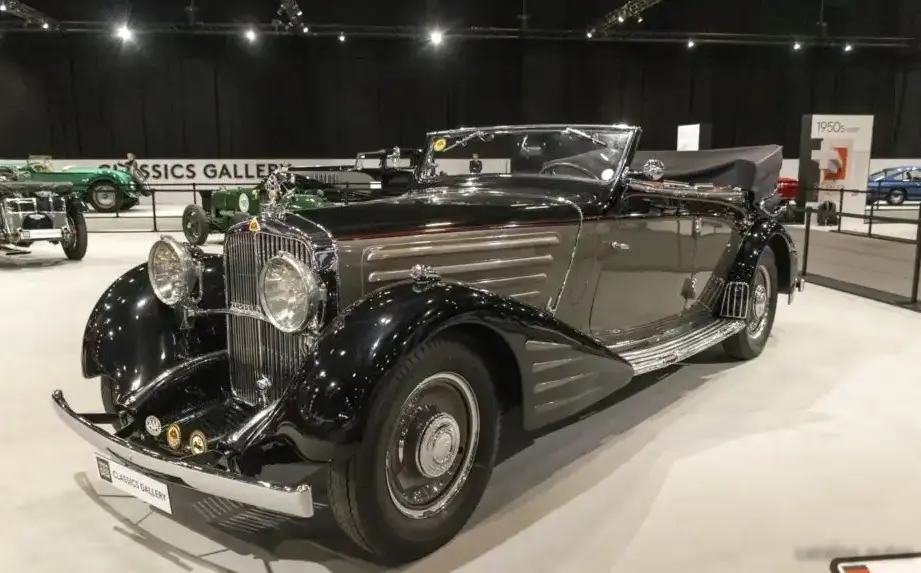
The Maybach Zeppelin Cabriolet DS8 8.0 V12, produced between 1930 and 1937, represents the pinnacle of pre-war German luxury motoring. This model was a flagship offering from Maybach, a manufacturer renowned for its exceptionally crafted and technologically advanced automobiles. The “Zeppelin” designation, evoking the famed German airships, signified the highest level of refinement and exclusivity within the Maybach range. The DS8, denoting “Deutsche Sport” 8-liter, was the core model upon which the Zeppelin Cabriolet was based, and it catered to an extremely affluent clientele seeking unparalleled comfort and prestige. The Cabriolet body style, with its fully retractable soft top, further enhanced the vehicle’s appeal to those desiring open-air motoring without sacrificing elegance.
Technical Specifications
| Brand | Maybach |
| Model | Zeppelin |
| Generation | Zeppelin Cabriolet |
| Type (Engine) | DS8 8.0 V12 (200 Hp) |
| Start of production | 1930 year |
| End of production | 1937 year |
| Powertrain Architecture | Internal Combustion engine |
| Body type | Cabriolet |
| Seats | 8 |
| Doors | 4 |
| Fuel consumption (economy) – combined | 28 l/100 km |
| Fuel consumption (economy) – combined (US mpg) | 8.4 US mpg |
| Fuel consumption (economy) – combined (UK mpg) | 10.1 UK mpg |
| Fuel consumption (economy) – combined (km/l) | 3.6 km/l |
| Fuel Type | Petrol (Gasoline) |
| Maximum speed | 160 km/h |
| Maximum speed (mph) | 99.42 mph |
| Weight-to-power ratio | 15 kg/Hp |
| Power | 200 Hp @ 3000 rpm |
| Power per litre | 25.1 Hp/l |
| Engine layout | Front, Longitudinal |
| Engine displacement | 7978 cm3 |
| Engine displacement (cu. in.) | 486.85 cu. in. |
| Number of cylinders | 12 |
| Engine configuration | V-engine |
| Cylinder Bore | 92 mm |
| Cylinder Bore (in.) | 3.62 in. |
| Piston Stroke | 100 mm |
| Piston Stroke (in.) | 3.94 in. |
| Compression ratio | 6.3:1 |
| Number of valves per cylinder | 2 |
| Fuel injection system | Carburettor |
| Engine aspiration | Naturally aspirated engine |
| Valvetrain | OHV |
| Kerb Weight | 3000 kg |
| Kerb Weight (lbs.) | 6613.87 lbs. |
| Fuel tank capacity | 135 l |
| Fuel tank capacity (US gal) | 35.66 US gal |
| Fuel tank capacity (UK gal) | 29.7 UK gal |
| Length | 5520 mm |
| Length (in.) | 217.32 in. |
| Width | 1820 mm |
| Width (in.) | 71.65 in. |
| Height | 1900 mm |
| Height (in.) | 74.8 in. |
| Wheelbase | 3735 mm |
| Wheelbase (in.) | 147.05 in. |
| Front track | 1520 mm |
| Front track (in.) | 59.84 in. |
| Rear (Back) track | 1520 mm |
| Rear (Back) track (in.) | 59.84 in. |
| Ride height (ground clearance) | 190 mm |
| Ride height (ground clearance) (in.) | 7.48 in. |
| Minimum turning circle (turning diameter) | 14 m |
| Minimum turning circle (turning diameter) (ft.) | 45.93 ft. |
| Drivetrain Architecture | The Internal combustion engine (ICE) drives the rear wheels of the vehicle. |
| Drive wheel | Rear wheel drive |
| Number of gears and type of gearbox | 5 gears, manual transmission |
| Front suspension | Rigid axle suspension, Leaf spring |
| Rear suspension | Rigid axle suspension, Leaf spring |
| Front brakes | Drum |
| Rear brakes | Drum |
| Steering type | Worm-reduction unit |
| Wheel rims size (Front) | 7J x 20 |
| Wheel rims size (Rear) | 7.5J x 20 |
Powertrain & Engine Architecture
The heart of the Zeppelin Cabriolet was the Maybach DS8 engine, a 7.978-liter (486.85 cubic inches) V12. This engine produced 200 horsepower at 3000 rpm, a substantial figure for the era. The engine employed a single overhead valve (OHV) configuration and utilized a carburetor for fuel delivery. The 6.3:1 compression ratio was relatively modest, prioritizing reliability and smooth operation over outright performance. The engine was longitudinally mounted in the chassis, driving the rear wheels. The five-speed manual transmission, while requiring a skilled driver, allowed for precise control of the engine’s power. The engine’s design emphasized refinement and durability, reflecting Maybach’s commitment to building automobiles that would last for generations.
Driving Characteristics
Despite its considerable size and weight (approximately 3000 kg or 6614 lbs), the Zeppelin Cabriolet offered a surprisingly capable driving experience. The 200 horsepower engine, while not overwhelming by modern standards, provided ample power for comfortable cruising at highway speeds (up to 99.42 mph). The five-speed manual transmission allowed the driver to keep the engine in its optimal power band. However, the car’s size and the relatively slow steering (utilizing a worm-reduction unit) meant it was not designed for spirited cornering. The focus was on providing a smooth, quiet, and luxurious ride, befitting its status as a top-tier luxury vehicle. Compared to potential supercharged variants or later Maybach models, the DS8 prioritized effortless cruising over outright performance.
Equipment & Trim Levels
The Zeppelin Cabriolet was lavishly equipped, reflecting its exceptionally high price point. Standard features included luxurious leather upholstery, often in bespoke configurations chosen by the customer. The interior was spacious, accommodating up to eight passengers in considerable comfort. Wood trim, often crafted from exotic veneers, adorned the dashboard and door panels. Optional extras were extensive, including a built-in radio, a cocktail cabinet, and even a telephone. The Cabriolet top was meticulously crafted and could be raised or lowered manually. The level of customization offered was unparalleled, allowing buyers to create a truly unique automobile.
Chassis & Braking
The Zeppelin Cabriolet utilized a robust chassis with a long wheelbase (3735 mm or 147.05 inches) to provide a stable and comfortable ride. Both front and rear suspension employed a rigid axle design with leaf springs. Braking was accomplished via drum brakes on all four wheels, which, while adequate for the time, lacked the stopping power of modern braking systems. Steering was handled by a worm-reduction unit, which provided a stable but somewhat indirect feel. The car rode on 7J x 20 inch wheels at the front and 7.5J x 20 inch wheels at the rear.
Market Reception & Comparison
The Maybach Zeppelin Cabriolet was universally praised by automotive critics for its exceptional quality, luxurious appointments, and smooth ride. However, its extremely high price limited its appeal to a very small segment of the market. Compared to other luxury cars of the era, such as Rolls-Royce and Hispano-Suiza, the Maybach offered a unique blend of German engineering precision and opulent comfort. Fuel economy, at 28 liters per 100 kilometers (8.4 US mpg), was unsurprisingly poor, but this was not a primary concern for the car’s wealthy clientele. Reliability was generally good, although maintenance costs were substantial due to the car’s complex engineering and the need for specialized parts.
Legacy
The Maybach Zeppelin Cabriolet remains a highly sought-after collectible today. Its rarity, historical significance, and exceptional craftsmanship ensure its continued desirability among collectors. The DS8 engine, while not known for its outright performance, is regarded as a remarkably durable and reliable powerplant. Surviving examples are meticulously maintained and often participate in classic car rallies and concours events. The Zeppelin Cabriolet represents a golden age of automotive luxury and serves as a testament to Maybach’s engineering prowess and commitment to excellence. The car’s legacy continues to inspire automotive designers and enthusiasts alike.
