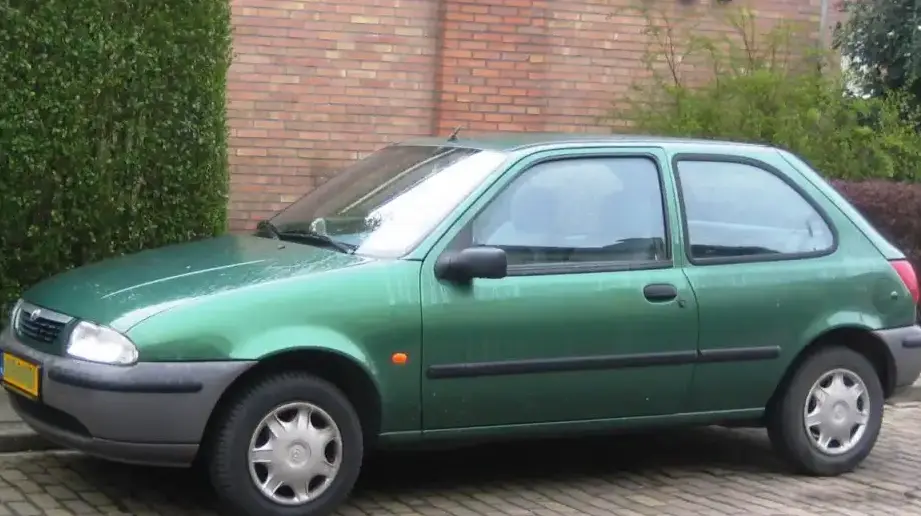
The Mazda 121 III, known as the Mazda Metro in some markets, was a supermini produced by Mazda between 1996 and 2000. Representing the third generation of the 121, designated chassis codes JASM and JBSM, this iteration was a significant departure from its predecessors, largely due to its collaboration with Ford. The 1.3-liter (60 hp) variant occupied the entry-level position in the 121 III lineup, offering an affordable and economical option for buyers in Europe and other regions where it was sold. This model aimed to provide basic transportation with Mazda’s reputation for reliability, competing with vehicles like the Ford Fiesta and Volkswagen Polo.
Technical Specifications
| Brand | Mazda |
| Model | 121 |
| Generation | 121 III (JASM, JBSM) |
| Type (Engine) | 1.3 (60 Hp) |
| Start of production | 1996 |
| End of production | 2000 |
| Powertrain Architecture | Internal Combustion engine |
| Body type | Hatchback |
| Seats | 5 |
| Doors | 3/5 |
| Fuel consumption (urban) | 7.6 l/100 km (30.9 US mpg, 37.2 UK mpg, 13.2 km/l) |
| Fuel consumption (extra urban) | 4.9 l/100 km (48 US mpg, 57.6 UK mpg, 20.4 km/l) |
| Fuel consumption (combined) | 6.8 l/100 km (34.6 US mpg, 41.5 UK mpg, 14.7 km/l) |
| Fuel Type | Petrol (Gasoline) |
| Acceleration 0 – 100 km/h | 15.9 sec |
| Acceleration 0 – 62 mph | 15.9 sec |
| Acceleration 0 – 60 mph | 15.1 sec |
| Maximum speed | 155 km/h (96.31 mph) |
| Weight-to-power ratio | 15.5 kg/Hp, 64.5 Hp/tonne |
| Weight-to-torque ratio | 9 kg/Nm, 110.8 Nm/tonne |
| Power | 60 Hp @ 5000 rpm |
| Power per litre | 46.2 Hp/l |
| Torque | 103 Nm @ 2500 rpm (75.97 lb.-ft. @ 2500 rpm) |
| Engine layout | Front, Transverse |
| Engine displacement | 1299 cm3 (79.27 cu. in.) |
| Number of cylinders | 4 |
| Engine configuration | Inline |
| Cylinder Bore | 74 mm (2.91 in.) |
| Piston Stroke | 75.5 mm (2.97 in.) |
| Compression ratio | 9.5:1 |
| Number of valves per cylinder | 2 |
| Fuel injection system | Single-point injection |
| Engine aspiration | Naturally aspirated engine |
| Valvetrain | OHC |
| Kerb Weight | 930 kg (2050.3 lbs.) |
| Max. weight | 1460 kg (3218.75 lbs.) |
| Max load | 530 kg (1168.45 lbs.) |
| Trunk (boot) space – minimum | 250 l (8.83 cu. ft.) |
| Fuel tank capacity | 42 l (11.1 US gal | 9.24 UK gal) |
| Length | 3828 mm (150.71 in.) |
| Width | 1634 mm (64.33 in.) |
| Height | 1330 mm (52.36 in.) |
| Wheelbase | 2446 mm (96.3 in.) |
| Front track | 1429 mm (56.26 in.) |
| Rear (Back) track | 1384 mm (54.49 in.) |
| Drivetrain Architecture | The Internal combustion engine (ICE) drives the front wheels of the vehicle. |
| Drive wheel | Front wheel drive |
| Number of gears and type of gearbox | 5 gears, manual transmission |
| Front suspension | Spring Strut |
| Rear suspension | Wishbone |
| Front brakes | Disc |
| Rear brakes | Drum |
| Assisting systems | ABS (Anti-lock braking system) |
| Steering type | Steering rack and pinion |
| Power steering | Hydraulic Steering |
| Tires size | 165/70 R13 |
| Wheel rims size | 13 |
INTRODUCTION
The Mazda 121 III, produced from 1996 to 2000, represented a significant shift for the model line. Developed in collaboration with Ford, it shared its platform with the Ford Fiesta Mk4. This collaboration aimed to reduce development costs and leverage economies of scale. The 1.3-liter, 60 horsepower variant was the base model, designed to appeal to budget-conscious buyers seeking a practical and reliable city car. Available in both 3-door and 5-door body styles, it served as the entry point into the 121 range, positioned below the more powerful 1.5 and 1.8-liter options.
Powertrain & Engine Architecture
The heart of the 121 III 1.3 was the Mazda B3 engine, a 1.3-liter inline-four cylinder petrol engine. This engine, while relatively simple in design, was known for its durability. It featured a single overhead camshaft (OHC) valvetrain with two valves per cylinder. Fuel delivery was handled by a single-point fuel injection system, a cost-saving measure compared to the multi-point injection found in higher-spec models. The engine produced 60 horsepower at 5000 rpm and 103 Nm (76 lb-ft) of torque at 2500 rpm. The engine’s relatively low output was paired with a standard five-speed manual transmission. The transmission was chosen for its simplicity and cost-effectiveness, contributing to the vehicle’s affordability. While an automatic transmission was offered in some markets, it was less common with the 1.3-liter engine due to the performance limitations.
Driving Characteristics
The 1.3-liter 121 III offered modest performance. Acceleration was leisurely, taking approximately 15.9 seconds to reach 62 mph (100 km/h). The engine felt strained when pushed hard, particularly when fully loaded or on inclines. The five-speed manual transmission helped to keep the engine in its optimal power band, but overall, the driving experience was geared towards economy rather than excitement. Compared to the 1.5 and 1.8-liter versions, the 1.3 felt noticeably slower and less refined. However, the light weight of the vehicle (around 930 kg) helped to mitigate some of the performance deficit. The steering was light and precise, making it easy to maneuver in urban environments. The suspension provided a comfortable ride, absorbing bumps and imperfections in the road reasonably well.
Equipment & Trim Levels
The 1.3-liter 121 III was typically equipped with basic features, reflecting its entry-level status. Standard equipment generally included power steering, central locking, and a basic stereo system. Interior upholstery was typically cloth, and the dashboard featured a simple, functional design. Optional extras included air conditioning, electric windows, and alloy wheels. Higher trim levels, available with the larger engines, offered more luxurious features such as upgraded upholstery, a sunroof, and more sophisticated audio systems. The 1.3 model prioritized practicality and affordability over luxury.
Chassis & Braking
The 121 III utilized a front-wheel-drive layout with a MacPherson strut suspension at the front and a twist-beam suspension at the rear. The front brakes were disc brakes, providing adequate stopping power, while the rear brakes were drum brakes, a cost-saving measure. Anti-lock Braking System (ABS) was available as an option, enhancing safety. The chassis was relatively lightweight, contributing to the vehicle’s nimble handling. The steering was rack and pinion, providing precise control. Tire size was typically 165/70 R13.
Market Reception & Comparison
The Mazda 121 III 1.3 was generally well-received as an affordable and reliable city car. Critics praised its fuel efficiency and ease of driving, but noted its lack of performance. Compared to its rivals, such as the Ford Fiesta and Volkswagen Polo, the 121 III offered a competitive price point and a reputation for durability. The 1.5 and 1.8-liter versions of the 121 III offered significantly better performance, but at a higher cost. The 1.3-liter model appealed to buyers who prioritized economy and practicality over driving excitement. Fuel economy figures were respectable, averaging around 34.6 US mpg (41.5 UK mpg) on the combined cycle.
Legacy
The Mazda 121 III 1.3, while not a performance icon, remains a popular choice in the used car market due to its affordability and reliability. The B3 engine is known for its longevity, and maintenance costs are relatively low. However, due to its age, potential buyers should be aware of common issues such as rust and wear and tear on suspension components. The 121 III represents a collaborative effort between Mazda and Ford, showcasing the benefits of platform sharing in the automotive industry. It remains a testament to Mazda’s commitment to building practical and dependable vehicles.