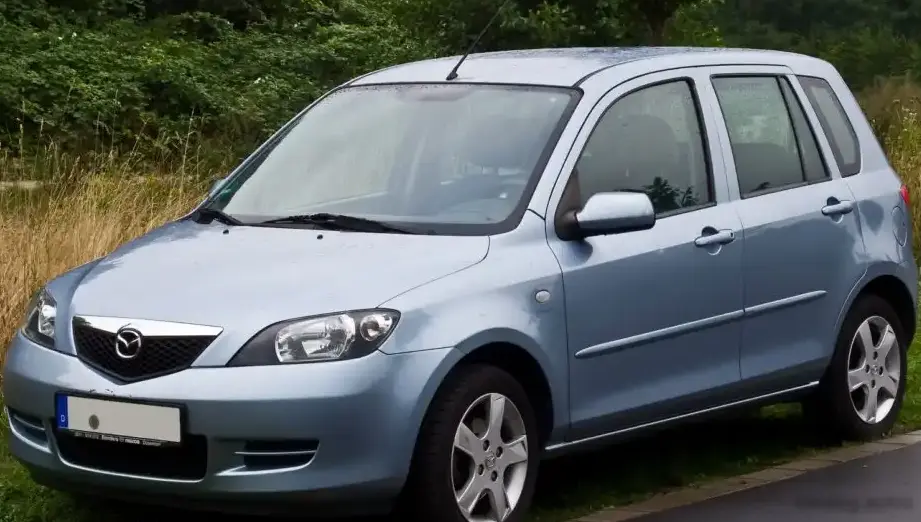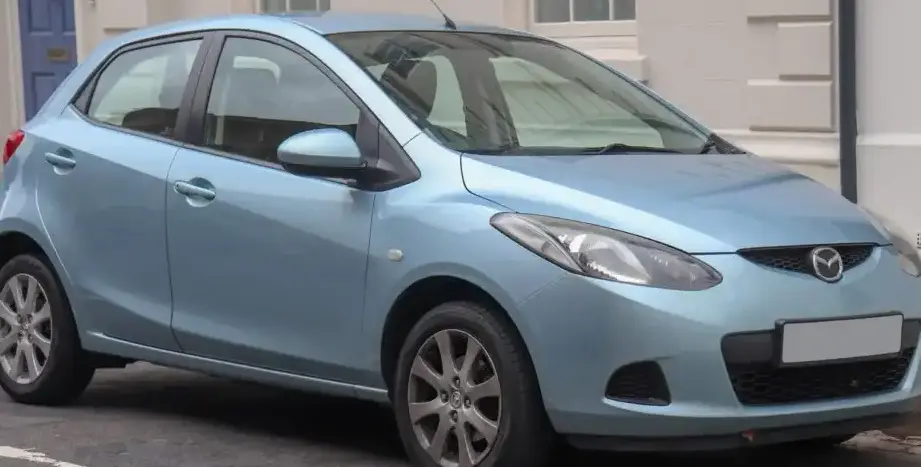
The Mazda2 II (DE) 1.3i, producing 86 horsepower, was a key variant in Mazda’s second-generation Mazda2 lineup, manufactured from 2007 to 2010. Positioned as the entry-level model in many European and Asian markets, it offered an affordable and fuel-efficient option within the broader DE platform, which also included more powerful 1.5L and diesel engine options. This model aimed to provide a practical and economical city car, appealing to first-time buyers and those seeking low running costs.
Technical Specifications
| Brand | Mazda |
| Model | 2 |
| Generation | 2 II (DE) |
| Type (Engine) | 1.3i (86 Hp) |
| Start of production | 2007 |
| End of production | 2010 |
| Powertrain Architecture | Internal Combustion engine |
| Body type | Hatchback |
| Seats | 5 |
| Doors | 5 |
| Fuel consumption (urban) | 6.9 l/100 km (34.1 US mpg, 40.9 UK mpg, 14.5 km/l) |
| Fuel consumption (extra urban) | 4.6 l/100 km (51.1 US mpg, 61.4 UK mpg, 21.7 km/l) |
| Fuel consumption (combined) | 5.4 l/100 km (43.6 US mpg, 52.3 UK mpg, 18.5 km/l) |
| CO2 emissions | 129 g/km |
| Fuel Type | Petrol (Gasoline) |
| Acceleration 0 – 100 km/h | 12.9 sec |
| Acceleration 0 – 62 mph | 12.9 sec |
| Acceleration 0 – 60 mph | 12.3 sec |
| Maximum speed | 172 km/h (106.88 mph) |
| Emission standard | Euro 4 |
| Weight-to-power ratio | 11.1 kg/Hp, 90.1 Hp/tonne |
| Weight-to-torque ratio | 7.8 kg/Nm, 127.7 Nm/tonne |
| Power | 86 Hp @ 6000 rpm |
| Power per litre | 63.8 Hp/l |
| Torque | 122 Nm @ 3500 rpm (89.98 lb.-ft. @ 3500 rpm) |
| Engine layout | Front, Transverse |
| Engine Model/Code | ZJ46 |
| Engine displacement | 1349 cm3 (82.32 cu. in.) |
| Number of cylinders | 4 |
| Engine configuration | Inline |
| Cylinder Bore | 74 mm (2.91 in.) |
| Piston Stroke | 78.4 mm (3.09 in.) |
| Compression ratio | 10:1 |
| Number of valves per cylinder | 4 |
| Fuel injection system | Multi-port manifold injection |
| Engine aspiration | Naturally aspirated engine |
| Valvetrain | DOHC |
| Engine oil capacity | 3.9 l (4.12 US qt | 3.43 UK qt) |
| Coolant | 5.2 l (5.49 US qt | 4.58 UK qt) |
| Kerb Weight | 955 kg (2105.41 lbs.) |
| Max. weight | 1485 kg (3273.86 lbs.) |
| Max load | 530 kg (1168.45 lbs.) |
| Trunk (boot) space – minimum | 250 l (8.83 cu. ft.) |
| Trunk (boot) space – maximum | 787 l (27.79 cu. ft.) |
| Fuel tank capacity | 43 l (11.36 US gal | 9.46 UK gal) |
| Permitted trailer load with brakes (12%) | 900 kg (1984.16 lbs.) |
| Permitted trailer load without brakes | 500 kg (1102.31 lbs.) |
| Length | 3900 mm (153.54 in.) |
| Width | 1695 mm (66.73 in.) |
| Height | 1475 mm (58.07 in.) |
| Wheelbase | 2490 mm (98.03 in.) |
| Front track | 1465 mm (57.68 in.) |
| Rear (Back) track | 1455 mm (57.28 in.) |
| Ride height (ground clearance) | 150 mm (5.91 in.) |
| Drag coefficient (Cd) | 0.31 |
| Minimum turning circle (turning diameter) | 9.8 m (32.15 ft.) |
| Drivetrain Architecture | The Internal combustion engine (ICE) drives the front wheels of the vehicle. |
| Drive wheel | Front wheel drive |
| Number of gears and type of gearbox | 5 gears, manual transmission |
| Front suspension | Spring Strut |
| Rear suspension | Coil spring |
| Front brakes | Ventilated discs |
| Rear brakes | Drum |
| Assisting systems | ABS (Anti-lock braking system) |
| Steering type | Steering rack and pinion |
| Power steering | Electric Steering |
| Tires size | 195/45 R16 |
| Wheel rims size | 16 |
INTRODUCTION
The Mazda2 II (DE) 1.3i, launched in 2007, represented Mazda’s attempt to capture a larger share of the European and Asian supermini market. Built on the 1HX0/A3 platform (shared with the Ford Fiesta Mk6), the DE generation Mazda2 offered a significant step up in terms of interior space, build quality, and driving dynamics compared to its predecessor. The 1.3i variant, with its 86 horsepower engine, served as the entry point to the range, prioritizing fuel efficiency and affordability over outright performance. It was particularly popular in countries with high fuel costs and congested urban environments.
Powertrain & Engine Architecture
The heart of the 1.3i Mazda2 is the ZJ46 engine, a 1.3-liter inline-four cylinder petrol engine. This engine utilizes a multi-port fuel injection system and a double overhead camshaft (DOHC) valvetrain, contributing to its relatively efficient operation. The engine’s 10:1 compression ratio is typical for naturally aspirated gasoline engines of this era. The 1.3L engine produced 86 hp at 6000 rpm and 122 Nm of torque at 3500 rpm. The engine was paired with a five-speed manual transmission as standard, although a four-speed automatic transmission was also available, albeit less common. The automatic transmission was designed for smooth, comfortable operation, prioritizing ease of use over sporty performance.
Driving Characteristics
The 1.3i Mazda2, particularly in its manual transmission guise, offered a reasonably engaging driving experience for a supermini. However, the automatic version, while comfortable, felt noticeably slower. Acceleration from 0-60 mph took around 12.3 seconds, and the top speed was approximately 107 mph. The engine’s torque peak at 3500 rpm meant that it required relatively high engine speeds to maintain momentum, especially when loaded or on inclines. The gear ratios in the automatic transmission were geared towards fuel economy, resulting in a less responsive feel compared to the manual version or the more powerful 1.5L models. The suspension, tuned for comfort, provided a compliant ride, but body roll was noticeable during cornering.
Equipment & Trim Levels
The 1.3i trim level typically included basic features such as power steering, central locking, electric front windows, and an audio system. Air conditioning was often an optional extra. Interior upholstery was typically cloth, and the dashboard featured a simple, functional design. Higher trim levels, such as the ‘Sport’ or ‘Comfort’ variants, added features like alloy wheels, a more sophisticated audio system, and upgraded interior trim. Safety features included ABS brakes and driver/passenger airbags as standard.
Chassis & Braking
The Mazda2 II (DE) utilized a front-wheel-drive layout with a MacPherson strut front suspension and a coil spring rear suspension. The front brakes were ventilated discs, providing adequate stopping power, while the rear brakes were drums, a cost-saving measure common in this segment. The chassis was relatively lightweight, contributing to the car’s nimble handling. The electric power steering provided light and easy steering, making it ideal for city driving. Stabilizer bars were fitted to both the front and rear axles to reduce body roll.
Market Reception & Comparison
The Mazda2 II (DE) 1.3i was generally well-received by automotive critics, who praised its stylish design, spacious interior, and enjoyable driving dynamics. However, the 1.3i engine was often criticized for being underpowered, particularly when paired with the automatic transmission. Compared to the 1.5-liter models, the 1.3i offered significantly less performance, but it also delivered better fuel economy. The 1.3i was also a more affordable option than the diesel variants, making it an attractive choice for budget-conscious buyers. Fuel economy figures of around 43.6 US mpg combined were competitive for its class.
Legacy
The Mazda2 II (DE) 1.3i has proven to be a relatively reliable vehicle, with the ZJ46 engine generally exhibiting good durability. Common issues include occasional oil leaks and wear on the suspension components. In the used car market, the 1.3i models are typically the most affordable Mazda2 II variants. While not offering the performance of the higher-spec models, they remain a practical and economical choice for those seeking a reliable and fuel-efficient city car. The availability of spare parts is generally good, and maintenance costs are relatively low, making it a sensible option for first-time car owners or those on a tight budget.