Technical Specifications
| Brand | Mazda |
| Model | 3 |
| Generation | 3 III Sedan (BM) |
| Type (Engine) | 2.0 Skyactiv-G (165 Hp) i-ELOOP |
| Start of production | 2014 |
| End of production | 2016 |
| Powertrain Architecture | Internal Combustion engine |
| Body type | Sedan |
| Seats | 5 |
| Doors | 4 |
| Fuel consumption (urban) | 7.5 l/100 km (31.4 US mpg) |
| Fuel consumption (extra urban) | 4.8 l/100 km (49 US mpg) |
| Fuel consumption (combined) | 5.8 l/100 km (40.6 US mpg) |
| CO2 emissions | 135 g/km |
| Fuel Type | Petrol (Gasoline) |
| Acceleration 0 – 100 km/h | 8.2 sec |
| Acceleration 0 – 62 mph | 8.2 sec |
| Acceleration 0 – 60 mph | 7.8 sec |
| Maximum speed | 210 km/h (130.49 mph) |
| Emission standard | Euro 5 |
| Weight-to-power ratio | 7.4 kg/Hp |
| Weight-to-torque ratio | 5.8 kg/Nm |
| Power | 165 Hp @ 6000 rpm |
| Torque | 210 Nm @ 4000 rpm (154.89 lb.-ft. @ 4000 rpm) |
| Engine layout | Front, Transverse |
| Engine Model/Code | PE-VPS |
| Engine displacement | 1998 cm3 (121.93 cu. in.) |
| Number of cylinders | 4 |
| Engine configuration | Inline |
| Compression ratio | 14:1 |
| Number of valves per cylinder | 4 |
| Fuel injection system | Direct injection |
| Engine oil capacity | 4.2 l (4.44 US qt | 3.7 UK qt) |
| Coolant capacity | 6.5 l (6.87 US qt | 5.72 UK qt) |
| Kerb Weight | 1220 kg (2689.64 lbs.) |
| Max. weight | 1815 kg (4001.39 lbs.) |
| Max load | 595 kg (1311.75 lbs.) |
| Trunk (boot) space – minimum | 419 l (14.8 cu. ft.) |
| Fuel tank capacity | 51 l (13.47 US gal | 11.22 UK gal) |
| Length | 4580 mm (180.31 in.) |
| Width with mirrors folded | 1795 mm (70.67 in.) |
| Width including mirrors | 2053 mm (80.83 in.) |
| Height | 1450 mm (57.09 in.) |
| Wheelbase | 2700 mm (106.3 in.) |
| Ride height (ground clearance) | 155 mm (6.1 in.) |
| Minimum turning circle | 10.6 m (34.78 ft.) |
| Drivetrain Architecture | Front wheel drive |
| Number of gears and type of gearbox | 6 gears, manual transmission |
| Front brakes | Ventilated discs |
| Rear brakes | Disc |
| Assisting systems | ABS (Anti-lock braking system) |
| Steering type | Steering rack and pinion |
| Power steering | Electric Steering |
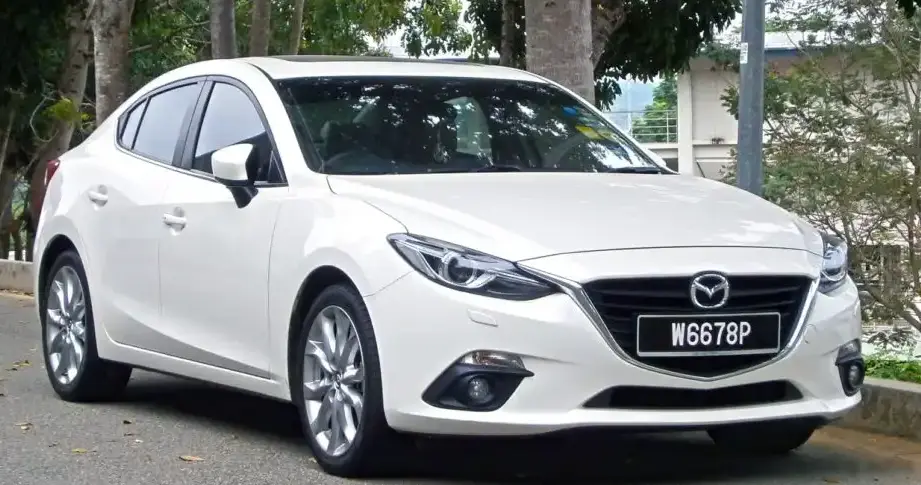
The Mazda 3 III Sedan (BM) 2.0 Skyactiv-G (165 Hp) i-ELOOP represents a notable iteration in Mazda’s long-running compact car series. Produced from 2014 to 2016, this variant held a significant position within the third generation (BM) Mazda 3 lineup, which initially debuted in 2013. Built upon Mazda’s Skyactiv Technology platform, it aimed to deliver a compelling combination of fuel efficiency, responsive handling, and refined styling. The “i-ELOOP” designation indicates the inclusion of Mazda’s intelligent energy loop system, a regenerative braking technology engineered to further improve fuel economy. This model was primarily marketed towards North American and European consumers, where fuel economy and driving dynamics were highly prioritized.
Powertrain & Engine Architecture
The Mazda 3 2.0 Skyactiv-G i-ELOOP is powered by the PE-VPS engine, a 1.998-liter naturally aspirated inline-four cylinder gasoline engine. This engine is a central component of Mazda’s Skyactiv technology, with a strong emphasis on achieving high compression – in this case, 14:1 – for enhanced thermal efficiency. Direct injection is utilized to precisely control fuel delivery, optimizing combustion and minimizing emissions. The engine features a dual overhead camshaft (DOHC) valvetrain with four valves per cylinder, contributing to its responsive character. The i-ELOOP system, a capacitor-based regenerative braking system, captures kinetic energy during deceleration and stores it to power electrical components, lessening the load on the alternator and improving fuel economy. This specific model was exclusively offered with a six-speed manual transmission, appealing to drivers who preferred a more engaging driving experience and a lower price point.
Driving Characteristics
The 165 horsepower and 154.89 lb-ft of torque generated by the 2.0-liter Skyactiv-G engine, combined with the six-speed manual transmission, provided a well-balanced driving experience. Acceleration from 0-60 mph was achieved in approximately 7.8 seconds, making it competitive within its segment. The gear ratios were carefully tuned to the engine’s powerband, offering good responsiveness in typical driving scenarios. While not as aggressively sporty as some of its competitors, the Mazda 3 delivered a refined and engaging driving experience, characterized by precise steering and a well-controlled chassis. Compared to the higher-output 2.5-liter variants, this 2.0-liter engine prioritized fuel efficiency over outright performance, making it a practical choice for daily commuting and drivers seeking a more economical option.
Equipment & Trim Levels
The 2.0 Skyactiv-G i-ELOOP trim generally included standard features such as air conditioning, power windows and locks, a basic audio system with USB connectivity, and stability control. Interior upholstery was typically cloth, focusing on durability and practicality. Higher trim levels offered optional upgrades like leather upholstery, a sunroof, a premium audio system, and Mazda’s infotainment system featuring a touchscreen display. The i-ELOOP system itself was a key selling point of this trim, marketed for its fuel-saving capabilities. The overall interior design was modern and functional, prioritizing ergonomics and ease of use.
Chassis & Braking
The Mazda 3 III Sedan (BM) employed a MacPherson strut front suspension and a multi-link rear suspension, providing a comfortable ride and responsive handling. The front brakes were ventilated discs, while the rear brakes were solid discs. An Anti-lock Braking System (ABS) was standard, enhancing safety and control during emergency braking. The chassis was engineered to be lightweight yet rigid, contributing to the car’s overall agility. Stabilizer bars were fitted to both the front and rear axles to minimize body roll during cornering maneuvers.
Market Reception & Comparison
The Mazda 3 III Sedan (BM) 2.0 Skyactiv-G i-ELOOP was generally well-received by automotive reviewers. It was praised for its fuel efficiency, engaging driving dynamics, and stylish design. However, some critics noted that the 2.0-liter engine could feel somewhat underpowered, especially when the car was fully loaded or driving uphill. Compared to the 2.5-liter variants, the 2.0-liter offered superior fuel economy but less overall performance. When compared to competitors like the Honda Civic and Toyota Corolla, the Mazda 3 distinguished itself with its more sporty handling and more upscale interior. Its reliability was generally considered good, although some owners reported minor issues with the infotainment system.
Legacy
The PE-VPS engine, as found in the Mazda 3 2.0 Skyactiv-G i-ELOOP, has proven to be a relatively reliable powertrain. While not entirely without potential issues – such as possible carbon buildup if oil changes are neglected – it generally requires routine maintenance and is known for its longevity. In the used car market, this variant represents a good value, offering a blend of fuel efficiency, reliability, and driving enjoyment. The i-ELOOP system, while not a revolutionary fuel saver, contributes to the car’s overall efficiency and adds a unique technological feature. The Mazda 3 III Sedan (BM) 2.0 Skyactiv-G i-ELOOP continues to be a popular choice for buyers seeking a well-rounded and dependable compact car.