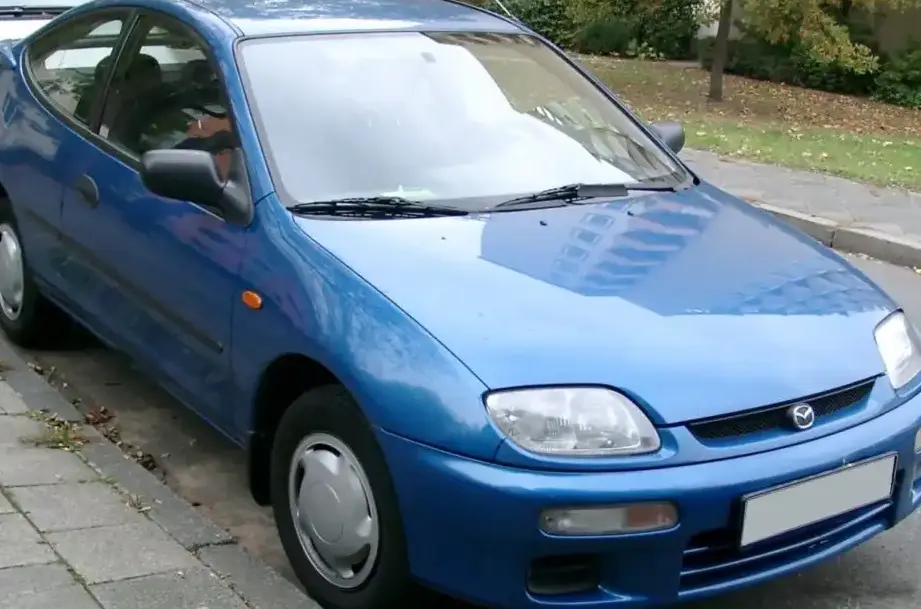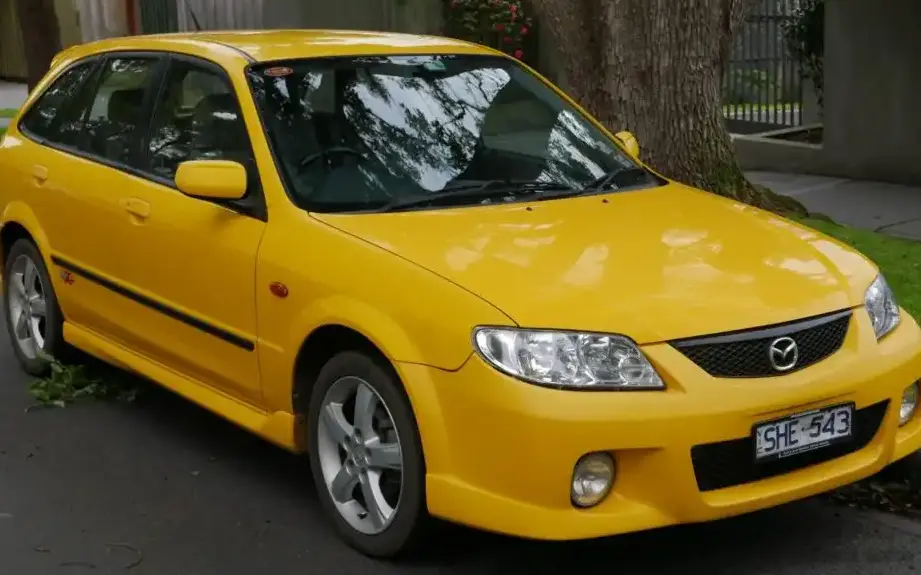
The Mazda 323 F VI (BJ) 1.5 i 16V, produced between 1998 and 2003, represented a key entry point into Mazda’s compact hatchback lineup during that period. Part of the BJ generation (the sixth iteration of the 323), this variant was primarily aimed at buyers seeking affordable, reliable transportation with reasonable fuel economy. It occupied the lower-mid range of the 323 F VI offerings, positioned below the more powerful 1.8L and V6 models, and served as a direct competitor to vehicles like the Honda Civic, Toyota Corolla, and Ford Focus in the European and Asian markets. While not officially sold in the United States, the 323 F VI was a significant model for Mazda globally.
Technical Specifications
| Brand | Mazda |
| Model | 323 |
| Generation | 323 F VI (BJ) |
| Type (Engine) | 1.5 i 16V (88 Hp) |
| Start of production | 1998 |
| End of production | 2003 |
| Powertrain Architecture | Internal Combustion engine |
| Body type | Hatchback |
| Seats | 5 |
| Doors | 5 |
| Fuel consumption (urban) | 9.5 l/100 km (24.8 US mpg) |
| Fuel consumption (extra urban) | 6.3 l/100 km (37.3 US mpg) |
| Fuel Type | Petrol (Gasoline) |
| Acceleration 0 – 100 km/h | 11.9 sec |
| Acceleration 0 – 62 mph | 11.9 sec |
| Acceleration 0 – 60 mph | 11.3 sec |
| Maximum speed | 177 km/h (109.98 mph) |
| Weight-to-power ratio | 12.7 kg/Hp |
| Weight-to-torque ratio | 8.4 kg/Nm |
| Power | 88 Hp @ 5500 rpm |
| Power per litre | 58.7 Hp/l |
| Torque | 132 Nm @ 4000 rpm (97.36 lb.-ft. @ 4000 rpm) |
| Engine layout | Front, Transverse |
| Engine Model/Code | ZL05, ZL06 |
| Engine displacement | 1498 cm3 (91.41 cu. in.) |
| Number of cylinders | 4 |
| Engine configuration | Inline |
| Cylinder Bore | 78 mm (3.07 in.) |
| Piston Stroke | 78.4 mm (3.09 in.) |
| Compression ratio | 9.4:1 |
| Number of valves per cylinder | 4 |
| Fuel injection system | Multi-port manifold injection |
| Engine aspiration | Naturally aspirated engine |
| Valvetrain | DOHC |
| Engine oil capacity | 2.9 l (3.06 US qt | 2.55 UK qt) |
| Coolant capacity | 6 l (6.34 US qt | 5.28 UK qt) |
| Kerb Weight | 1115 kg (2458.15 lbs.) |
| Max. weight | 1625 kg (3582.51 lbs.) |
| Max load | 510 kg (1124.36 lbs.) |
| Trunk (boot) space – minimum | 355 l (12.54 cu. ft.) |
| Trunk (boot) space – maximum | 1000 l (35.31 cu. ft.) |
| Fuel tank capacity | 55 l (14.53 US gal | 12.1 UK gal) |
| Length | 4200 mm (165.35 in.) |
| Width | 1705 mm (67.13 in.) |
| Height | 1410 mm (55.51 in.) |
| Wheelbase | 2610 mm (102.76 in.) |
| Front track | 1470 mm (57.87 in.) |
| Rear (Back) track | 1470 mm (57.87 in.) |
| Drivetrain Architecture | Front wheel drive |
| Drive wheel | Front wheel drive |
| Number of gears and type of gearbox | 5 gears, manual transmission |
| Front suspension | Coil spring |
| Rear suspension | Coil spring |
| Front brakes | Ventilated discs |
| Rear brakes | Drum |
| Assisting systems | ABS (Anti-lock braking system) |
| Steering type | Steering rack and pinion |
| Power steering | Hydraulic Steering |
| Tires size | 185/65 R14 |
| Wheel rims size | 14 |
Powertrain & Engine Architecture
The 1.5 i 16V variant of the Mazda 323 F VI utilized the ZL05 or ZL06 engine code, depending on the specific market and year of production. This engine is a naturally aspirated, inline-four cylinder powerplant with a displacement of 1498 cc (91.41 cubic inches). It features a double overhead camshaft (DOHC) valvetrain operating four valves per cylinder, contributing to its relatively efficient breathing. Fuel delivery is managed by a multi-port fuel injection system, providing precise fuel metering for improved combustion. The engine’s 9.4:1 compression ratio was a compromise between performance and the ability to run on readily available fuel grades. The engine was typically paired with a five-speed manual transmission, although a four-speed automatic transmission was also offered, impacting performance and fuel economy.
Driving Characteristics
The 88 horsepower and 132 Nm (97.36 lb-ft) of torque produced by the 1.5L engine resulted in a 0-60 mph acceleration time of around 11.3 seconds and a top speed of 177 km/h (109.98 mph). While not particularly sporty, the 1.5L engine provided adequate power for everyday driving situations. The automatic transmission, while offering convenience, noticeably dulled acceleration compared to the manual version due to its less efficient power transfer and wider gear ratios. The car felt most comfortable during relaxed cruising, with sufficient power for highway merging and overtaking, but required more planning when tackling steep inclines or fully loaded. The suspension, tuned for comfort, provided a reasonably smooth ride, although it could feel somewhat soft during spirited cornering.
Equipment & Trim Levels
The 1.5 i 16V trim typically included basic amenities such as power steering, central locking, electric front windows, and an AM/FM radio. Air conditioning was often an optional extra. Interior upholstery was generally cloth, with a simple, functional dashboard layout. Higher trim levels, available with the 1.8L engine, offered features like alloy wheels, upgraded audio systems, and more luxurious interior appointments. The 1.5L model was often considered the entry-level trim, appealing to budget-conscious buyers who prioritized practicality and fuel efficiency over luxury or performance.
Chassis & Braking
The Mazda 323 F VI utilized a front-wheel-drive layout with a MacPherson strut front suspension and a coil spring rear suspension. The front brakes were ventilated discs, providing adequate stopping power, while the rear brakes were typically drum brakes on the 1.5L model to keep costs down. Anti-lock Braking System (ABS) was often included as standard equipment, enhancing safety. The chassis was designed to balance ride comfort with reasonable handling, although it wasn’t particularly sporty. Stabilizer bars were present, but their thickness was relatively modest compared to higher-performance variants.
Market Reception & Comparison
The 1.5L automatic version of the Mazda 323 F VI received mixed reviews. Critics generally praised its fuel economy and affordability but noted its lack of outright performance. Compared to the 1.8L and V6 models, the 1.5L felt noticeably slower and less refined. However, it offered a compelling value proposition for buyers seeking a reliable and economical hatchback. Fuel economy figures of around 6.3 l/100 km (37.3 US mpg) on the extra-urban cycle were competitive for its class. The manual transmission version was generally preferred by enthusiasts due to its improved responsiveness and fuel efficiency.
Legacy
The ZL05/ZL06 1.5L engine, while not known for being particularly groundbreaking, proved to be a durable and reliable powerplant. Properly maintained examples of the 323 F VI 1.5 i 16V continue to be found on the used car market today, often at very affordable prices. Common issues are generally limited to age-related wear and tear, such as corrosion and worn suspension components. The automatic transmission, while reliable, may exhibit some sluggishness over time. Overall, the 1.5L automatic variant of the Mazda 323 F VI remains a practical and economical choice for those seeking a simple, dependable hatchback.