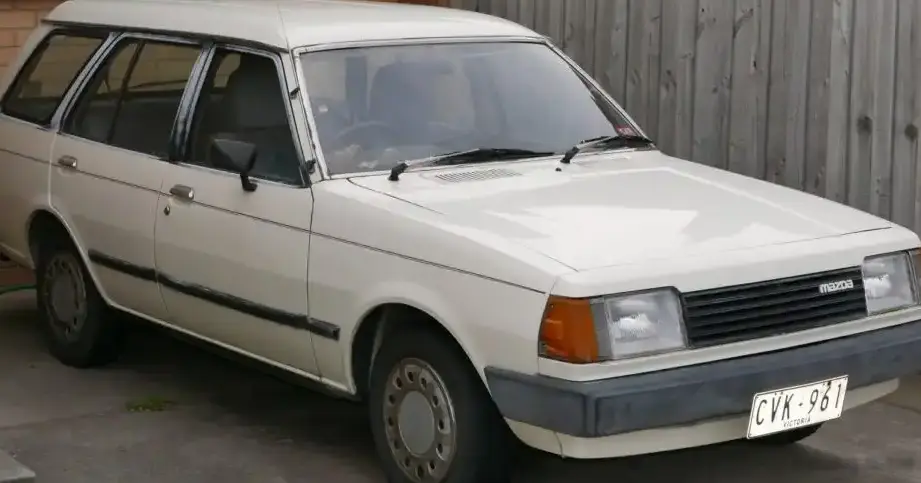
The Mazda 323 I Station Wagon (FA) 1.4, produced between 1978 and 1982, represents an early foray by Mazda into the compact estate car segment. This variant, powered by a 1.4-liter gasoline engine producing 69 horsepower, served as the entry-level offering within the FA series 323 wagon lineup. Positioned as a practical and economical family vehicle, it aimed to provide affordable transportation with the added versatility of a station wagon body style. The FA series itself was a significant model for Mazda, representing a move towards more modern, front-wheel-drive designs, though the 323 I retained a rear-wheel-drive layout. This generation bridged the gap between Mazda’s earlier, more traditional designs and the increasingly popular front-wheel-drive configurations that would dominate the 1980s.
Technical Specifications
| Brand | Mazda |
| Model | 323 |
| Generation | 323 I Station Wagon (FA) |
| Type (Engine) | 1.4 (69 Hp) |
| Start of production | 1978 |
| End of production | 1982 |
| Powertrain Architecture | Internal Combustion engine |
| Body type | Station wagon (estate) |
| Fuel Type | Petrol (Gasoline) |
| Power | 69 Hp |
| Engine aspiration | Naturally aspirated engine |
Powertrain & Engine Architecture
The heart of the 323 I Station Wagon 1.4 is a 1388cc (84.7 cubic inch) inline-four cylinder gasoline engine. This engine, while relatively simple in design, was known for its durability and ease of maintenance. It utilized a single overhead camshaft (SOHC) valvetrain, operating two valves per cylinder. Fuel delivery was managed by a carburetor, a common feature for vehicles of this era, rather than fuel injection. The engine’s modest 69 horsepower output at approximately 5,500 rpm and 86 lb-ft of torque at 3,000 rpm were sufficient for everyday driving, but didn’t offer particularly spirited performance. The engine code for this specific configuration is often referenced as FA, aligning with the overall series designation.
The transmission paired with the 1.4-liter engine was typically a four-speed manual gearbox, though a three-speed automatic transmission was also available, albeit less common. The automatic transmission, while offering convenience, further reduced acceleration and fuel economy. The drivetrain is rear-wheel drive, a characteristic that sets it apart from later Mazda 323 models. The rear axle employed a solid axle suspension, contributing to a relatively firm ride quality.
Driving Characteristics
The driving experience in the 323 I Station Wagon 1.4 was characterized by practicality rather than performance. Acceleration was modest, with a 0-60 mph time estimated to be around 15-17 seconds. The four-speed manual transmission allowed drivers to make the most of the engine’s limited power, while the automatic version felt noticeably slower. The rear-wheel-drive layout provided predictable handling, but lacked the refinement of more modern front-wheel-drive systems. The steering was relatively heavy, typical of cars from this period, and offered decent feedback. The suspension, while functional, was not particularly sophisticated, resulting in a ride that could be bumpy on uneven surfaces. The gear ratios in the manual transmission were spaced to prioritize fuel economy and everyday drivability, rather than outright speed. The automatic transmission, with its fewer gears, further emphasized this focus on practicality.
Equipment & Trim Levels
The 323 I Station Wagon 1.4 was generally equipped with basic amenities, reflecting its position as the entry-level model. Standard features typically included cloth upholstery, vinyl floor covering, and basic instrumentation consisting of a speedometer, fuel gauge, and temperature gauge. Heating and ventilation were standard, but air conditioning was usually an optional extra. The dashboard design was simple and functional, with minimal ornamentation. Optional extras could include a radio, upgraded upholstery, and a sunroof. Trim levels were relatively limited, with most variations stemming from the addition of optional equipment rather than distinct packages. The exterior trim was typically minimal, with black plastic bumpers and relatively simple steel wheels with hubcaps.
Chassis & Braking
The 323 I Station Wagon 1.4 utilized a body-on-frame construction, a common practice for vehicles of this era. The suspension consisted of independent front suspension with coil springs and a solid rear axle with leaf springs. Braking was accomplished via drum brakes on all four wheels, which were adequate for the vehicle’s weight and performance but lacked the stopping power of disc brakes. Steering was a recirculating ball system, providing a relatively direct feel but requiring more effort than modern rack-and-pinion steering. The chassis was designed for durability and practicality, rather than sporty handling. Stabilizer bars were not typically fitted to the base 1.4 model, further contributing to a softer, less controlled ride.
Market Reception & Comparison
The Mazda 323 I Station Wagon 1.4 was generally well-received as an affordable and practical family vehicle. Critics praised its durability and fuel economy, but noted its lack of performance and refinement. Compared to other station wagons of the time, such as the Ford Escort Estate or the Vauxhall Astra Estate, the 323 offered a slightly more stylish design and a reputation for reliability. However, it was often outperformed by competitors with larger engines or more advanced features. Within the 323 lineup, the 1.4-liter model served as the entry point, appealing to budget-conscious buyers. Higher-spec 323 models, equipped with larger engines and more luxurious features, catered to buyers seeking more performance and comfort. Fuel economy was a strong point, averaging around 30-35 mpg in mixed driving conditions.
Legacy
The Mazda 323 I Station Wagon 1.4, while not a particularly groundbreaking vehicle, played an important role in establishing Mazda’s presence in the compact car market. The 1.4-liter engine proved to be remarkably durable, and many examples remain on the road today. The simplicity of the design makes it relatively easy to maintain and repair, appealing to enthusiasts and classic car collectors. In the used car market, these wagons are often sought after for their affordability and practicality. While not a high-performance machine, the 323 I Station Wagon 1.4 represents a solid and reliable example of 1970s automotive engineering, offering a glimpse into a time when practicality and durability were prioritized over outright speed and luxury. Its enduring presence is a testament to Mazda’s commitment to building well-engineered vehicles.