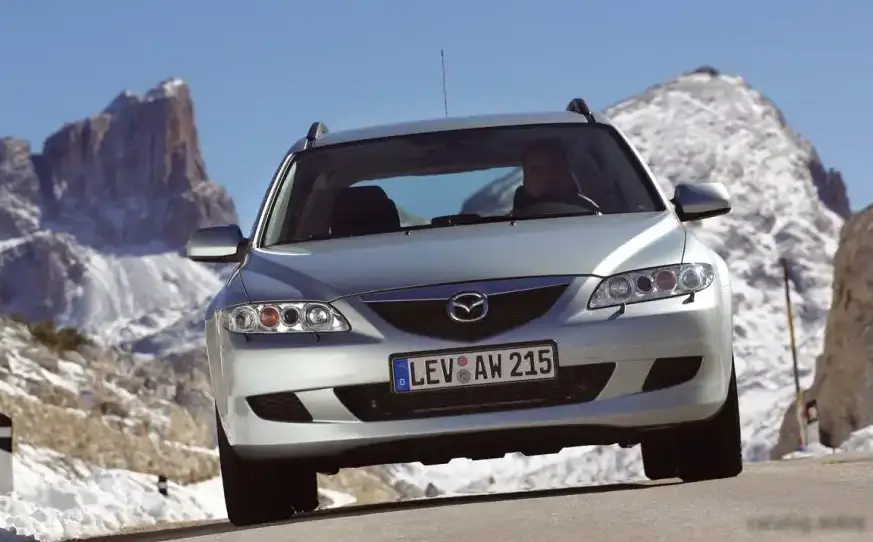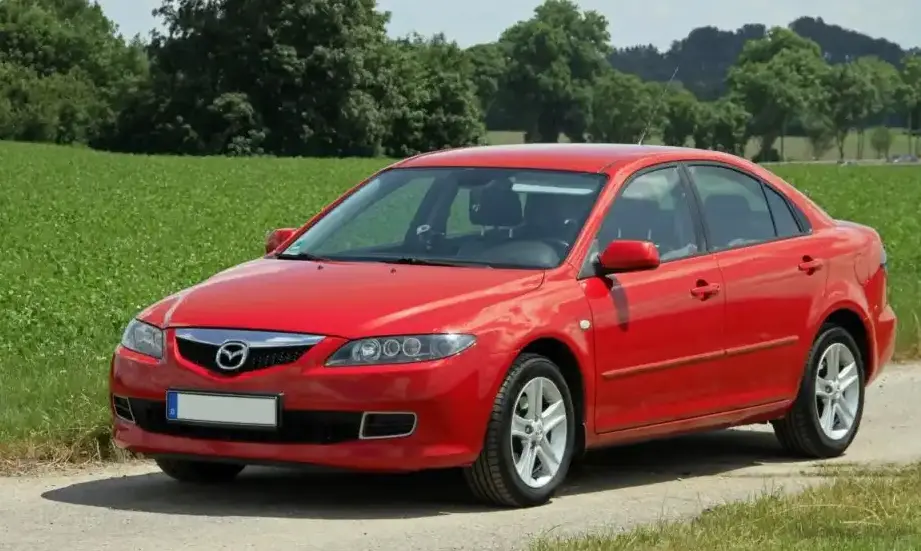
The Mazda 6 first generation (GG/GY/GG1) facelift, produced from 2005 to 2008, represented a significant step forward for Mazda in the mid-size segment. This iteration of the 6, available as a sedan, wagon, and hatchback, aimed to blend sporty handling with practicality and a more refined interior. The 2.0-liter (147 hp) hatchback variant occupied a middle ground in the lineup, offering a balance between performance and fuel efficiency, positioned above the base 1.8-liter models and below the more powerful 2.3-liter options. It was primarily marketed in Europe and other international markets, offering a compelling alternative to established competitors like the Ford Mondeo and Volkswagen Passat.
Technical Specifications
| Brand | Mazda |
| Model | 6 |
| Generation | 6 I Hatchback (Typ GG/GY/GG1 facelift 2005) |
| Type (Engine) | 2.0 (147 Hp) |
| Start of production | 2005 |
| End of production | 2008 |
| Powertrain Architecture | Internal Combustion engine |
| Body type | Hatchback |
| Seats | 5 |
| Doors | 5 |
| Fuel consumption (urban) | 11 l/100 km (21.4 US mpg, 25.7 UK mpg, 9.1 km/l) |
| Fuel consumption (extra urban) | 6.3 l/100 km (37.3 US mpg, 44.8 UK mpg, 15.9 km/l) |
| Fuel consumption (combined) | 8 l/100 km (29.4 US mpg, 35.3 UK mpg, 12.5 km/l) |
| CO2 emissions | 191 g/km |
| Fuel Type | Petrol (Gasoline) |
| Acceleration 0 – 100 km/h | 9.9 sec |
| Acceleration 0 – 62 mph | 9.9 sec |
| Acceleration 0 – 60 mph | 9.4 sec |
| Maximum speed | 210 km/h (130.49 mph) |
| Emission standard | Euro 4 |
| Weight-to-power ratio | 9.1 kg/Hp, 109.3 Hp/tonne |
| Weight-to-torque ratio | 7.3 kg/Nm, 136.8 Nm/tonne |
| Power | 147 Hp @ 6500 rpm |
| Power per litre | 73.5 Hp/l |
| Torque | 184 Nm @ 4000 rpm (135.71 lb.-ft. @ 4000 rpm) |
| Engine layout | Front, Transverse |
| Engine Model/Code | LFF7 |
| Engine displacement | 1999 cm3 (121.99 cu. in.) |
| Number of cylinders | 4 |
| Engine configuration | Inline |
| Cylinder Bore | 87.5 mm (3.44 in.) |
| Piston Stroke | 83.1 mm (3.27 in.) |
| Compression ratio | 10.8:1 |
| Number of valves per cylinder | 4 |
| Fuel injection system | Multi-port manifold injection |
| Engine aspiration | Naturally aspirated engine |
| Valvetrain | DOHC |
| Engine oil capacity | 4.3 l (4.54 US qt | 3.78 UK qt) |
| Coolant | 7.5 l (7.93 US qt | 6.6 UK qt) |
| Kerb Weight | 1345 kg (2965.22 lbs.) |
| Max. weight | 1885 kg (4155.71 lbs.) |
| Max load | 540 kg (1190.5 lbs.) |
| Trunk (boot) space – minimum | 492 l (17.37 cu. ft.) |
| Trunk (boot) space – maximum | 1662 l (58.69 cu. ft.) |
| Fuel tank capacity | 64 l (16.91 US gal | 14.08 UK gal) |
| Permitted trailer load with brakes (12%) | 1500 kg (3306.93 lbs.) |
| Permitted trailer load without brakes | 550 kg (1212.54 lbs.) |
| Length | 4690 mm (184.65 in.) |
| Width | 1780 mm (70.08 in.) |
| Height | 1435 mm (56.5 in.) |
| Wheelbase | 2675 mm (105.31 in.) |
| Front track | 1540 mm (60.63 in.) |
| Rear (Back) track | 1540 mm (60.63 in.) |
| Ride height (ground clearance) | 130 mm (5.12 in.) |
| Drag coefficient (Cd) | 0.31 |
| Minimum turning circle (turning diameter) | 10.8 m (35.43 ft.) |
| Drivetrain Architecture | The Internal combustion engine (ICE) drives the front wheels of the vehicle. |
| Drive wheel | Front wheel drive |
| Number of gears and type of gearbox | 6 gears, manual transmission |
| Front brakes | Ventilated discs |
| Rear brakes | Disc |
| Assisting systems | ABS (Anti-lock braking system) |
| Steering type | Steering rack and pinion |
| Tires size | 205/55 R16 V |
| Wheel rims size | 16 |
Powertrain & Engine Architecture
The heart of this Mazda 6 variant is the LFF7 2.0-liter inline-four cylinder engine. This engine, a member of Mazda’s F-series, utilizes a cast iron block and an aluminum cylinder head. It features multi-port fuel injection and a double overhead camshaft (DOHC) valvetrain with four valves per cylinder. This configuration allowed for a reasonable balance of power and efficiency. The engine’s 147 horsepower output at 6500 rpm and 184 Nm (135.71 lb-ft) of torque at 4000 rpm provided adequate performance for everyday driving. The engine was paired with a six-speed manual transmission, offering precise gear changes and contributing to the car’s engaging driving experience. While an automatic transmission was available in some markets, the 6-speed manual was the more common pairing for this engine.
Driving Characteristics
The 2.0-liter Mazda 6 hatchback with the six-speed manual transmission offered a responsive and enjoyable driving experience. While not as overtly sporty as some of its rivals, it provided a good balance between comfort and handling. The engine’s power delivery was linear, with a noticeable surge in the mid-range. The six-speed gearbox allowed drivers to keep the engine in its optimal power band, resulting in brisk acceleration. Compared to the base 1.8-liter models, the 2.0-liter offered significantly more power and torque, making it more capable for highway cruising and overtaking maneuvers. However, it didn’t possess the outright performance of the 2.3-liter variants. The chassis was well-tuned, providing a comfortable ride without sacrificing handling precision.
Equipment & Trim Levels
The 2.0-liter Mazda 6 hatchback typically came equipped with a respectable level of standard features. These included air conditioning, power windows and mirrors, a CD player with multiple speakers, and ABS brakes. Higher trim levels added features such as alloy wheels, a sunroof, automatic climate control, and upgraded interior upholstery. Interior materials were generally of good quality for the price point, and the dashboard layout was functional and user-friendly. Optional extras included a navigation system and leather seats.
Chassis & Braking
The Mazda 6’s chassis featured independent suspension at all four corners, with MacPherson struts at the front and multi-link suspension at the rear. This setup provided a comfortable ride and good handling characteristics. The front brakes were ventilated discs, while the rear brakes were solid discs. ABS (Anti-lock Braking System) was standard, enhancing safety and stability during braking. The steering was a rack-and-pinion system, providing precise and responsive steering feel.
Market Reception & Comparison
The 2.0-liter Mazda 6 hatchback was generally well-received by automotive critics. It was praised for its stylish design, comfortable interior, and engaging driving dynamics. However, some critics noted that the engine could feel slightly underpowered when fully loaded or driving uphill. Compared to the 1.8-liter models, the 2.0-liter offered a noticeable improvement in performance, making it a more appealing option for drivers who frequently used the highway. Fuel economy was competitive for its class, averaging around 29.4 US mpg in combined driving. Reliability was generally good, although some owners reported minor issues with the electrical system.
Legacy
The 2.0-liter Mazda 6 hatchback (GG/GY/GG1 facelift) remains a popular choice in the used car market today. Its combination of practicality, reliability, and driving enjoyment has made it a desirable option for budget-conscious buyers. The LFF7 engine is known for its durability, and with proper maintenance, it can provide many years of reliable service. While not a particularly rare or collectible model, it represents a significant milestone in Mazda’s history, showcasing the company’s commitment to building stylish and engaging vehicles.