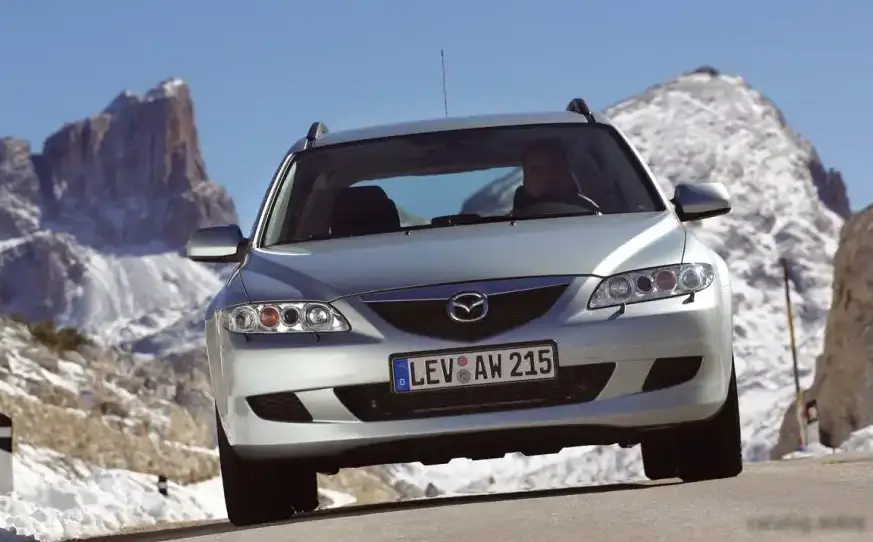
The Mazda 6 MPS (Mazda Performance Series), launched in 2005 as part of the GG/GY/GG1 facelift of the first-generation Mazda 6, represented a significant departure for the model line. Positioned as the performance flagship, the MPS offered a potent combination of all-wheel drive and a turbocharged engine, aimed at enthusiasts seeking a practical yet engaging sedan. Production of this variant ran from 2005 to 2007, primarily targeting the European and Australian markets, with limited availability elsewhere. It distinguished itself from the standard Mazda 6 models with its aggressive styling, upgraded suspension, and significantly more powerful engine.
Technical Specifications
| Brand | Mazda |
| Model | 6 |
| Generation | 6 I Sedan (Typ GG/GY/GG1 facelift 2005) |
| Type (Engine) | MPS 2.3 (260 Hp) AWD |
| Start of production | 2005 |
| End of production | 2007 |
| Powertrain Architecture | Internal Combustion engine |
| Body type | Sedan |
| Seats | 5 |
| Doors | 4 |
| Fuel consumption (urban) | 14 l/100 km (16.8 US mpg, 20.2 UK mpg, 7.1 km/l) |
| Fuel consumption (extra urban) | 8 l/100 km (29.4 US mpg, 35.3 UK mpg, 12.5 km/l) |
| Fuel consumption (combined) | 10.2 l/100 km (23.1 US mpg, 27.7 UK mpg, 9.8 km/l) |
| CO2 emissions | 243 g/km |
| Fuel Type | Petrol (Gasoline) |
| Acceleration 0 – 100 km/h | 6.6 sec |
| Acceleration 0 – 62 mph | 6.6 sec |
| Acceleration 0 – 60 mph | 6.3 sec |
| Maximum speed | 240 km/h (149.13 mph) |
| Emission standard | Euro 4 |
| Weight-to-power ratio | 6.1 kg/Hp, 163.5 Hp/tonne |
| Weight-to-torque ratio | 4.2 kg/Nm, 239 Nm/tonne |
| Power | 260 Hp @ 5500 rpm |
| Power per litre | 115 Hp/l |
| Torque | 380 Nm @ 3000 rpm (280.27 lb.-ft. @ 3000 rpm) |
| Engine layout | Front, Transverse |
| Engine Model/Code | L3KG |
| Engine displacement | 2261 cm3 (137.97 cu. in.) |
| Number of cylinders | 4 |
| Engine configuration | Inline |
| Cylinder Bore | 87.5 mm (3.44 in.) |
| Piston Stroke | 94 mm (3.7 in.) |
| Compression ratio | 9.5:1 |
| Number of valves per cylinder | 4 |
| Fuel injection system | Direct injection |
| Engine aspiration | Turbocharger, Intercooler |
| Valvetrain | DOHC |
| Engine oil capacity | 6.4 l (6.76 US qt | 5.63 UK qt) |
| Coolant | 8 l (8.45 US qt | 7.04 UK qt) |
| Kerb Weight | 1590 kg (3505.35 lbs.) |
| Max. weight | 2085 kg (4596.64 lbs.) |
| Max load | 495 kg (1091.29 lbs.) |
| Trunk (boot) space – minimum | 455 l (16.07 cu. ft.) |
| Fuel tank capacity | 60 l (15.85 US gal | 13.2 UK gal) |
| Length | 4765 mm (187.6 in.) |
| Width | 1780 mm (70.08 in.) |
| Height | 1430 mm (56.3 in.) |
| Wheelbase | 2675 mm (105.31 in.) |
| Front track | 1540 mm (60.63 in.) |
| Rear (Back) track | 1540 mm (60.63 in.) |
| Ride height (ground clearance) | 135 mm (5.31 in.) |
| Drag coefficient (Cd) | 0.30 |
| Minimum turning circle | 11.2 m (36.75 ft.) |
| Drive wheel | All wheel drive (4×4) |
| Number of gears and type of gearbox | 6 gears, manual transmission |
| Front brakes | Ventilated discs |
| Rear brakes | Disc |
| Assisting systems | ABS (Anti-lock braking system) |
| Steering type | Steering rack and pinion |
| Tires size | 215/45 R18 Y |
| Wheel rims size | 18 |
Powertrain & Engine Architecture
The heart of the Mazda 6 MPS is the L3KG 2.3-liter turbocharged inline-four engine. This engine, derived from the powerplant used in the Mazda 3 MPS, was specifically tuned for the larger and heavier Mazda 6. It featured direct injection, a high-flow turbocharger with an intercooler, and a robust internal architecture designed to handle the increased power output. The engine produced 260 horsepower at 5500 rpm and 380 Nm (280 lb-ft) of torque at 3000 rpm. The engine utilized a double overhead camshaft (DOHC) valvetrain with four valves per cylinder, optimizing airflow for improved performance. The sole transmission option was a six-speed manual gearbox, chosen for its durability and driver engagement. The engine’s layout was front-transverse, a common configuration for front-wheel-drive based vehicles adapted to all-wheel drive.
Driving Characteristics
The Mazda 6 MPS offered a distinctly different driving experience compared to other Mazda 6 variants. The all-wheel-drive system, utilizing a viscous coupling, provided excellent traction and stability, particularly in adverse weather conditions. Acceleration from 0 to 60 mph was achieved in approximately 6.3 seconds, and the car had a top speed of 149 mph. While the turbocharged engine delivered strong mid-range punch, some turbo lag was noticeable at lower engine speeds. The six-speed manual transmission offered precise shifts, and the gear ratios were well-matched to the engine’s powerband. Compared to the naturally aspirated 2.0-liter and 2.3-liter Mazda 6 models, the MPS provided significantly more performance, but at the expense of fuel economy. The suspension was firmer and lower, contributing to improved handling but a slightly less comfortable ride.
Equipment & Trim Levels
The Mazda 6 MPS was generally well-equipped, although trim levels varied slightly depending on the market. Standard features typically included sport seats with unique upholstery, a leather-wrapped steering wheel, automatic climate control, and a premium audio system. Exterior styling cues included a more aggressive front bumper with larger air intakes, side skirts, a rear spoiler, and unique alloy wheels. Optional extras often included a sunroof, navigation system, and xenon headlights. The interior generally featured dark metallic trim accents, reinforcing the car’s sporty character.
Chassis & Braking
The chassis of the Mazda 6 MPS was reinforced to handle the increased power and torque. The suspension featured stiffer springs and dampers, along with a thicker stabilizer bar, to reduce body roll and improve handling. Brakes consisted of ventilated discs at the front and solid discs at the rear. The anti-lock braking system (ABS) was standard. The all-wheel-drive system distributed power between the front and rear axles as needed, enhancing traction and stability. The steering was a rack and pinion system, providing precise and responsive control.
Market Reception & Comparison
The Mazda 6 MPS was generally well-received by automotive critics, who praised its performance, handling, and value for money. However, some criticized its fuel economy and slightly firm ride. Compared to other performance sedans of the time, such as the Subaru Impreza WRX and the Mitsubishi Lancer Evolution, the Mazda 6 MPS offered a more refined and comfortable driving experience, but with slightly less outright performance. Against the standard Mazda 6 models, the MPS represented a significant upgrade in terms of performance and handling, but it also came with a higher price tag and increased running costs.
Legacy
The Mazda 6 MPS remains a popular choice among enthusiasts seeking an affordable and engaging performance sedan. The L3KG engine, while known for its potential, requires regular maintenance to ensure reliability. Common issues include turbocharger wear and potential oil consumption. The all-wheel-drive system is generally robust, but the viscous coupling may require replacement over time. Today, well-maintained examples of the Mazda 6 MPS are becoming increasingly collectible, and the car is remembered as a bold and innovative offering from Mazda.