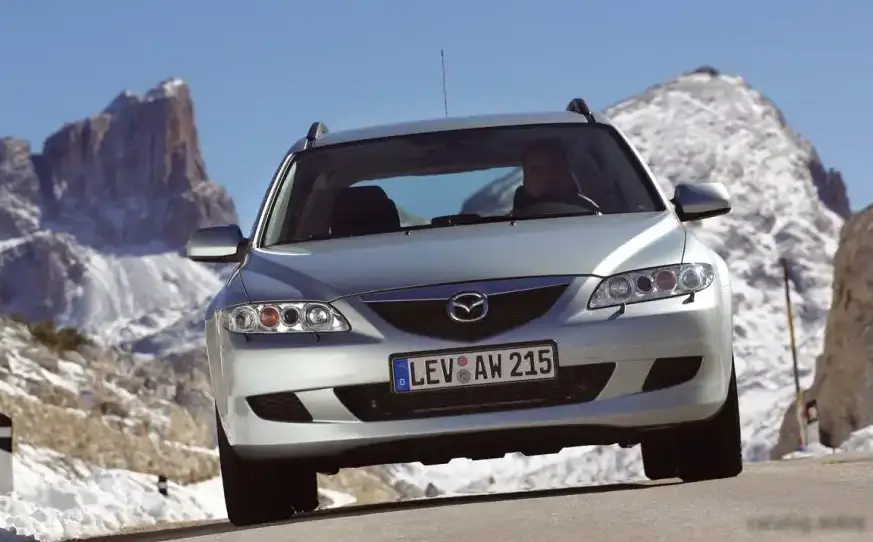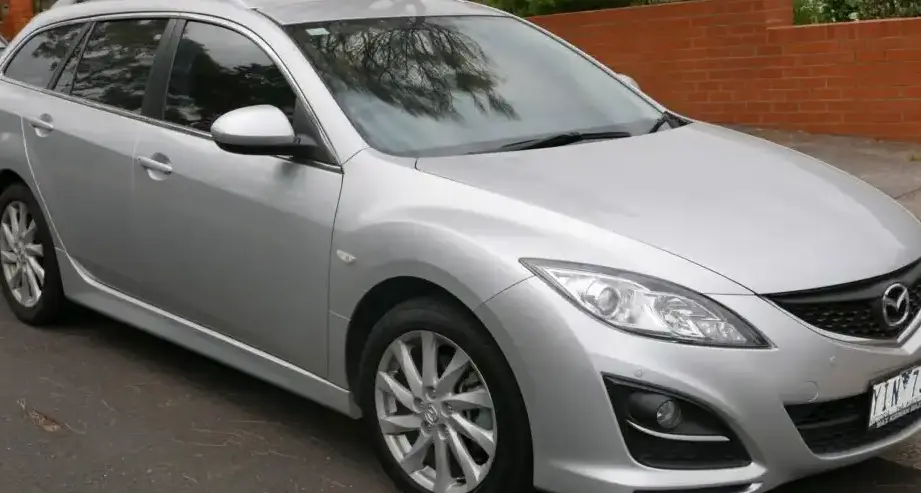
The Mazda 6 II Combi (GH series, post-facelift 2010) 1.8 is a front-wheel-drive station wagon that served as an entry-level offering within the second generation of Mazda’s popular mid-size family car. Produced from 2010 to 2012, this variant aimed to provide a balance of practicality, fuel efficiency, and affordability for European and other international markets. It occupied a position below the more powerful 2.0-liter and 2.5-liter gasoline engines, as well as the diesel options, catering to buyers prioritizing economy over outright performance. The facelifted GH series, introduced in 2010, brought revised styling, improved interior materials, and updated technology compared to the pre-facelift models.
Technical Specifications
| Brand | Mazda |
| Model | 6 |
| Generation | 6 II Combi (GH, facelift 2010) |
| Type (Engine) | 1.8 (120 Hp) |
| Start of production | 2010 |
| End of production | 2012 |
| Powertrain Architecture | Internal Combustion engine |
| Body type | Station wagon (estate) |
| Seats | 5 |
| Doors | 5 |
| Fuel consumption (urban) | 9.3 l/100 km (25.3 US mpg) |
| Fuel consumption (extra urban) | 5.1 l/100 km (46.1 US mpg) |
| Fuel consumption (combined) | 6.6 l/100 km (35.6 US mpg) |
| CO2 emissions | 157 g/km |
| Fuel Type | Petrol (Gasoline) |
| Acceleration 0 – 100 km/h | 11.8 sec |
| Acceleration 0 – 62 mph | 11.8 sec |
| Acceleration 0 – 60 mph | 11.2 sec |
| Maximum speed | 190 km/h (118.06 mph) |
| Emission standard | Euro 4 |
| Weight-to-power ratio | 11 kg/Hp |
| Weight-to-torque ratio | 8 kg/Nm |
| Power | 120 Hp @ 5500 rpm |
| Torque | 165 Nm @ 4300 rpm (121.7 lb.-ft. @ 4300 rpm) |
| Engine layout | Front, Transverse |
| Engine Model/Code | L8 |
| Engine displacement | 1798 cm3 (109.72 cu. in.) |
| Number of cylinders | 4 |
| Engine configuration | Inline |
| Cylinder Bore | 83 mm (3.27 in.) |
| Piston Stroke | 83.1 mm (3.27 in.) |
| Compression ratio | 10.8:1 |
| Number of valves per cylinder | 4 |
| Fuel injection system | Multi-port manifold injection |
| Engine aspiration | Naturally aspirated |
| Valvetrain | DOHC |
| Engine oil capacity | 4.3 l (4.54 US qt | 3.78 UK qt) |
| Coolant capacity | 7.5 l (7.93 US qt | 6.6 UK qt) |
| Kerb Weight | 1325 kg (2921.12 lbs.) |
| Max. weight | 1965 kg (4332.08 lbs.) |
| Max load | 640 kg (1410.96 lbs.) |
| Trunk (boot) space – minimum | 519 l (18.33 cu. ft.) |
| Trunk (boot) space – maximum | 1751 l (61.84 cu. ft.) |
| Fuel tank capacity | 64 l (16.91 US gal | 14.08 UK gal) |
| Max. roof load | 100 kg (220.46 lbs.) |
| Permitted trailer load with brakes (12%) | 1300 kg (2866.01 lbs.) |
| Length | 4785 mm (188.39 in.) |
| Width | 1795 mm (70.67 in.) |
| Height | 1490 mm (58.66 in.) |
| Wheelbase | 2725 mm (107.28 in.) |
| Front track | 1550-1570 mm (61.02 – 61.81 in.) |
| Rear track | 1550-1570 mm (61.02 – 61.81 in.) |
| Ride height (ground clearance) | 165 mm (6.5 in.) |
| Minimum turning circle | 11.8 m (38.71 ft.) |
| Drivetrain | Front wheel drive |
| Number of gears | 5 |
| Gearbox type | Manual transmission |
| Front suspension | Double wishbone, Transverse stabilizer |
| Rear suspension | Independent multi-link suspension, Transverse stabilizer |
| Front brakes | Ventilated discs, 299 mm |
| Rear brakes | Disc, 280 mm |
| Assisting systems | ABS (Anti-lock braking system) |
| Steering type | Steering rack and pinion |
| Power steering | Electric |
| Tires size | 205/60 R16; 215/50 R17; 225/45 R18 |
| Wheel rims size | 6.5J x 16; 7J x 17; 7.5J x 18 |
INTRODUCTION
The Mazda 6 II Combi 1.8, produced between 2010 and 2012, represented Mazda’s attempt to offer a practical and economical station wagon option within the competitive D-segment. Based on the GH platform, the facelift brought subtle but noticeable improvements to the exterior and interior design. This variant was primarily aimed at buyers in Europe and other markets where station wagons remain popular, offering a spacious interior and large cargo area. The 1.8-liter engine and five-speed manual transmission combination was designed to prioritize fuel efficiency and affordability, making it an attractive choice for families and individuals seeking a versatile vehicle for everyday use.
Powertrain & Engine Architecture
The heart of the Mazda 6 II Combi 1.8 is the MZR 1.8-liter (1798cc) inline-four cylinder gasoline engine. This engine, internally designated as the L8, utilizes a naturally aspirated configuration with multi-point fuel injection. The engine features a double overhead camshaft (DOHC) valvetrain with four valves per cylinder, contributing to its relatively efficient operation. The compression ratio is set at 10.8:1. The engine’s output of 120 horsepower at 5500 rpm and 165 Nm (121.7 lb-ft) of torque at 4300 rpm is modest, but sufficient for everyday driving. The engine is transversely mounted in the front of the vehicle. The five-speed manual transmission was the standard offering, providing a direct and engaging driving experience. While an automatic transmission was available in some markets, the 1.8-liter engine was often paired with the manual due to the automatic’s impact on fuel economy and performance.
Driving Characteristics
The Mazda 6 II Combi 1.8, with its 120 hp and five-speed manual transmission, delivers a driving experience focused on practicality and fuel economy rather than outright performance. Acceleration from 0-60 mph takes around 11.2 seconds, and the top speed is approximately 118 mph. The engine feels adequate for everyday driving situations, such as commuting and highway cruising, but can feel strained when fully loaded or attempting brisk acceleration. The five-speed gearbox is well-matched to the engine’s characteristics, offering smooth shifts and a reasonable spread of ratios. Compared to the more powerful 2.0-liter and 2.5-liter variants, the 1.8 feels noticeably less responsive. However, the lighter engine weight contributes to slightly improved handling and fuel efficiency. The steering is precise and well-weighted, providing a confident feel on the road.
Equipment & Trim Levels
The 1.8-liter Mazda 6 Combi typically served as the entry-level trim, offering a good level of standard equipment. Standard features generally included air conditioning, power windows, power mirrors, a CD/MP3 stereo system, and ABS brakes. Safety features such as front and side airbags were also standard. Interior upholstery was typically cloth, and the dashboard featured a functional, if somewhat understated, design. Optional extras included alloy wheels, a sunroof, a navigation system, and upgraded audio systems. Higher trim levels, such as the Sport or Touring models, added features like leather upholstery, automatic climate control, and parking sensors.
Chassis & Braking
The Mazda 6 II Combi 1.8 utilizes a front-wheel-drive chassis with a double wishbone suspension setup at the front and an independent multi-link suspension at the rear. This suspension configuration provides a good balance of ride comfort and handling. The front suspension incorporates a transverse stabilizer bar to reduce body roll during cornering. Braking duties are handled by ventilated discs at the front and solid discs at the rear. ABS (Anti-lock Braking System) is standard, enhancing braking performance and stability. The chassis is designed to provide a stable and predictable driving experience, even when fully loaded.
Market Reception & Comparison
The Mazda 6 II Combi 1.8 was generally well-received by automotive critics as a practical and economical family car. Reviewers praised its spacious interior, large cargo area, and comfortable ride. However, the engine’s modest power output was often cited as a drawback, particularly when compared to more powerful alternatives. In terms of fuel economy, the 1.8-liter engine offered competitive figures, achieving around 35.6 US mpg on the combined cycle. Compared to the 2.0-liter gasoline and diesel variants, the 1.8 offered lower running costs but sacrificed performance. The 1.8 was often seen as a sensible choice for buyers prioritizing practicality and affordability over driving excitement.
Legacy
The Mazda 6 II Combi 1.8 has proven to be a relatively reliable vehicle, with the MZR 1.8-liter engine generally considered durable and long-lasting. Common issues are typically related to age and mileage, such as wear and tear on suspension components and potential oil leaks. On the used car market, these models represent a good value proposition for buyers seeking an affordable and practical station wagon. The availability of spare parts is generally good, and maintenance costs are relatively low. While not a particularly sought-after variant by enthusiasts, the 1.8-liter Mazda 6 Combi remains a popular choice for those seeking a dependable and economical family vehicle.