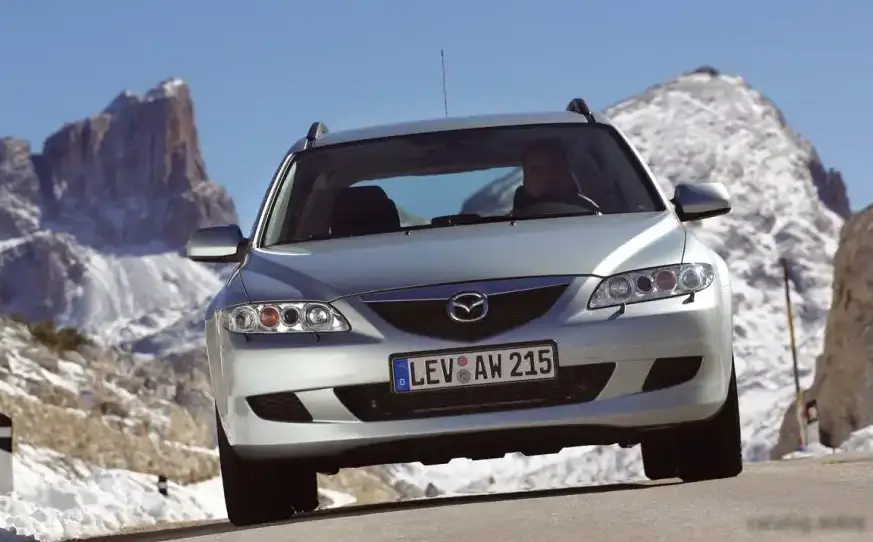
The Mazda 6 II Sedan (GH series, post-facelift 2010) 2.2 CD, producing 180 horsepower, represents a significant iteration of Mazda’s mid-size offering. Introduced in 2010 and continuing through 2012, this variant was primarily aimed at the European market, where diesel engines held a substantial share of the segment. It built upon the foundation of the GH platform, which debuted in 2008, incorporating styling refinements and updated technology. This specific engine and power output positioned itself as a strong contender within the Mazda 6 lineup, offering a balance between performance, fuel efficiency, and refinement. It was offered alongside gasoline engine options and a lower-powered diesel variant.
Technical Specifications
| Brand | Mazda |
| Model | 6 |
| Generation | 6 II Sedan (GH, facelift 2010) |
| Type (Engine) | 2.2 CD (180 Hp) |
| Start of production | 2010 |
| End of production | 2012 |
| Powertrain Architecture | Internal Combustion engine |
| Body type | Sedan |
| Seats | 5 |
| Doors | 4 |
| Fuel consumption (urban) | 6.9 l/100 km (34.1 US mpg, 40.9 UK mpg, 14.5 km/l) |
| Fuel consumption (extra urban) | 4.5 l/100 km (52.3 US mpg, 62.8 UK mpg, 22.2 km/l) |
| Fuel consumption (combined) | 5.4 l/100 km (43.6 US mpg, 52.3 UK mpg, 18.5 km/l) |
| CO2 emissions | 143 g/km |
| Fuel Type | Diesel |
| Acceleration 0 – 100 km/h | 8.5 sec |
| Acceleration 0 – 62 mph | 8.5 sec |
| Acceleration 0 – 60 mph | 8.1 sec |
| Maximum speed | 218 km/h (135.46 mph) |
| Emission standard | Euro 5 |
| Weight-to-power ratio | 8.4 kg/Hp, 119.2 Hp/tonne |
| Weight-to-torque ratio | 3.8 kg/Nm, 264.9 Nm/tonne |
| Power | 180 Hp @ 3500 rpm |
| Power per litre | 82.5 Hp/l |
| Torque | 400 Nm @ 1800 rpm (295.02 lb.-ft. @ 1800 rpm) |
| Engine layout | Front, Transverse |
| Engine displacement | 2183 cm3 (133.21 cu. in.) |
| Number of cylinders | 4 |
| Engine configuration | Inline |
| Cylinder Bore | 86 mm (3.39 in.) |
| Piston Stroke | 94 mm (3.7 in.) |
| Compression ratio | 16.3:1 |
| Number of valves per cylinder | 4 |
| Fuel injection system | Diesel Commonrail |
| Engine aspiration | Turbocharger, Intercooler |
| Valvetrain | DOHC |
| Engine oil capacity | 4.7 l (4.97 US qt | 4.14 UK qt) |
| Coolant capacity | 9 l (9.51 US qt | 7.92 UK qt) |
| Kerb Weight | 1510 kg (3328.98 lbs.) |
| Max. weight | 2065 kg (4552.55 lbs.) |
| Max load | 555 kg (1223.57 lbs.) |
| Trunk (boot) space (minimum) | 519 l (18.33 cu. ft.) |
| Fuel tank capacity | 64 l (16.91 US gal | 14.08 UK gal) |
| Length | 4755 mm (187.2 in.) |
| Width | 1795 mm (70.67 in.) |
| Height | 1440 mm (56.69 in.) |
| Wheelbase | 2725 mm (107.28 in.) |
| Front track | 1560-1570 mm (61.42 – 61.81 in.) |
| Rear track | 1560-1570 mm (61.42 – 61.81 in.) |
| Ride height (ground clearance) | 165 mm (6.5 in.) |
| Minimum turning circle | 11.8 m (38.71 ft.) |
| Drivetrain Architecture | Front wheel drive |
| Number of gears | 6 |
| Gearbox type | Manual transmission |
| Front suspension | Double wishbone, Transverse stabilizer |
| Rear suspension | Independent multi-link suspension, Transverse stabilizer |
| Front brakes | Ventilated discs, 299 mm |
| Rear brakes | Disc, 280 mm |
| Assisting systems | ABS (Anti-lock braking system) |
| Steering type | Steering rack and pinion |
| Power steering | Electric Steering |
| Tires size | 205/60 R16; 215/50 R17; 225/45 R18 |
| Wheel rims size | 6.5J x 16; 7J x 17; 7.5J x 18 |
Powertrain & Engine Architecture
The heart of this Mazda 6 variant is the 2.2-liter four-cylinder diesel engine, typically identified by engine codes such as SHHP. This engine utilizes a common-rail direct injection system, delivering fuel at extremely high pressure for optimized combustion. The engine features a variable geometry turbocharger (VGT) and an intercooler, enhancing both power and torque output. The DOHC (Double Overhead Camshaft) valvetrain, with four valves per cylinder, contributes to efficient gas exchange. The 16.3:1 compression ratio is typical for a diesel engine, maximizing thermal efficiency. The engine’s design prioritized low-end torque, making it well-suited for everyday driving and overtaking maneuvers. The 6-speed manual transmission was the standard offering, providing precise gear changes and contributing to the car’s overall driving experience.
Driving Characteristics
The 180 hp 2.2 CD offered a noticeable step up in performance compared to the lower-powered diesel options available in the Mazda 6 range. Acceleration from 0-60 mph in around 8.1 seconds was respectable for a mid-size sedan of this era. The engine’s strong torque output – 400 Nm (295 lb-ft) – was readily available from low engine speeds, providing effortless acceleration in most driving situations. The manual transmission allowed for greater driver control, although it required more engagement than an automatic. Compared to gasoline-powered Mazda 6 models, the diesel offered superior fuel economy and a more relaxed cruising experience. However, it lacked the high-revving character of the gasoline engines.
Equipment & Trim Levels
The 2.2 CD 180 hp model typically occupied a mid-range position within the Mazda 6 lineup. Standard equipment often included air conditioning, power windows, power mirrors, a CD/MP3 stereo system, and alloy wheels. Higher trim levels added features such as leather upholstery, a sunroof, automatic climate control, and a navigation system. Safety features like ABS, traction control, and multiple airbags were standard across the range. The interior design was generally functional and well-built, with a focus on ergonomics and driver comfort.
Chassis & Braking
The Mazda 6 II Sedan featured a MacPherson strut front suspension and a multi-link rear suspension, providing a good balance between ride comfort and handling. Stabilizer bars were fitted to both axles to reduce body roll during cornering. The braking system consisted of ventilated discs at the front and solid discs at the rear. ABS (Anti-lock Braking System) was standard, enhancing braking performance and stability. The steering was a rack-and-pinion system with electric power assistance, offering precise and responsive steering feel.
Market Reception & Comparison
The Mazda 6 II Sedan 2.2 CD 180 hp was generally well-received by automotive critics. It was praised for its fuel efficiency, strong performance, and comfortable ride. Compared to rivals like the Ford Mondeo, Volkswagen Passat, and Opel/Vauxhall Insignia, the Mazda 6 offered a more engaging driving experience and a stylish design. However, some critics noted that the interior materials were not as premium as those found in some competitors. The diesel engine’s fuel economy was a major selling point, particularly in Europe, where diesel fuel was often cheaper than gasoline.
Legacy
The 2.2 CD engine proved to be a relatively reliable unit, although, like all diesel engines, it required regular maintenance, including oil changes and filter replacements. The particulate filter could be a potential source of issues if the vehicle was primarily used for short trips. Today, well-maintained examples of the Mazda 6 II Sedan 2.2 CD 180 hp can still be found on the used car market. They represent a good value proposition for buyers seeking a fuel-efficient, comfortable, and reliable mid-size sedan. The engine’s longevity and relatively low running costs continue to make it an attractive option for those looking for a practical and economical vehicle.