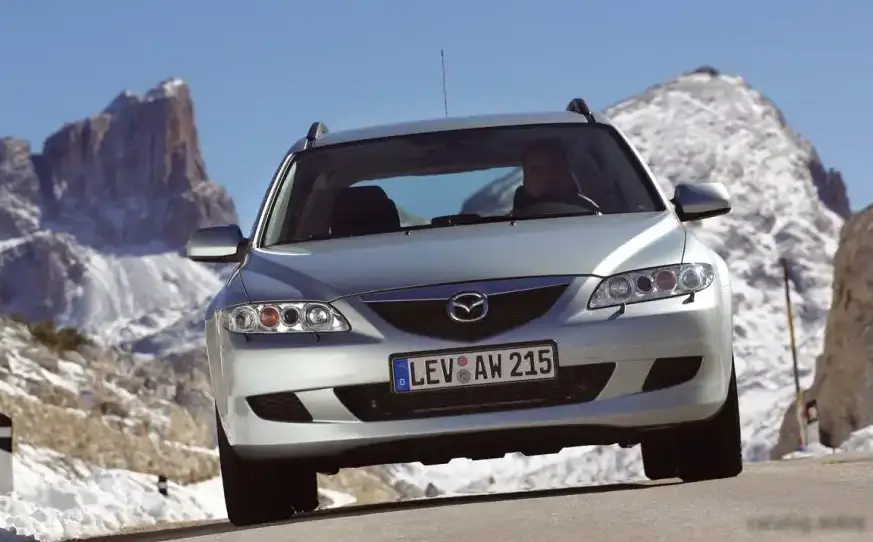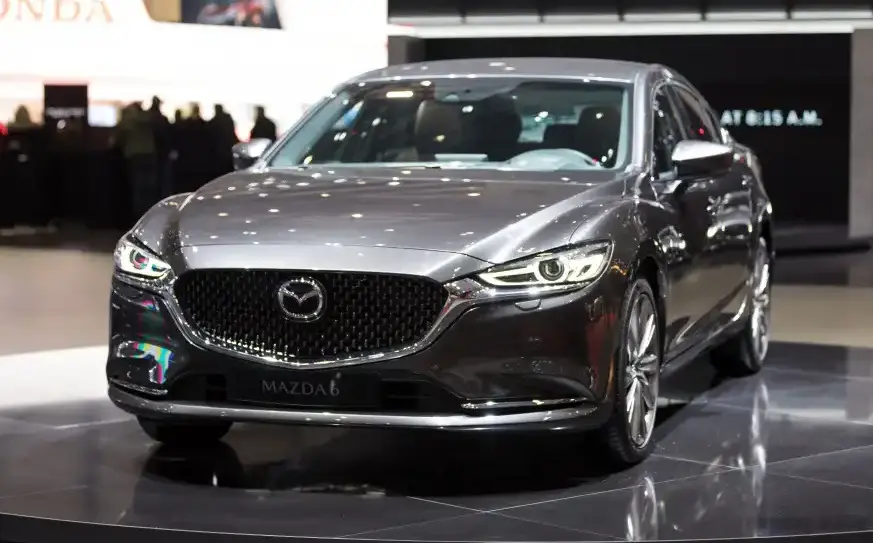
The Mazda 6 III Sedan (GJ series), particularly the facelifted version introduced in 2018, represented a significant evolution of Mazda’s mid-size offering. This iteration, built from 2018 onwards, continued the GJ generation’s focus on sophisticated styling, driving dynamics, and fuel efficiency. The 2.5 SKYACTIV-G (194 Hp) variant paired with the SKYACTIV-Drive automatic transmission was positioned as a mainstream offering, balancing performance with practicality and comfort. It aimed to appeal to buyers seeking a refined and engaging driving experience without the added cost of the higher-trim models.
Technical Specifications
| Brand | Mazda |
| Model | 6 |
| Generation | 6 III Sedan (GJ, facelift 2018) |
| Type (Engine) | 2.5 SKYACTIV-G (194 Hp) SKYACTIV-Drive |
| Start of production | 2018 |
| Powertrain Architecture | Internal Combustion engine |
| Body type | Sedan |
| Seats | 5 |
| Doors | 4 |
| Fuel consumption (urban) | 8.8 l/100 km (26.7 US mpg, 32.1 UK mpg, 11.4 km/l) |
| Fuel consumption (extra urban) | 5.4 l/100 km (43.6 US mpg, 52.3 UK mpg, 18.5 km/l) |
| Fuel consumption (combined) | 6.7 l/100 km (35.1 US mpg, 42.2 UK mpg, 14.9 km/l) |
| CO2 emissions | 153 g/km |
| Fuel Type | Petrol (Gasoline) |
| Acceleration 0 – 100 km/h | 8.1 sec |
| Acceleration 0 – 62 mph | 8.1 sec |
| Acceleration 0 – 60 mph | 7.7 sec |
| Maximum speed | 223 km/h (138.57 mph) |
| Emission standard | Euro 6 |
| Weight-to-power ratio | 7.5 kg/Hp, 132.7 Hp/tonne |
| Weight-to-torque ratio | 5.7 kg/Nm, 176.5 Nm/tonne |
| Power | 194 Hp @ 6000 rpm |
| Power per litre | 78 Hp/l |
| Torque | 258 Nm @ 4000 rpm (190.29 lb.-ft. @ 4000 rpm) |
| Engine layout | Front, Transverse |
| Engine Model/Code | PYZC |
| Engine displacement | 2488 cm3 (151.83 cu. in.) |
| Number of cylinders | 4 |
| Engine configuration | Inline |
| Cylinder Bore | 89 mm (3.5 in.) |
| Piston Stroke | 100 mm (3.94 in.) |
| Compression ratio | 13:1 |
| Number of valves per cylinder | 4 |
| Fuel injection system | Direct injection |
| Engine aspiration | Naturally aspirated engine |
| Engine oil capacity | 4.5 l (4.76 US qt | 3.96 UK qt) |
| Coolant | 7.2 l (7.61 US qt | 6.34 UK qt) |
| Kerb Weight | 1462-1532 kg (3223.16 – 3377.48 lbs.) |
| Max. weight | 2095 kg (4618.68 lbs.) |
| Max load | 563-633 kg (1241.2 – 1395.53 lbs.) |
| Trunk (boot) space – minimum | 480 l (16.95 cu. ft.) |
| Fuel tank capacity | 62 l (16.38 US gal | 13.64 UK gal) |
| Max. roof load | 75 kg (165.35 lbs.) |
| Permitted trailer load with brakes (8%) | 1700 kg (3747.86 lbs.) |
| Permitted trailer load with brakes (12%) | 1500 kg (3306.93 lbs.) |
| Permitted trailer load without brakes | 680 kg (1499.14 lbs.) |
| Length | 4870 mm (191.73 in.) |
| Width | 1840 mm (72.44 in.) |
| Height | 1450 mm (57.09 in.) |
| Wheelbase | 2830 mm (111.42 in.) |
| Front track | 1585-1595 mm (62.4 – 62.8 in.) |
| Rear (Back) track | 1575-1585 mm (62.01 – 62.4 in.) |
| Ride height (ground clearance) | 165 mm (6.5 in.) |
| Minimum turning circle (turning diameter) | 11.2 m (36.75 ft.) |
| Drivetrain Architecture | The Internal combustion engine (ICE) drives the front wheels of the vehicle. |
| Drive wheel | Front wheel drive |
| Number of gears and type of gearbox | 6 gears, automatic transmission |
| Front brakes | Ventilated discs |
| Rear brakes | Disc |
| Assisting systems | ABS (Anti-lock braking system) |
| Steering type | Steering rack and pinion |
| Power steering | Electric Steering |
INTRODUCTION
The 2018 Mazda 6 2.5 SKYACTIV-G with the SKYACTIV-Drive automatic transmission represents a key variant within the GJ series facelift. The GJ generation Mazda 6, launched in 2012, aimed to elevate Mazda’s presence in the competitive mid-size sedan segment. The 2018 facelift brought refreshed styling, improved interior materials, and enhancements to the SKYACTIV technology suite. This particular engine and transmission combination was a popular choice, offering a balance between performance, fuel economy, and affordability. It sat comfortably in the middle of the range, above the base 2.0-liter engine and below the more powerful turbocharged options.
Powertrain & Engine Architecture
At the heart of this Mazda 6 variant lies the PYZC 2.5-liter inline-four cylinder engine, a cornerstone of Mazda’s SKYACTIV technology. This engine is characterized by its high compression ratio of 13:1, achieved through meticulous engineering and optimized combustion chamber design. It utilizes direct injection, enhancing fuel atomization and improving efficiency. The engine’s valvetrain employs dual overhead camshafts (DOHC) and four valves per cylinder, maximizing airflow and contributing to its responsive nature. The SKYACTIV-Drive automatic transmission is a six-speed unit with a torque converter. Unlike traditional automatic transmissions, the SKYACTIV-Drive prioritizes quick, seamless shifts and a more direct driving feel. It achieves this through a sophisticated control system and a wider range of gear ratios. The transmission is designed to anticipate driver inputs and select the optimal gear for any given situation.
Driving Characteristics
The 2.5-liter engine paired with the SKYACTIV-Drive automatic delivers a smooth and refined driving experience. While not overtly sporty, the combination provides ample power for everyday driving and confident highway cruising. The 194 horsepower and 258 lb-ft of torque are readily available, offering brisk acceleration. The SKYACTIV-Drive transmission contributes to this by providing quick and decisive shifts, minimizing the sensation of gear hunting. Compared to the manual transmission versions, the automatic offers greater convenience, particularly in urban environments. However, it does slightly diminish the driver’s sense of control and engagement. Against the higher-output turbocharged engines, this variant feels less potent, especially during aggressive acceleration. The gear ratios are tuned for a balance of fuel efficiency and responsiveness, with a focus on maintaining engine speed within the optimal torque band.
Equipment & Trim Levels
The 2.5 SKYACTIV-G with SKYACTIV-Drive was typically offered in mid-range trim levels, such as the Touring or Grand Touring. Standard features generally included automatic climate control, a touchscreen infotainment system with Bluetooth connectivity, a rearview camera, and a suite of safety features like ABS, stability control, and multiple airbags. Higher trims added features like leather upholstery, a premium sound system, a sunroof, and advanced driver-assistance systems such as adaptive cruise control and lane departure warning. Interior upholstery was typically cloth in the lower trims, upgrading to leather in the higher ones. Dashboard configurations were consistent across the range, featuring a clean and modern design with intuitive controls.
Chassis & Braking
The Mazda 6 GJ series utilizes a front-wheel-drive platform with a MacPherson strut front suspension and a multi-link rear suspension. This setup provides a comfortable ride while maintaining good handling characteristics. The 2.5-liter variants typically featured slightly larger stabilizer bars compared to the base 2.0-liter models, enhancing body control and reducing roll during cornering. Braking duties are handled by ventilated discs at the front and solid discs at the rear. ABS (Anti-lock Braking System) is standard, providing enhanced stopping power and stability in emergency braking situations. The steering system is an electric power-assisted rack and pinion, offering precise and responsive steering feel.
Market Reception & Comparison
The 2.5-liter SKYACTIV-G with SKYACTIV-Drive was generally well-received by automotive critics. It was praised for its refined engine, smooth transmission, and comfortable ride. Fuel economy was also a strong point, with combined figures around 35 mpg. Compared to competitors like the Honda Accord and Toyota Camry, the Mazda 6 offered a more engaging driving experience and a more upscale interior. However, some critics noted that the rear seat space was slightly less generous than in some rivals. In terms of reliability, the SKYACTIV powertrain has proven to be generally robust, with few widespread issues reported. The automatic transmission is also considered reliable, although regular maintenance is crucial for optimal performance.
Legacy
The 2.5-liter SKYACTIV-G engine and SKYACTIV-Drive transmission combination have become a staple of the Mazda lineup. The powertrain’s reputation for reliability and efficiency has contributed to the Mazda 6’s strong resale value in the used car market. While newer Mazda 6 models have introduced turbocharged engines and further refinements to the SKYACTIV technology, the 2018 2.5-liter variant remains a compelling option for buyers seeking a well-rounded and dependable mid-size sedan. Its blend of performance, fuel economy, and driving enjoyment continues to appeal to a wide range of drivers.