Technical Specifications
| Brand | Mazda |
| Model | 6 |
| Generation | 6 III Sport Combi (GJ, facelift 2015) |
| Type (Engine) | 2.2 SKYACTIV-D (150 Hp) i-ELOOP |
| Start of production | 2015 |
| End of production | 2017 |
| Powertrain Architecture | Internal Combustion engine |
| Body type | Station wagon (estate) |
| Seats | 5 |
| Doors | 5 |
| Fuel consumption (urban) | 5 l/100 km (47 US mpg, 56.5 UK mpg, 20 km/l) |
| Fuel consumption (extra urban) | 3.8 l/100 km (61.9 US mpg, 74.3 UK mpg, 26.3 km/l) |
| Fuel consumption (combined) | 4.2 l/100 km (56 US mpg, 67.3 UK mpg, 23.8 km/l) |
| CO2 emissions | 110 g/km |
| Fuel Type | Diesel |
| Acceleration 0 – 100 km/h | 9.3 sec |
| Acceleration 0 – 62 mph | 9.3 sec |
| Acceleration 0 – 60 mph | 8.8 sec |
| Maximum speed | 210 km/h (130.49 mph) |
| Emission standard | Euro 6 |
| Weight-to-power ratio | 9.9 kg/Hp, 101 Hp/tonne |
| Weight-to-torque ratio | 3.9 kg/Nm, 255.9 Nm/tonne |
| Power | 150 Hp @ 4500 rpm |
| Power per litre | 68.5 Hp/l |
| Torque | 380 Nm @ 1800-2600 rpm (280.27 lb.-ft. @ 1800-2600 rpm) |
| Engine layout | Front, Transverse |
| Engine Model/Code | SHY4 |
| Engine displacement | 2191 cm3 (133.7 cu. in.) |
| Number of cylinders | 4 |
| Engine configuration | Inline |
| Cylinder Bore | 86 mm (3.39 in.) |
| Piston Stroke | 94.3 mm (3.71 in.) |
| Compression ratio | 14:1 |
| Number of valves per cylinder | 4 |
| Fuel injection system | Diesel Commonrail |
| Engine aspiration | BiTurbo, Intercooler |
| Engine oil capacity | 5.1 l (5.39 US qt | 4.49 UK qt) |
| Coolant | 8.5 l (8.98 US qt | 7.48 UK qt) |
| Kerb Weight | 1485-1576 kg (3273.86 – 3474.49 lbs.) |
| Max. weight | 2090 kg (4607.66 lbs.) |
| Max load | 514-605 kg (1133.18 – 1333.8 lbs.) |
| Trunk (boot) space – minimum | 522 l (18.43 cu. ft.) |
| Trunk (boot) space – maximum | 1664 l (58.76 cu. ft.) |
| Fuel tank capacity | 62 l (16.38 US gal | 13.64 UK gal) |
| Max. roof load | 100 kg (220.46 lbs.) |
| Permitted trailer load with brakes (8%) | 1800 kg (3968.32 lbs.) |
| Permitted trailer load with brakes (12%) | 1600 kg (3527.4 lbs.) |
| Permitted trailer load without brakes | 730 kg (1609.37 lbs.) |
| Permitted towbar download | 75 kg (165.35 lbs.) |
| Length | 4805 mm (189.17 in.) |
| Width | 1840 mm (72.44 in.) |
| Height | 1480 mm (58.27 in.) |
| Wheelbase | 2750 mm (108.27 in.) |
| Minimum turning circle | 11 m (36.09 ft.) |
| Drivetrain Architecture | Front wheel drive |
| Number of gears | 6 |
| Type of gearbox | Manual transmission |
| Front brakes | Ventilated discs |
| Rear brakes | Disc |
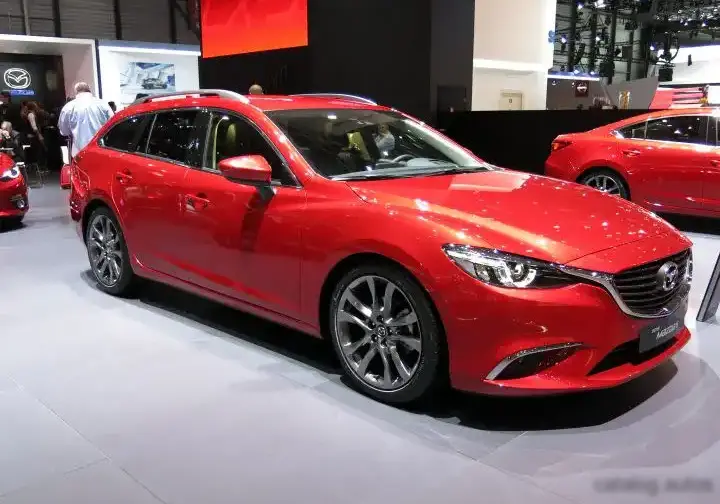
The Mazda 6 III Sport Combi, particularly the 2.2 SKYACTIV-D 150 hp variant, was introduced as part of the GJ series facelift in 2015. Building upon the success of the second-generation Mazda 6, the GJ series aimed to elevate the car’s premium feel and driving dynamics. The facelift brought subtle styling revisions, enhanced interior materials, and improvements to the SKYACTIV technology. This specific engine and transmission combination was targeted at buyers seeking a balance between fuel economy, reasonable performance, and a comfortable driving experience. It occupied a middle ground in the Mazda 6 Combi lineup, slotting below the more powerful 2.2L 175 hp version and above the lower-powered 2.0L petrol options.
Powertrain & Engine Architecture
The heart of this variant is the SHY4 2.2-liter four-cylinder diesel engine, a cornerstone of Mazda’s SKYACTIV-D technology. This engine features a high compression ratio of 14:1, achieved through optimized combustion chamber design and piston shape. The engine utilizes a twin-turbocharger setup – a small turbo for immediate response at low RPMs and a larger turbo for sustained power at higher speeds. An intercooler further enhances performance by cooling the intake air. Fuel is delivered via a common-rail direct injection system, ensuring precise fuel metering and efficient combustion. The 6-speed manual transmission was the standard offering, chosen for its efficiency and driver engagement. The i-ELOOP system, Mazda’s mild hybrid technology, recovers kinetic energy during deceleration and stores it in a capacitor, providing a small boost during acceleration and reducing the load on the alternator, further improving fuel economy.
Driving Characteristics
The 150 hp SKYACTIV-D engine, paired with the 6-speed manual transmission, provided a respectable, though not exhilarating, driving experience. Maximum torque of 380 Nm (280 lb-ft) was available from 1800-2600 rpm, providing good pulling power for everyday driving and overtaking maneuvers. The gear ratios were well-matched, allowing for relaxed cruising on the highway and sufficient acceleration in urban environments. Compared to the 175 hp version, the 150 hp model felt slightly less responsive, particularly at higher RPMs. However, the difference was often negligible for typical commuting and long-distance journeys. The manual transmission offered a precise and engaging shift feel, contributing to a more connected driving experience.
Equipment & Trim Levels
The 2.2 SKYACTIV-D 150 hp Combi typically came equipped with a solid base level of features. Standard equipment often included alloy wheels, air conditioning, a touchscreen infotainment system with Bluetooth connectivity, power windows and mirrors, and a comprehensive suite of safety features including ABS, ESP, and multiple airbags. Higher trim levels, such as ‘Sport’ or ‘Touring’, added features like leather upholstery, heated front seats, a sunroof, and advanced driver-assistance systems like lane departure warning and adaptive cruise control. Interior upholstery was generally cloth on the base models, with leather options available on higher trims. Dashboard configuration was consistent across the range, featuring a clean and modern design with intuitive controls.
Chassis & Braking
The Mazda 6 Combi utilized a front-wheel-drive layout with a MacPherson strut suspension at the front and a multi-link suspension at the rear. This setup provided a good balance between ride comfort and handling precision. The 150 hp variant, being a mid-range model, typically featured ventilated disc brakes at the front and solid disc brakes at the rear. The braking system was generally well-regarded for its stopping power and feel. Stabilizer bars were fitted to both the front and rear axles to reduce body roll during cornering. The suspension tuning was geared towards providing a comfortable ride without sacrificing handling agility.
Market Reception & Comparison
The Mazda 6 Combi 2.2 SKYACTIV-D 150 hp received generally positive reviews from automotive critics. It was praised for its fuel efficiency, comfortable ride, and well-equipped interior. Critics noted that while the performance wasn’t sporty, it was more than adequate for most drivers. Compared to the 175 hp version, the 150 hp model offered a slightly better fuel economy and a lower price point, making it an attractive option for budget-conscious buyers. Against competitors like the Ford Mondeo Estate, Volkswagen Passat Estate, and Peugeot 508 SW, the Mazda 6 Combi stood out for its stylish design and engaging driving dynamics.
Legacy
The SHY4 2.2 SKYACTIV-D engine has proven to be a relatively reliable powertrain, although, like any diesel engine, it requires regular maintenance, including oil changes and diesel particulate filter (DPF) regeneration. The i-ELOOP system has also demonstrated good long-term reliability. On the used car market, the Mazda 6 Combi 2.2 SKYACTIV-D 150 hp remains a popular choice, offering a compelling combination of practicality, fuel efficiency, and affordability. Its reputation for reliability and relatively low running costs contribute to its continued desirability among used car buyers. However, potential buyers should be aware of the importance of maintaining the DPF and ensuring regular servicing to prevent potential issues.