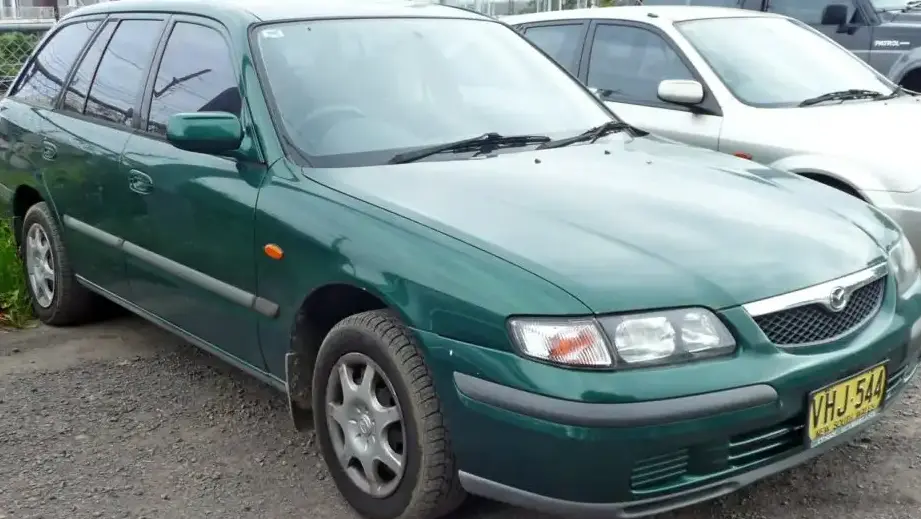
The Mazda 626 V Station Wagon, specifically the GF/GW generation produced between 1998 and 2000, represented Mazda’s entry into the competitive mid-size wagon segment. This variant, equipped with the 1.9-liter FPY3 engine producing 90 horsepower, served as the base engine option for the wagon body style in many European and Asian markets. While not a performance leader, it offered a practical and affordable family vehicle with a focus on fuel efficiency and everyday usability. It was positioned as the entry-level trim, appealing to buyers prioritizing value and space over outright speed. This generation of 626 was a significant departure from previous models, adopting a more modern and aerodynamic design.
Technical Specifications
| Brand | Mazda |
| Model | 626 |
| Generation | 626 V Station Wagon (GF,GW) |
| Type (Engine) | 1.9 (90 Hp) |
| Start of production | 1998 |
| End of production | 2000 |
| Powertrain Architecture | Internal Combustion engine |
| Body type | Station wagon (estate) |
| Seats | 5 |
| Doors | 5 |
| Fuel consumption (urban) | 10.4 l/100 km (22.6 US mpg) |
| Fuel consumption (extra urban) | 6.6 l/100 km (35.6 US mpg) |
| Fuel Type | Petrol (Gasoline) |
| Acceleration 0 – 100 km/h | 12.9 sec |
| Acceleration 0 – 62 mph | 12.9 sec |
| Acceleration 0 – 60 mph | 12.3 sec |
| Maximum speed | 178 km/h (110.6 mph) |
| Weight-to-power ratio | 14.2 kg/Hp |
| Weight-to-torque ratio | 8.8 kg/Nm |
| Power | 90 Hp @ 5000 rpm |
| Torque | 145 Nm @ 2500 rpm (106.95 lb.-ft. @ 2500 rpm) |
| Engine layout | Front, Transverse |
| Engine Model/Code | FPY3 |
| Engine displacement | 1840 cm3 (112.28 cu. in.) |
| Number of cylinders | 4 |
| Engine configuration | Inline |
| Cylinder Bore | 83 mm (3.27 in.) |
| Piston Stroke | 85 mm (3.35 in.) |
| Compression ratio | 9.6:1 |
| Number of valves per cylinder | 4 |
| Fuel injection system | Multi-port manifold injection |
| Engine aspiration | Naturally aspirated engine |
| Valvetrain | DOHC |
| Engine oil capacity | 3.5 l (3.7 US qt | 3.08 UK qt) |
| Coolant capacity | 7.5 l (7.93 US qt | 6.6 UK qt) |
| Kerb Weight | 1280 kg (2821.92 lbs.) |
| Max. weight | 1840 kg (4056.51 lbs.) |
| Max load | 560 kg (1234.59 lbs.) |
| Trunk (boot) space – minimum | 540 l (19.07 cu. ft.) |
| Trunk (boot) space – maximum | 1677 l (59.22 cu. ft.) |
| Fuel tank capacity | 64 l (16.91 US gal | 14.08 UK gal) |
| Length | 4660 mm (183.46 in.) |
| Width | 1710 mm (67.32 in.) |
| Height | 1515 mm (59.65 in.) |
| Wheelbase | 2670 mm (105.12 in.) |
| Front track | 1465 mm (57.68 in.) |
| Rear track | 1470 mm (57.87 in.) |
| Drivetrain Architecture | Front wheel drive |
| Number of gears | 5 |
| Gearbox type | Manual transmission |
| Front suspension | Spring Strut |
| Rear suspension | Wishbone |
| Front brakes | Ventilated discs |
| Rear brakes | Disc |
| Assisting systems | ABS (Anti-lock braking system) |
| Steering type | Steering rack and pinion |
| Power steering | Hydraulic Steering |
| Tires size | 185/65 R15 |
| Wheel rims size | 6J x 15 |
Powertrain & Engine Architecture
The heart of this 626 variant was the FPY3 engine, a 1.9-liter inline-four cylinder gasoline engine. This engine was part of Mazda’s F-series, known for its relatively simple and robust design. The FPY3 featured a multi-port fuel injection system, delivering fuel directly into the intake ports, and a double overhead camshaft (DOHC) valvetrain, optimizing airflow for improved efficiency. The 9.6:1 compression ratio was a compromise between performance and the ability to run on readily available fuel grades. The engine’s 90 horsepower output at 5000 rpm and 145 Nm (106.95 lb-ft) of torque at 2500 rpm were adequate for everyday driving but didn’t offer significant acceleration. The engine was paired with a 5-speed manual transmission, which was the standard offering for this trim level. The transmission was chosen for its durability and relatively simple maintenance requirements.
Driving Characteristics
The 1.9-liter engine and 5-speed manual transmission combination in the 626 V Station Wagon provided a predictable, if not exhilarating, driving experience. Acceleration was modest, taking approximately 12.9 seconds to reach 62 mph (100 km/h). The engine felt most comfortable in the mid-range, offering sufficient power for highway cruising and overtaking maneuvers, though it required downshifting for quicker responses. Compared to the higher-output 2.0-liter variants, this 1.9L model felt noticeably less powerful, especially when fully loaded with passengers and cargo. However, the lower power output translated to better fuel economy, making it a more economical choice for daily commuting. The suspension provided a comfortable ride, absorbing bumps and imperfections in the road effectively, though it wasn’t particularly sporty in handling.
Equipment & Trim Levels
The 1.9-liter 626 V Station Wagon typically came with a fairly basic level of equipment, reflecting its position as the entry-level trim. Standard features generally included power steering, central locking, electric front windows, and an AM/FM radio. Interior upholstery was typically cloth, and the dashboard featured a functional, if somewhat plain, design. Optional extras, depending on the market, could include air conditioning, alloy wheels, a sunroof, and upgraded audio systems. Safety features were relatively standard for the late 1990s, including ABS brakes and driver and passenger airbags.
Chassis & Braking
The 626 V Station Wagon utilized a front-wheel-drive layout with a MacPherson strut suspension in the front and a multi-link wishbone suspension in the rear. This suspension setup provided a good balance between ride comfort and handling. The braking system consisted of ventilated disc brakes on the front wheels and solid disc brakes on the rear wheels. ABS (Anti-lock Braking System) was standard, enhancing braking performance and stability, particularly on slippery surfaces. The chassis was designed to provide a stable and predictable driving experience, prioritizing comfort and practicality over sporty handling.
Market Reception & Comparison
The 1.9-liter 626 V Station Wagon was generally well-received as a practical and affordable family vehicle. Critics praised its spacious interior, comfortable ride, and good fuel economy. However, it was often criticized for its lack of power and somewhat uninspired styling. Compared to other trims in the 626 lineup, such as the 2.0-liter models, the 1.9L version offered a more economical option but at the expense of performance. It competed with other mid-size wagons from manufacturers like Ford, Volkswagen, and Toyota, offering a compelling value proposition for buyers seeking a reliable and spacious vehicle.
Legacy
The FPY3 engine, while not known for being particularly groundbreaking, proved to be a relatively reliable and durable powerplant. Properly maintained examples of the 1.9-liter 626 V Station Wagon can still be found on the road today, testament to its inherent robustness. In the used car market, these models are often sought after by buyers looking for an affordable and practical wagon. While not a collector’s item, the 626 V Station Wagon represents a solid and dependable vehicle from a period when Mazda was establishing itself as a major player in the global automotive market. The simplicity of the engine and transmission makes it relatively easy and inexpensive to maintain, contributing to its continued presence on the roads.