Technical Specifications
| Brand | Mazda |
| Model | 626 |
| Generation | 626 V Station Wagon (GF,GW) |
| Type (Engine) | 2.0 H.P. (136 Hp) |
| Start of production | 1998 |
| End of production | 2002 |
| Powertrain Architecture | Internal Combustion engine |
| Body type | Station wagon (estate) |
| Seats | 5 |
| Doors | 5 |
| Fuel consumption (urban) | 10.9 l/100 km (21.6 US mpg) |
| Fuel consumption (extra urban) | 6.7 l/100 km (35.1 US mpg) |
| Fuel Type | Petrol (Gasoline) |
| Acceleration 0 – 100 km/h | 10.5 sec |
| Acceleration 0 – 62 mph | 10.5 sec |
| Acceleration 0 – 60 mph | 10 sec |
| Maximum speed | 202 km/h (125.52 mph) |
| Weight-to-power ratio | 9.6 kg/Hp |
| Weight-to-torque ratio | 7.2 kg/Nm |
| Power | 136 Hp @ 5800 rpm |
| Torque | 181 Nm @ 4500 rpm (133.5 lb.-ft. @ 4500 rpm) |
| Engine layout | Front, Transverse |
| Engine Model/Code | FS2C |
| Engine displacement | 1991 cm3 (121.5 cu. in.) |
| Number of cylinders | 4 |
| Engine configuration | Inline |
| Cylinder Bore | 83 mm (3.27 in.) |
| Piston Stroke | 92 mm (3.62 in.) |
| Compression ratio | 9.7:1 |
| Number of valves per cylinder | 4 |
| Fuel injection system | Multi-port manifold injection |
| Engine aspiration | Naturally aspirated engine |
| Valvetrain | DOHC |
| Engine oil capacity | 3.5 l (3.7 US qt | 3.08 UK qt) |
| Coolant capacity | 7.5 l (7.93 US qt | 6.6 UK qt) |
| Kerb Weight | 1305 kg (2877.03 lbs.) |
| Max. weight | 1850 kg (4078.55 lbs.) |
| Max load | 545 kg (1201.52 lbs.) |
| Trunk (boot) space – minimum | 540 l (19.07 cu. ft.) |
| Trunk (boot) space – maximum | 1677 l (59.22 cu. ft.) |
| Fuel tank capacity | 64 l (16.91 US gal | 14.08 UK gal) |
| Length | 4660 mm (183.46 in.) |
| Width | 1710 mm (67.32 in.) |
| Height | 1515 mm (59.65 in.) |
| Wheelbase | 2670 mm (105.12 in.) |
| Front track | 1465 mm (57.68 in.) |
| Rear track | 1470 mm (57.87 in.) |
| Drivetrain Architecture | Front wheel drive |
| Number of gears | 5 gears, manual transmission |
| Front suspension | Spring Strut |
| Rear suspension | Wishbone |
| Front brakes | Ventilated discs |
| Rear brakes | Disc |
| Assisting systems | ABS (Anti-lock braking system) |
| Steering type | Steering rack and pinion |
| Power steering | Hydraulic Steering |
| Tires size | 195/60 R15 |
| Wheel rims size | 6J x 15 |
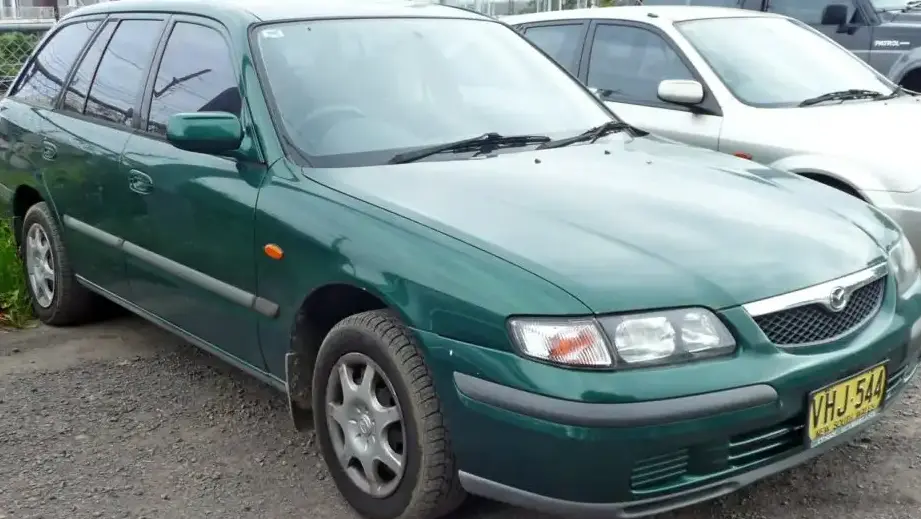
The Mazda 626 V Station Wagon (GF/GW) 2.0 H.P. (136 Hp) was produced from 1998 to 2002 as part of the third generation of the 626. This generation marked a shift towards a more modern and refined design, aiming to compete with established European and Japanese rivals. The wagon body style, popular in Europe and other markets, offered increased practicality and cargo capacity compared to the sedan version. The 2.0-liter engine and five-speed manual transmission combination was positioned as a mainstream offering, appealing to buyers who prioritized fuel economy and everyday usability over outright performance. It sat below the more powerful V6 options available in some markets, and above the smaller displacement engine choices.
Powertrain & Engine Architecture
The heart of this 626 variant is the FS2C engine, a 1.991-liter inline-four cylinder gasoline engine. This engine utilizes a multi-port fuel injection system, delivering fuel directly to each intake port for improved combustion efficiency. The engine features a double overhead camshaft (DOHC) valvetrain, operating four valves per cylinder, which contributes to enhanced breathing and power output. The FS2C engine is naturally aspirated, meaning it doesn’t rely on a turbocharger or supercharger for forced induction. The five-speed manual transmission was the standard offering for this trim, providing drivers with full control over gear selection. The transmission’s gear ratios were tuned for a balance of acceleration and fuel efficiency, with a relatively tall fifth gear for comfortable highway cruising. The engine code ‘FS’ designates a family of Mazda engines, while the ‘2C’ suffix denotes specific variations within that family.
Driving Characteristics
The 136 horsepower and 133.5 lb-ft of torque produced by the FS2C engine provided adequate, but not exhilarating, performance. Acceleration from 0-60 mph took around 10 seconds, making it competitive with other mid-size wagons of the era. The manual transmission allowed for precise gear changes, and the engine felt responsive within its optimal power band. Compared to the higher-output V6 versions, this 2.0-liter variant offered a more economical driving experience, with fuel consumption figures of around 21.6 mpg in the city and 35.1 mpg on the highway. The gear ratios were spaced to provide reasonable acceleration in each gear, but the engine lacked the low-end grunt of a turbocharged engine or the high-revving excitement of a V6. Handling was generally secure and predictable, thanks to the front-wheel-drive layout and well-tuned suspension.
Equipment & Trim Levels
The 2.0-liter 626 V Station Wagon typically came equipped with a reasonable level of standard features. These included power windows, power door locks, air conditioning, and an AM/FM stereo. Interior upholstery was typically cloth, with a relatively simple and functional dashboard layout. Optional extras included alloy wheels, a sunroof, and upgraded audio systems. Higher trim levels, if available in specific markets, might have added features such as leather upholstery, automatic climate control, and a CD changer. Safety features included dual front airbags and ABS (Anti-lock Braking System) as standard equipment.
Chassis & Braking
The 626 V Station Wagon utilized a front-wheel-drive layout with a MacPherson strut suspension in the front and a multi-link wishbone suspension in the rear. This suspension setup provided a comfortable ride quality while maintaining reasonable handling characteristics. The front brakes were ventilated discs, offering good stopping power, while the rear brakes were solid discs. The ABS system helped to prevent wheel lockup during hard braking, enhancing safety and control. Steering was rack-and-pinion with hydraulic power assistance, providing a light and responsive feel.
Market Reception & Comparison
The Mazda 626 V Station Wagon 2.0 H.P. was generally well-received by automotive critics as a practical and reliable family vehicle. It was praised for its spacious interior, comfortable ride, and reasonable fuel economy. However, some critics noted that the engine lacked the power and refinement of some of its rivals. Compared to other trims in the 626 lineup, the 2.0-liter variant offered a more affordable entry point, making it accessible to a wider range of buyers. It provided a good balance between performance, fuel efficiency, and price, appealing to those who didn’t require the extra power of the V6 models. Fuel economy was competitive with similar vehicles in its class, and reliability was generally considered to be good.
Legacy
The Mazda 626 V Station Wagon, including the 2.0 H.P. variant, has developed a reputation for reliability and durability. The FS2C engine, while not particularly powerful, is known for its longevity and relatively low maintenance costs. Today, these vehicles can be found in the used car market at affordable prices. While they may require some maintenance due to their age, they remain a viable option for those seeking a practical and reliable wagon. Parts availability is generally good, and the relatively simple mechanical design makes them relatively easy to repair. The 626 V Station Wagon represents a significant chapter in Mazda’s history, showcasing the company’s commitment to building well-rounded and dependable vehicles.