
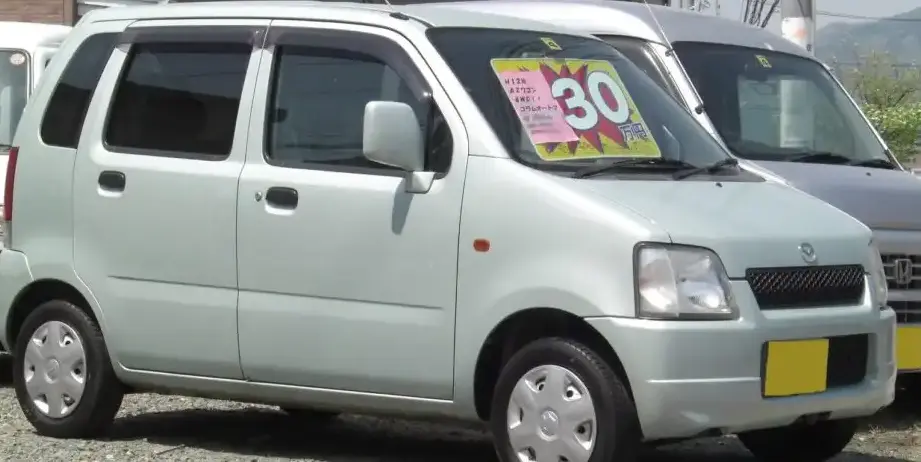
The Mazda Az-Wagon II 0.7 12V (55 hp) was a compact, entry-level minivan produced by Mazda between 1998 and 2000. Part of the second generation of the Az-Wagon (designated chassis code T200), this variant occupied the base trim level, offering affordable transportation within the Japanese Kei car class. While not officially sold in the United States, the Az-Wagon II represented Mazda’s attempt to capture a segment of the market prioritizing fuel efficiency and maneuverability in densely populated urban areas. This particular engine and transmission combination was designed for practicality and low running costs, rather than outright performance.
Technical Specifications
| Brand | Mazda |
| Model | Az-wagon |
| Generation | Az-wagon II |
| Type (Engine) | 0.7 12V (55 Hp) |
| Start of production | 1998 |
| End of production | 2000 |
| Powertrain Architecture | Internal Combustion engine |
| Body type | Minivan |
| Seats | 4 |
| Doors | 3/5 |
| Fuel consumption (urban) | 8 l/100 km (29.4 US mpg) |
| Fuel consumption (extra urban) | 4 l/100 km (58.8 US mpg) |
| Fuel Type | Petrol (Gasoline) |
| Maximum speed | 130 km/h (80.78 mph) |
| Weight-to-power ratio | 13.6 kg/Hp |
| Weight-to-torque ratio | 12.3 kg/Nm |
| Power | 55 Hp @ 6500 rpm |
| Power per litre | 83.7 Hp/l |
| Torque | 61 Nm @ 4000 rpm (44.99 lb.-ft. @ 4000 rpm) |
| Engine layout | Front, Transverse |
| Engine displacement | 657 cm3 (40.09 cu. in.) |
| Number of cylinders | 3 |
| Engine configuration | Inline |
| Cylinder Bore | 68 mm (2.68 in.) |
| Piston Stroke | 60.4 mm (2.38 in.) |
| Compression ratio | 10.5:1 |
| Number of valves per cylinder | 4 |
| Fuel injection system | Multi-port manifold injection |
| Engine aspiration | Naturally aspirated engine |
| Valvetrain | DOHC |
| Kerb Weight | 750 kg (1653.47 lbs.) |
| Fuel tank capacity | 30 l (7.93 US gal) |
| Length | 3395 mm (133.66 in.) |
| Width | 1475 mm (58.07 in.) |
| Height | 1690 mm (66.54 in.) |
| Wheelbase | 2360 mm (92.91 in.) |
| Front track | 1290 mm (50.79 in.) |
| Rear track | 1290 mm (50.79 in.) |
| Minimum turning circle | 8.4 m (27.56 ft.) |
| Drivetrain Architecture | Front wheel drive |
| Drive wheel | Front wheel drive |
| Number of gears | 5 gears, manual transmission |
| Front suspension | Spring Strut |
| Rear suspension | Coil spring |
| Front brakes | Disc |
| Rear brakes | Drum |
| Assisting systems | ABS (Anti-lock braking system) |
| Steering type | Steering rack and pinion |
| Tires size | 155/65 R13 |
Introduction
The Az-Wagon II, launched in 1998, represented a significant update to Mazda’s Kei car offering. Built on the T200 platform, it aimed to provide a more refined and practical experience compared to its predecessor. The 0.7 12V (55 hp) variant was the entry point to the range, designed for buyers prioritizing affordability and fuel economy. Available with both 3-door and 5-door configurations, it catered to individuals and small families needing a compact and easy-to-maneuver vehicle for urban commuting. This variant sat at the bottom of the Az-Wagon II lineup, below the more powerful turbocharged options.
Powertrain & Engine Architecture
At the heart of the Az-Wagon II 0.7 was the F6A engine, a 657cc inline-three cylinder petrol engine. This engine featured a double overhead camshaft (DOHC) valvetrain with four valves per cylinder, contributing to its relatively efficient operation for its displacement. The engine utilized a multi-port fuel injection system, ensuring precise fuel delivery. The 55 horsepower output was achieved at 6500 rpm, while peak torque of 61 Nm (45 lb-ft) arrived at 4000 rpm. This engine was paired with a standard five-speed manual transmission. The engine’s compact size and lightweight construction were key to the Az-Wagon’s overall efficiency and nimble handling. The F6A engine, while simple in design, was known for its reliability and ease of maintenance. It was a common engine in other Kei cars of the era, benefiting from economies of scale in production and parts availability.
Driving Characteristics
The 0.7-liter engine, coupled with the five-speed manual transmission, provided adequate, though not exhilarating, performance. Acceleration was modest, with a 0-60 mph time estimated to be around 15-17 seconds. The focus was on drivability and fuel efficiency rather than outright speed. The gear ratios were tuned for maximizing fuel economy, meaning the engine needed to be revved to achieve optimal performance. Compared to the slightly more powerful (and often turbocharged) variants available in the Az-Wagon II lineup, this 0.7L version felt noticeably slower, particularly when fully loaded or climbing hills. However, its light weight and compact dimensions made it surprisingly agile in city traffic. The steering was light and responsive, making parking and maneuvering in tight spaces easy. The suspension, while basic, provided a reasonably comfortable ride on typical urban roads.
Equipment & Trim Levels
The base 0.7 12V trim level of the Az-Wagon II was fairly basic, reflecting its position as the entry-level model. Standard features typically included power steering, a basic audio system, and cloth upholstery. Air conditioning was often an optional extra. Interior plastics were durable but utilitarian. The 5-door version offered greater practicality with easier access to the rear seats. Optional extras could include upgraded audio systems, alloy wheels, and color-coded bumpers. The dashboard layout was simple and functional, prioritizing ease of use over aesthetic appeal. The seats were designed for comfort during shorter commutes, rather than long-distance travel.
Chassis & Braking
The Az-Wagon II utilized a front-engine, front-wheel-drive layout. Suspension consisted of a MacPherson strut setup at the front and a coil spring arrangement at the rear. The relatively lightweight nature of the vehicle meant that the suspension could effectively manage bumps and imperfections in the road. Braking was handled by disc brakes at the front and drum brakes at the rear. An Anti-lock Braking System (ABS) was included as a standard safety feature. The steering employed a rack and pinion system, providing responsive and precise handling. The compact wheelbase contributed to the vehicle’s nimble handling characteristics.
Market Reception & Comparison
The Az-Wagon II 0.7 12V was well-received in Japan as an affordable and practical Kei car. Critics praised its fuel efficiency and maneuverability, making it ideal for navigating crowded city streets. However, its limited power output was a common criticism, particularly when compared to other Kei car options offering turbocharged engines. Compared to higher-spec Az-Wagon II models, such as those equipped with the 660cc turbocharged engine, the 0.7L version offered significantly less performance. The turbocharged models provided a much more spirited driving experience, but at the cost of increased fuel consumption and complexity. However, the 0.7L version benefited from lower running costs and a simpler mechanical layout, potentially leading to greater long-term reliability. It appealed to buyers who prioritized economy and practicality over performance.
Legacy
The Mazda Az-Wagon II 0.7 12V, while not a performance icon, remains a testament to Mazda’s commitment to producing efficient and practical vehicles. The F6A engine proved to be a reliable unit, and well-maintained examples continue to be found on the used car market today. Its simplicity and affordability make it an attractive option for those seeking a basic and economical mode of transportation. While its age means that parts availability may become a concern in the future, the Az-Wagon II 0.7 12V holds a place as a representative example of the Japanese Kei car segment and Mazda’s early efforts in the micro-minivan market. It represents a practical solution for urban mobility, prioritizing fuel efficiency and ease of use over outright performance.
