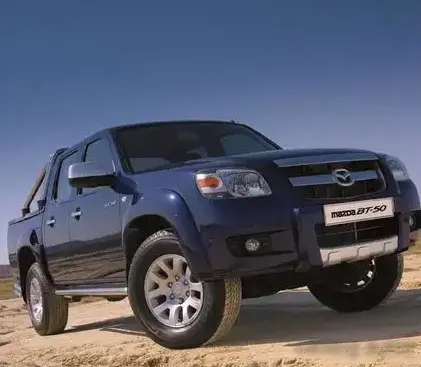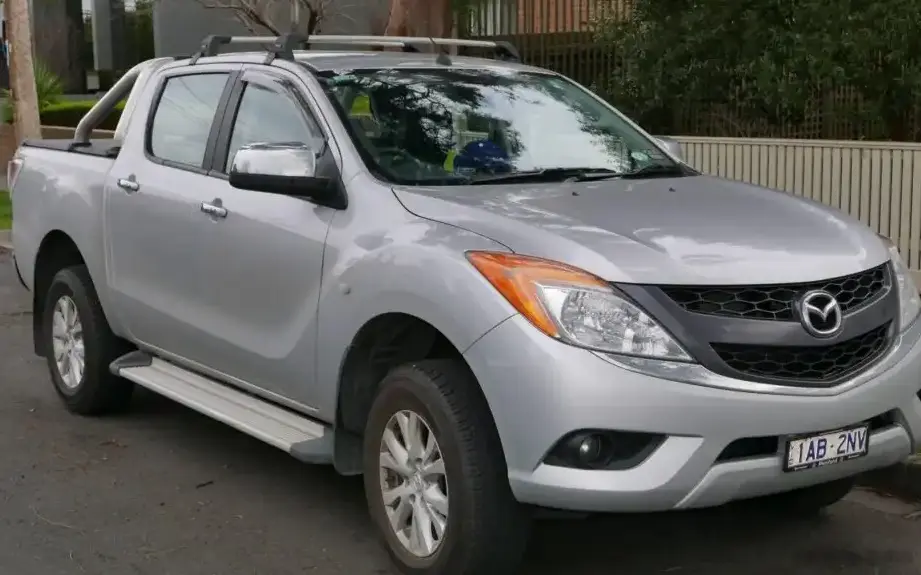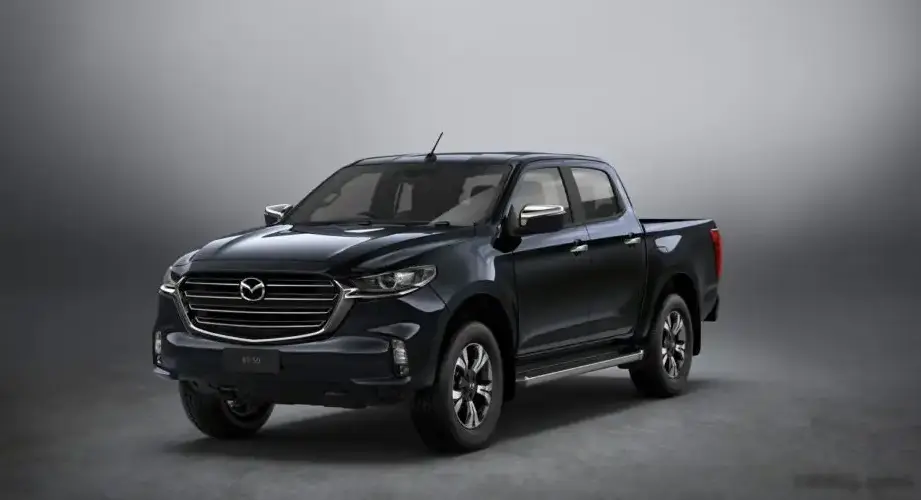
The Mazda BT-50 Dual Cab III 3.0d (190 Hp) 4×4 Automatic represents Mazda’s entry into the modern mid-size pickup truck market, launched in June 2020. This variant is a key component of the BT-50’s third generation (often referred to as the T6 platform), developed in collaboration with Isuzu – sharing significant mechanical underpinnings with the Isuzu D-Max. Positioned as a versatile workhorse and family vehicle, the 3.0d 4×4 Automatic aimed to balance capability, comfort, and fuel efficiency. It was primarily sold in markets outside of North America, including Australia, New Zealand, South Africa, and parts of Asia and Europe.
Technical Specifications
| Brand | Mazda |
| Model | BT-50 |
| Generation | BT-50 Dual Cab III |
| Type (Engine) | 3.0d (190 Hp) 4×4 Automatic |
| Start of production | June, 2020 |
| Powertrain Architecture | Internal Combustion engine |
| Body type | Pick-up |
| Seats | 5 |
| Doors | 4 |
| Fuel consumption (urban) | 9.8 l/100 km (24 US mpg, 28.8 UK mpg, 10.2 km/l) |
| Fuel consumption (extra urban) | 6.9 l/100 km (34.1 US mpg, 40.9 UK mpg, 14.5 km/l) |
| Fuel consumption (combined) | 8.0 l/100 km (29.4 US mpg, 35.3 UK mpg, 12.5 km/l) |
| Fuel Type | Diesel |
| Emission standard | Euro 5 |
| Weight-to-power ratio | 10.6 kg/Hp, 94.5 Hp/tonne |
| Weight-to-torque ratio | 4.5 kg/Nm, 223.9 Nm/tonne |
| Power | 190 Hp @ 3600 rpm |
| Power per litre | 63.4 Hp/l |
| Torque | 450 Nm @ 1600-2600 rpm (331.9 lb.-ft. @ 1600-2600 rpm) |
| Engine layout | Front, Longitudinal |
| Engine Model/Code | 4JJ3 |
| Engine displacement | 2999 cm3 (183.01 cu. in.) |
| Number of cylinders | 4 |
| Engine configuration | Inline |
| Cylinder Bore | 95.4 mm (3.76 in.) |
| Piston Stroke | 104.9 mm (4.13 in.) |
| Compression ratio | 16.3:1 |
| Number of valves per cylinder | 4 |
| Fuel injection system | Diesel Commonrail |
| Engine aspiration | Turbocharger, Intercooler |
| Valvetrain | DOHC |
| Engine oil capacity | 7.5 l (7.93 US qt | 6.6 UK qt) |
| Coolant capacity | 10.5 l (11.1 US qt | 9.24 UK qt) |
| Kerb Weight | 2010-2035 kg (4431.29 – 4486.41 lbs.) |
| Max. weight | 3100 kg (6834.33 lbs.) |
| Max load | 1065-1090 kg (2347.92 – 2403.04 lbs.) |
| Fuel tank capacity | 76 l (20.08 US gal | 16.72 UK gal) |
| Permitted trailer load with brakes (12%) | 3500 kg (7716.18 lbs.) |
| Permitted trailer load without brakes | 750 kg (1653.47 lbs.) |
| Permitted towbar download | 350 kg (771.62 lbs.) |
| Length | 5280 mm (207.87 in.) |
| Width | 1870 mm (73.62 in.) |
| Height | 1785-1790 mm (70.28 – 70.47 in.) |
| Wheelbase | 3125 mm (123.03 in.) |
| Front track | 1570 mm (61.81 in.) |
| Rear track | 1570 mm (61.81 in.) |
| Front overhang | 905 mm (35.63 in.) |
| Rear overhang | 1250 mm (49.21 in.) |
| Ride height (ground clearance) | 235-240 mm (9.25 – 9.45 in.) |
| Minimum turning circle | 12.5 m (41.01 ft.) |
| Approach angle | 30.0-30.4° |
| Departure angle | 23.9-24.2° |
| Ramp-over angle | 23.3-23.8° |
| Wading depth | 800 mm (31.5 in.) |
| Drivetrain Architecture | All wheel drive (4×4). ICE drives rear wheels, front wheels engaged via clutch. |
| Drive wheel | All wheel drive (4×4) |
| Number of gears | 6 |
| Gearbox type | Automatic transmission |
| Front suspension | Double wishbone |
| Rear suspension | Leaf spring |
| Front brakes | Ventilated discs, 320 mm |
| Rear brakes | Drum, 295 mm |
| Assisting systems | ABS (Anti-lock braking system) |
| Steering type | Steering rack and pinion |
| Power steering | Electric |
| Tires size | 255/65 R17; 265/60 R18 |
| Wheel rims size | 7.0J x 17; 7.5J x 18 |
INTRODUCTION
The Mazda BT-50 Dual Cab III 3.0d 4×4 Automatic, introduced in 2020, marked a significant shift for Mazda’s pickup truck offering. This generation moved away from the previous Ford-based platform to a collaboration with Isuzu, resulting in a vehicle sharing its core structure and mechanicals with the Isuzu D-Max. The “Dual Cab” designation indicates a four-door configuration with seating for five passengers, making it suitable for both commercial and family use. The 3.0d variant, powered by a 2.999-liter turbocharged diesel engine and paired with a six-speed automatic transmission, was a popular choice for buyers seeking a balance between performance, fuel economy, and ease of driving.
Powertrain & Engine Architecture
At the heart of the BT-50 3.0d 4×4 Automatic lies the Isuzu-sourced 4JJ3-TC engine, a 2.999-liter (183.01 cubic inches) inline-four cylinder diesel. This engine utilizes a common-rail direct injection system, delivering fuel at extremely high pressure for optimized combustion. A variable geometry turbocharger (VGT) with an intercooler further enhances performance by increasing air intake and reducing intake temperatures. The engine produces 190 horsepower at 3600 rpm and a substantial 450 Nm (331.9 lb.-ft.) of torque between 1600 and 2600 rpm, providing ample pulling power for towing and hauling. The six-speed automatic transmission, also sourced from Isuzu, is designed to handle the engine’s torque output and provide smooth, efficient gear changes. The transmission features a torque converter for smooth launches and a range of gear ratios optimized for both on-road cruising and off-road capability.
Driving Characteristics
The BT-50 3.0d 4×4 Automatic delivers a driving experience focused on practicality and usability. While not a performance-oriented pickup, the engine’s torque output provides strong acceleration, particularly in the lower and mid-range. The automatic transmission shifts smoothly, making it a comfortable choice for daily driving and long journeys. Compared to the manual transmission versions, the automatic offers greater convenience, especially in stop-and-go traffic. However, the automatic does slightly diminish fuel economy and responsiveness. The 4×4 system, selectable via a rotary dial, allows drivers to switch between two-wheel drive (2H), four-wheel drive high (4H), and four-wheel drive low (4L) depending on the terrain and driving conditions. The leaf spring rear suspension, while robust, can result in a slightly firmer ride when unladen compared to coil-sprung alternatives found in some competitors.
Equipment & Trim Levels
The BT-50 Dual Cab III 3.0d 4×4 Automatic typically came well-equipped, though specific features varied depending on the market and optional packages. Standard equipment generally included air conditioning, power windows and locks, a touchscreen infotainment system with Bluetooth connectivity, and a rearview camera. Higher trim levels added features such as leather upholstery, heated front seats, a premium sound system, and advanced driver-assistance systems (ADAS) like lane departure warning and automatic emergency braking. Exterior features often included alloy wheels, side steps, and a bed liner. The interior design prioritized durability and functionality, with hard-wearing materials and a straightforward layout.
Chassis & Braking
The BT-50’s chassis is a robust ladder-frame construction, providing a solid foundation for both on-road and off-road driving. The front suspension utilizes a double wishbone setup, offering improved ride comfort and handling compared to older designs. The rear suspension employs leaf springs, chosen for their load-carrying capacity and durability. Braking duties are handled by ventilated discs on the front wheels and drum brakes on the rear. An Anti-lock Braking System (ABS) is standard, enhancing safety by preventing wheel lockup during hard braking. The steering system is a rack-and-pinion setup with electric power assistance, providing precise and responsive steering feel.
Market Reception & Comparison
The BT-50 Dual Cab III 3.0d 4×4 Automatic was generally well-received by automotive critics, praised for its robust build quality, capable engine, and comfortable interior. Compared to its key rivals, such as the Toyota Hilux, Ford Ranger, and Nissan Navara, the BT-50 offered a competitive package, often at a slightly lower price point. Fuel economy was considered respectable, though not class-leading. Reliability proved to be a strong point, benefiting from Isuzu’s reputation for building durable diesel engines. Some critics noted that the interior design was less refined than some competitors, and the ride quality could be firm when unladen.
Legacy
The Mazda BT-50 Dual Cab III 3.0d 4×4 Automatic has established itself as a reliable and capable workhorse in the used car market. The 4JJ3 engine is known for its longevity and relatively low maintenance costs. While not as popular as some of its competitors, the BT-50 offers a compelling alternative for buyers seeking a durable and practical pickup truck. Its collaborative development with Isuzu has resulted in a vehicle that benefits from both Mazda’s design expertise and Isuzu’s engineering prowess, ensuring its continued relevance in the mid-size pickup segment.