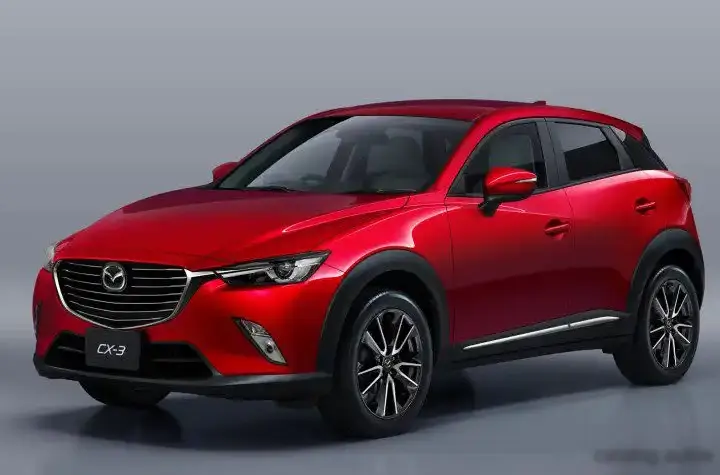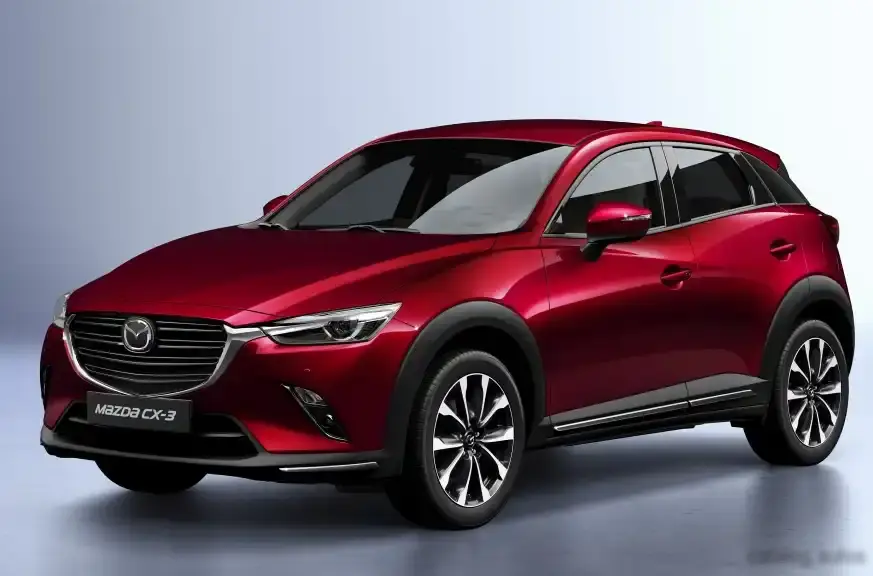
The Mazda CX-3 (facelift, introduced in 2018) 1.8 SKYACTIV-D variant, producing 115 horsepower, represented a key offering in Mazda’s compact crossover lineup, particularly in European and Asian markets. Positioned as a fuel-efficient and relatively affordable entry point into the CX-3 range, it catered to buyers prioritizing economy and practicality over outright performance. This facelift brought styling updates and refinements to the original CX-3, which debuted in 2015, building upon the success of Mazda’s “KODO – Soul of Motion” design language. The 2018 update aimed to enhance the vehicle’s appeal and competitiveness in a growing segment.
Technical Specifications
| Brand | Mazda |
| Model | CX-3 |
| Generation | CX-3 (facelift 2018) |
| Type (Engine) | 1.8 SKYACTIV-D (115 Hp) |
| Start of production | 2018 |
| Powertrain Architecture | Internal Combustion engine |
| Body type | SUV |
| Seats | 5 |
| Doors | 5 |
| Fuel consumption (urban) | 4.8 l/100 km (49 US mpg, 58.9 UK mpg, 20.8 km/l) |
| Fuel consumption (extra urban) | 4.1 l/100 km (57.4 US mpg, 68.9 UK mpg, 24.4 km/l) |
| Fuel consumption (combined) | 4.4 l/100 km (53.5 US mpg, 64.2 UK mpg, 22.7 km/l) |
| CO2 emissions | 114 g/km |
| Fuel Type | Diesel |
| Acceleration 0 – 100 km/h | 9.9 sec |
| Acceleration 0 – 62 mph | 9.9 sec |
| Acceleration 0 – 60 mph | 9.4 sec |
| Maximum speed | 184 km/h (114.33 mph) |
| Emission standard | Euro 6 |
| Weight-to-power ratio | 10.8 kg/Hp, 92.5 Hp/tonne |
| Weight-to-torque ratio | 4.6 kg/Nm, 217.2 Nm/tonne |
| Power | 115 Hp @ 4000 rpm |
| Power per litre | 65.4 Hp/l |
| Torque | 270 Nm @ 1600-2600 rpm (199.14 lb.-ft. @ 1600-2600 rpm) |
| Engine layout | Front, Transverse |
| Engine Model/Code | S8Y1 |
| Engine displacement | 1759 cm3 (107.34 cu. in.) |
| Number of cylinders | 4 |
| Engine configuration | Inline |
| Cylinder Bore | 79 mm (3.11 in.) |
| Piston Stroke | 89.7 mm (3.53 in.) |
| Compression ratio | 14.8:1 |
| Number of valves per cylinder | 4 |
| Fuel injection system | Diesel Commonrail |
| Engine aspiration | Turbocharger, Intercooler |
| Engine oil capacity | 5.1 l (5.39 US qt | 4.49 UK qt) |
| Coolant | 6.6 l (6.97 US qt | 5.81 UK qt) |
| Kerb Weight | 1243-1295 kg (2740.35 – 2854.99 lbs.) |
| Max. weight | 1755 kg (3869.11 lbs.) |
| Max load | 460-512 kg (1014.13 – 1128.77 lbs.) |
| Trunk (boot) space – minimum | 350 l (12.36 cu. ft.) |
| Trunk (boot) space – maximum | 1260 l (44.5 cu. ft.) |
| Fuel tank capacity | 48 l (12.68 US gal | 10.56 UK gal) |
| Max. roof load | 50 kg (110.23 lbs.) |
| Permitted trailer load with brakes (8%) | 1200 kg (2645.55 lbs.) |
| Permitted trailer load with brakes (12%) | 1200 kg (2645.55 lbs.) |
| Permitted trailer load without brakes | 655 kg (1444.03 lbs.) |
| Permitted towbar download | 75 kg (165.35 lbs.) |
| Length | 4275 mm (168.31 in.) |
| Width | 1765 mm (69.49 in.) |
| Height | 1535 mm (60.43 in.) |
| Wheelbase | 2570 mm (101.18 in.) |
| Front track | 1523 mm (59.96 in.) |
| Rear (Back) track | 1521 mm (59.88 in.) |
| Ride height (ground clearance) | 155 mm (6.1 in.) |
| Minimum turning circle (turning diameter) | 10.6 m (34.78 ft.) |
| Drivetrain Architecture | The Internal combustion engine (ICE) drives the front wheels of the vehicle. |
| Drive wheel | Front wheel drive |
| Number of gears and type of gearbox | 6 gears, manual transmission |
| Front brakes | Ventilated discs |
| Rear brakes | Ventilated discs |
| Assisting systems | ABS (Anti-lock braking system) |
| Steering type | Steering rack and pinion |
| Power steering | Electric Steering |
INTRODUCTION
The 2018 Mazda CX-3 1.8 SKYACTIV-D 115 hp model was a significant variant within the second generation (facelift) of the CX-3. Introduced as part of a broader refresh, this version aimed to provide a balance between fuel efficiency, reasonable performance, and affordability. Built on the Mazda’s 1HX0/A3 platform, shared with models like the Mazda3, the CX-3 sought to offer a more stylish and engaging driving experience than many of its competitors in the subcompact SUV segment. This particular diesel engine and manual transmission combination was especially popular in European markets where diesel fuel was more prevalent and tax incentives favored lower CO2 emissions.
Powertrain & Engine Architecture
At the heart of the CX-3 1.8 SKYACTIV-D lies Mazda’s S8Y1 engine, a 1.8-liter inline-four cylinder diesel. This engine is a key component of Mazda’s SKYACTIV technology, designed to maximize efficiency and reduce emissions. The S8Y1 features a high compression ratio of 14.8:1, contributing to its fuel economy. It utilizes a common-rail direct injection system, delivering fuel directly into the combustion chamber at extremely high pressure for optimized combustion. A turbocharger with an intercooler further enhances performance by forcing more air into the engine. The engine produces 115 horsepower at 4000 rpm and 270 Nm (199 lb-ft) of torque between 1600 and 2600 rpm. This torque band provides good low-end responsiveness, making it suitable for everyday driving. The engine is transversely mounted in the front of the vehicle. The 6-speed manual transmission was the standard offering for this variant, providing drivers with full control over gear selection.
Driving Characteristics
The CX-3 1.8 SKYACTIV-D with a manual transmission delivers a driving experience focused on efficiency and usability. While not a performance-oriented model, the 115 hp engine and 270 Nm of torque provide adequate power for most driving situations. Acceleration from 0 to 100 km/h takes approximately 9.9 seconds. The manual gearbox allows for precise control, and the engine’s torque band makes it easy to maintain speed on highways and navigate city streets. Compared to higher-output versions of the CX-3, such as those with the 2.0-liter gasoline engine, this diesel variant prioritizes fuel economy over outright speed. The gear ratios are tuned for efficiency, meaning the engine doesn’t rev as high as in the petrol models. This results in a more relaxed driving experience, but it also means that overtaking maneuvers require more planning.
Equipment & Trim Levels
The 1.8 SKYACTIV-D variant typically came with a respectable level of standard equipment. Base models included features like air conditioning, power windows, power mirrors, a basic audio system with USB connectivity, and a suite of safety features including ABS, stability control, and multiple airbags. Higher trim levels, such as Sport or Touring, added features like alloy wheels, a touchscreen infotainment system with navigation, automatic climate control, rear parking sensors, and a rearview camera. Interior upholstery was typically cloth, with options for leather or partial leather in higher trims. The dashboard layout was clean and modern, with a focus on driver ergonomics.
Chassis & Braking
The CX-3’s chassis is designed to provide a comfortable yet engaging driving experience. It utilizes a MacPherson strut front suspension and a torsion beam rear suspension. The front brakes are ventilated discs, while the rear brakes are also ventilated discs, providing adequate stopping power for the vehicle’s weight. The electric power steering system offers precise and responsive handling. Stabilizer bars are fitted to both the front and rear axles to reduce body roll during cornering. The suspension tuning is geared towards comfort, but it still provides a reasonably controlled ride.
Market Reception & Comparison
The Mazda CX-3 1.8 SKYACTIV-D was generally well-received by automotive critics, particularly for its fuel efficiency and stylish design. Reviewers praised the engine’s torque and responsiveness, as well as the car’s overall handling. However, some critics noted that the engine could be a bit noisy under heavy acceleration. Compared to the gasoline-powered CX-3 variants, the diesel model offered significantly better fuel economy, making it an attractive option for drivers who cover long distances. It also compared favorably to competitors like the Nissan Juke and Peugeot 2008 in terms of driving dynamics and interior quality. The diesel’s higher initial cost was often offset by its lower running costs.
Legacy
The Mazda CX-3 1.8 SKYACTIV-D has proven to be a reliable and durable powertrain. The SKYACTIV-D engines, in general, have a good reputation for longevity, provided they are properly maintained. Common maintenance items include regular oil changes, filter replacements, and timing chain inspections. On the used car market, these models continue to be sought after by buyers looking for a fuel-efficient and stylish compact SUV. While diesel engines have faced increased scrutiny in recent years due to emissions concerns, the CX-3’s relatively clean diesel technology and adherence to Euro 6 standards have helped maintain its appeal. The 1.8 SKYACTIV-D variant remains a viable option for those seeking a practical and economical crossover.