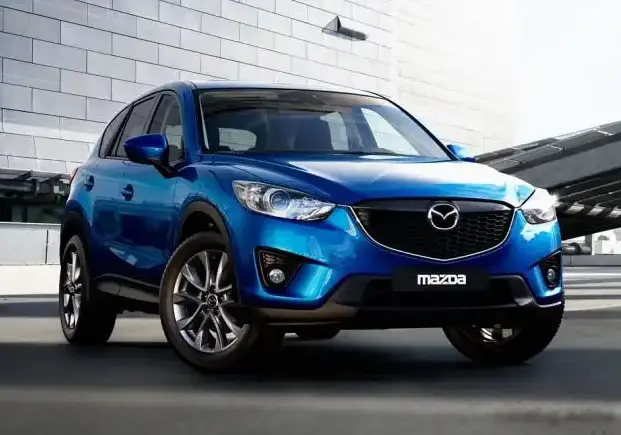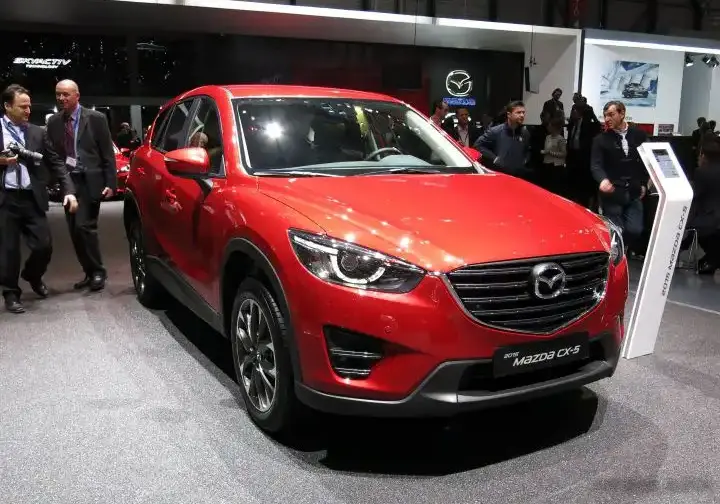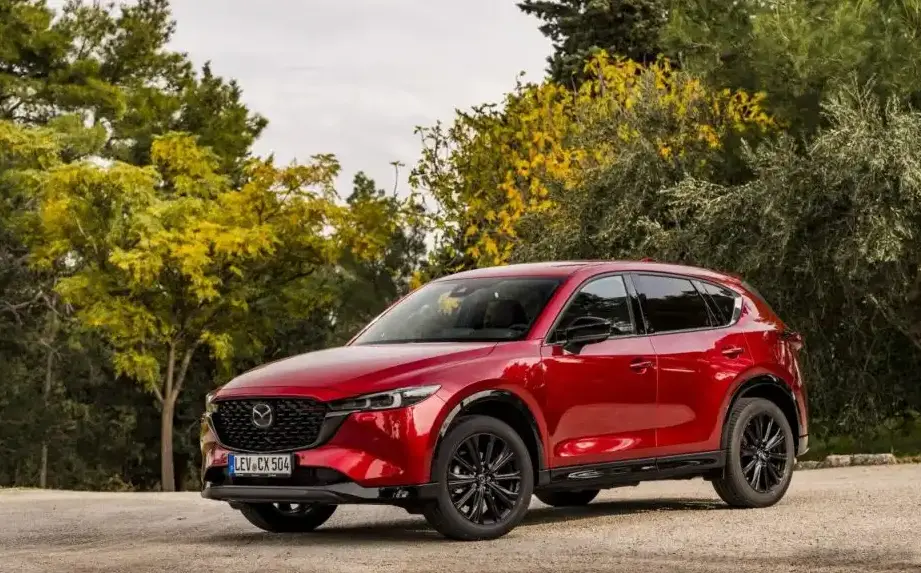
The Mazda CX-5 II (facelift 2021) 2.0 e-SKYACTIV G (165 Hp) Mild Hybrid Automatic represents a key variant within the second generation of Mazda’s popular compact SUV. Introduced in November 2022, this model aimed to balance fuel efficiency with everyday usability, slotting into the CX-5 lineup as an entry-level to mid-range option. It builds upon the foundation of the KF series CX-5, which debuted in 2017, and incorporates Mazda’s Skyactiv technology suite, including a mild hybrid system for improved real-world economy. This version primarily targeted the European and Asian markets, where fuel costs and emissions regulations are particularly stringent, though it was also available in select other regions.
Technical Specifications
| Brand | Mazda |
| Model | CX-5 |
| Generation | CX-5 II (facelift 2021) |
| Type (Engine) | 2.0 e-SKYACTIV G (165 Hp) Mild Hybrid Automatic |
| Start of production | November, 2022 |
| Powertrain Architecture | MHEV (Mild Hybrid Electric Vehicle) |
| Body type | SUV |
| Seats | 5 |
| Doors | 5 |
| Fuel consumption at Low speed (WLTP) | 8.6-8.7 l/100 km (27.4 – 27 US mpg, 32.8 – 32.5 UK mpg, 11.6 – 11.5 km/l) |
| Fuel consumption at Medium speed (WLTP) | 6.5-6.6 l/100 km (36.2 – 35.6 US mpg, 43.5 – 42.8 UK mpg, 15.4 – 15.2 km/l) |
| Fuel consumption at high speed (WLTP) | 5.9 l/100 km (39.9 US mpg, 47.9 UK mpg, 16.9 km/l) |
| Fuel consumption at very high speed (WLTP) | 7.3 l/100 km (32.2 US mpg, 38.7 UK mpg, 13.7 km/l) |
| Combined fuel consumption (WLTP) | 6.9 l/100 km (34.1 US mpg, 40.9 UK mpg, 14.5 km/l) |
| CO2 emissions (WLTP) | 155-156 g/km |
| Fuel Type | Petrol (Gasoline) |
| Acceleration 0 – 100 km/h | 10.2 sec |
| Acceleration 0 – 62 mph | 10.2 sec |
| Acceleration 0 – 60 mph | 9.7 sec |
| Maximum speed | 192 km/h (119.3 mph) |
| Emission standard | Euro 6d |
| Weight-to-power ratio | 9.5 kg/Hp, 105.6 Hp/tonne |
| Weight-to-torque ratio | 7.3 kg/Nm, 136.3 Nm/tonne |
| Battery voltage | 24 V |
| Battery technology | Lithium-ion (Li-Ion) |
| Power | 165 Hp @ 6000 rpm |
| Power per litre | 82.6 Hp/l |
| Torque | 213 Nm @ 4000 rpm (157.1 lb.-ft. @ 4000 rpm) |
| Engine layout | Front, Transverse |
| Engine Model/Code | PE |
| Engine displacement | 1998 cm3 (121.93 cu. in.) |
| Number of cylinders | 4 |
| Engine configuration | Inline |
| Cylinder Bore | 83.5 mm (3.29 in.) |
| Piston Stroke | 91.2 mm (3.59 in.) |
| Compression ratio | 13.5:1 |
| Number of valves per cylinder | 4 |
| Fuel injection system | Direct injection |
| Engine aspiration | Naturally aspirated engine |
| Valvetrain | DOHC |
| Engine oil capacity | 4.2 l (4.44 US qt | 3.7 UK qt) |
| Coolant | 7.1 l (7.5 US qt | 6.25 UK qt) |
| Kerb Weight | 1563-1623 kg (3445.83 – 3578.1 lbs.) |
| Max. weight | 2105 kg (4640.73 lbs.) |
| Max load | 482-542 kg (1062.63 – 1194.91 lbs.) |
| Trunk (boot) space – minimum | 522 l (18.43 cu. ft.) |
| Trunk (boot) space – maximum | 1638 l (57.85 cu. ft.) |
| Fuel tank capacity | 56 l (14.79 US gal | 12.32 UK gal) |
| Max. roof load | 75 kg (165.35 lbs.) |
| Permitted trailer load with brakes (12%) | 2000 kg (4409.25 lbs.) |
| Length | 4575 mm (180.12 in.) |
| Width | 1845 mm (72.64 in.) |
| Width including mirrors | 2115 mm (83.27 in.) |
| Height | 1675-1680 mm (65.94 – 66.14 in.) |
| Wheelbase | 2700 mm (106.3 in.) |
| Front track | 1595 mm (62.8 in.) |
| Rear (Back) track | 1595 mm (62.8 in.) |
| Ride height (ground clearance) | 192-200 mm (7.56 – 7.87 in.) |
| Minimum turning circle (turning diameter) | 11.9 m (39.04 ft.) |
| Drivetrain Architecture | ICE and electric motor drive the front wheels |
| Drive wheel | Front wheel drive |
| Number of gears and type of gearbox | 6 gears, automatic transmission |
| Front suspension | Independent type McPherson |
| Rear suspension | Independent multi-link suspension |
| Front brakes | Ventilated discs, 297 mm |
| Rear brakes | Disc, 303 mm |
| Assisting systems | ABS (Anti-lock braking system) |
| Steering type | Steering rack and pinion |
| Power steering | Electric Steering |
| Tires size | 225/65 R17; 225/55 R19 |
| Wheel rims size | 17; 19 |
Powertrain & Engine Architecture
At the heart of the CX-5 2.0 e-SKYACTIV G lies Mazda’s PE engine, a 1.998-liter inline-four cylinder gasoline engine. This engine is characterized by its high compression ratio of 13.5:1, achieved through careful engineering and optimized combustion chamber design. It utilizes direct injection, enhancing fuel atomization and improving efficiency. The engine employs a DOHC (Dual Overhead Camshaft) valvetrain, contributing to precise valve control and optimized breathing. The mild hybrid system consists of a 24V lithium-ion battery and an integrated starter generator (ISG). The ISG assists the engine during acceleration, providing a small power boost and reducing load, and also enables smoother start-stop functionality. This system doesn’t allow for electric-only driving, but it significantly improves fuel economy in urban conditions. The engine is paired with a six-speed automatic transmission, tuned for smooth shifts and efficient operation.
Driving Characteristics
The 165 hp and 213 Nm (157 lb-ft) of torque delivered by this powertrain configuration results in a comfortable, rather than sporty, driving experience. Acceleration from 0-60 mph takes around 9.7 seconds, and 0-100 km/h in 10.2 seconds. Compared to higher-output CX-5 variants, such as those equipped with the 2.5-liter engine, this version feels less eager to accelerate. The automatic transmission is well-programmed, offering smooth gear changes, but it can sometimes feel hesitant during quick overtaking maneuvers. The mild hybrid system provides a subtle boost during initial acceleration, but its impact is not dramatic. Overall, the driving experience is geared towards refinement and fuel efficiency, making it well-suited for daily commuting and long-distance cruising.
Equipment & Trim Levels
The 2.0 e-SKYACTIV G Mild Hybrid Automatic typically came equipped with a respectable level of standard features. These generally included Mazda’s MZD Connect infotainment system with a 8-inch display screen, Bluetooth connectivity, and smartphone integration (Apple CarPlay and Android Auto). Safety features such as ABS, traction control, stability control, and multiple airbags were standard. Higher trim levels offered additional features like leather upholstery, a premium sound system, a sunroof, and advanced driver-assistance systems (ADAS) such as adaptive cruise control, lane departure warning, and blind-spot monitoring. Interior upholstery was typically cloth on base models, with leather options available on higher trims. Dashboard configuration was consistent across the range, featuring a clean and modern design.
Chassis & Braking
The CX-5 II utilizes a McPherson strut front suspension and a multi-link rear suspension, providing a comfortable and controlled ride. The suspension tuning is geared towards balancing ride comfort with handling stability. Front brakes are ventilated discs measuring 297mm, while rear brakes are solid discs measuring 303mm. ABS (Anti-lock Braking System) is standard, ensuring effective braking performance in various conditions. Stabilizer bars are fitted to both the front and rear axles, reducing body roll during cornering. The chassis is designed to provide a stable and predictable driving experience, prioritizing comfort and safety over outright sportiness.
Market Reception & Comparison
The Mazda CX-5 2.0 e-SKYACTIV G Mild Hybrid Automatic was generally well-received by automotive critics. It was praised for its fuel efficiency, comfortable ride, and well-appointed interior. However, some reviewers noted that the engine lacked the punch of higher-output alternatives. Compared to the 2.5-liter CX-5, this variant offered lower running costs but sacrificed some performance. Against competitors like the Nissan Qashqai and Hyundai Tucson, the CX-5 stood out for its refined driving experience and premium interior quality. Fuel economy figures of around 6.9 l/100 km (34.1 US mpg) were competitive within its class.
Legacy
The PE engine, while not known for any major inherent flaws, benefits from Mazda’s reputation for reliability. The mild hybrid system has also proven to be relatively robust. In the used car market, the CX-5 2.0 e-SKYACTIV G Mild Hybrid Automatic represents a sensible choice for buyers seeking a fuel-efficient and reliable compact SUV. Regular maintenance, including oil changes and adherence to Mazda’s recommended service intervals, is crucial for ensuring long-term reliability. The combination of Mazda’s Skyactiv technology and the well-engineered automatic transmission contribute to the vehicle’s overall durability and longevity.