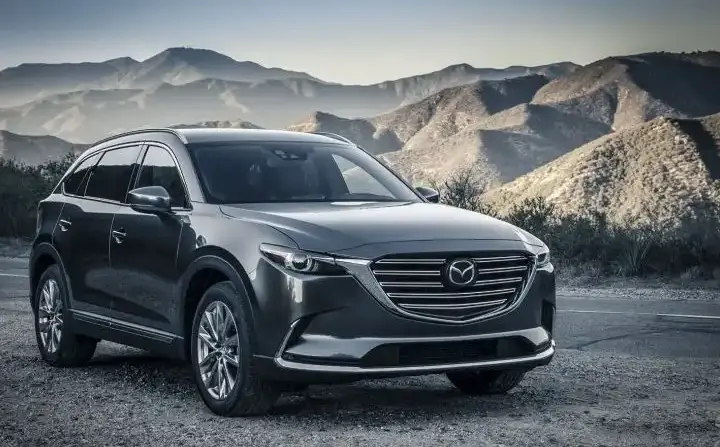
The Mazda CX-9 II, produced from 2016 to 2023, represented a significant evolution for Mazda’s three-row crossover SUV. The 2.5 SKYACTIV-G variant, equipped with a 250 horsepower engine and an automatic transmission, was a mainstay of the lineup throughout its production run. This version aimed to balance performance, fuel efficiency, and family-friendly practicality within the mid-size SUV segment. It served as a key offering in the North American market, where three-row SUVs are particularly popular, and competed with vehicles like the Honda Pilot, Toyota Highlander, and Ford Explorer.
Technical Specifications
| Brand | Mazda |
| Model | CX-9 |
| Generation | CX-9 II |
| Type (Engine) | 2.5 SKYACTIV-G (250 Hp) Automatic |
| Start of production | 2016 |
| End of production | 2023 |
| Powertrain Architecture | Internal Combustion engine |
| Body type | SUV |
| Seats | 7 |
| Doors | 5 |
| Fuel consumption (urban) | 10.6 l/100 km (22.2 US mpg) |
| Fuel consumption (extra urban) | 8.4 l/100 km (28 US mpg) |
| Fuel Type | Petrol (Gasoline) |
| Weight-to-power ratio | 7.3 kg/Hp |
| Weight-to-torque ratio | 5.9 kg/Nm |
| Power | 250 Hp @ 5000 rpm |
| Power per litre | 100.5 Hp/l |
| Torque | 310 Nm @ 2000 rpm (228.64 lb.-ft. @ 2000 rpm) |
| Engine layout | Front, Transverse |
| Engine Model/Code | PYZ4 |
| Engine displacement | 2488 cm3 (151.83 cu. in.) |
| Number of cylinders | 4 |
| Engine configuration | Inline |
| Cylinder Bore | 89 mm (3.5 in.) |
| Piston Stroke | 100 mm (3.94 in.) |
| Compression ratio | 10.5:1 |
| Number of valves per cylinder | 4 |
| Fuel injection system | Direct injection |
| Engine aspiration | Turbocharger, Intercooler |
| Engine oil capacity | 4.8 l (5.07 US qt | 4.22 UK qt) |
| Coolant | 9.8 l (10.36 US qt | 8.62 UK qt) |
| Kerb Weight | 1837 kg (4049.89 lbs.) |
| Trunk (boot) space – minimum | 407 l (14.37 cu. ft.) |
| Trunk (boot) space – maximum | 2017 l (71.23 cu. ft.) |
| Fuel tank capacity | 72 l (19.02 US gal | 15.84 UK gal) |
| Length | 5065 mm (199.41 in.) |
| Width | 1969 mm (77.52 in.) |
| Width including mirrors | 2207 mm (86.89 in.) |
| Height | 1716-1753 mm (67.56 – 69.02 in.) |
| Wheelbase | 2930 mm (115.35 in.) |
| Front track | 1659 mm (65.31 in.) |
| Rear (Back) track | 1656 mm (65.2 in.) |
| Ride height (ground clearance) | 216-224 mm (8.5 – 8.82 in.) |
| Minimum turning circle (turning diameter) | 11.8 m (38.71 ft.) |
| Drivetrain Architecture | The Internal combustion engine (ICE) drives the front wheels of the vehicle. |
| Drive wheel | Front wheel drive |
| Number of gears and type of gearbox | 6 gears, automatic transmission |
| Front suspension | Independent, type McPherson with coil spring and anti-roll bar |
| Rear suspension | Independent multi-link suspension |
| Front brakes | Ventilated discs |
| Rear brakes | Disc |
| Assisting systems | ABS (Anti-lock braking system) |
| Steering type | Steering rack and pinion |
| Power steering | Electric Steering |
| Tires size | 255/60 R18; 255/50 R20 |
| Wheel rims size | 8J x 18; 8.5J x 20 |
INTRODUCTION
The Mazda CX-9 II, launched in 2016, marked a departure from its predecessor with a new design language, a more refined interior, and a focus on driving dynamics. The 2.5-liter SKYACTIV-G engine paired with a six-speed automatic transmission was a core component of this second generation. This configuration was positioned as the mainstream offering within the CX-9 lineup, appealing to buyers seeking a balance between performance and fuel economy. It sat above the base trims, which were less common, and below potential higher-spec models with additional luxury features. The CX-9 II was primarily sold in North America, with limited availability in other markets.
Powertrain & Engine Architecture
The heart of the CX-9 II 2.5 SKYACTIV-G is the PYZ4 engine, a 2.5-liter inline-four cylinder gasoline engine. This engine utilizes Mazda’s SKYACTIV technology, which encompasses a high compression ratio (10.5:1) and direct injection to maximize efficiency and power. The engine also features a twin-scroll turbocharger and intercooler, contributing to its 250 horsepower output at 5000 rpm and 310 Nm (228.64 lb-ft) of torque at 2000 rpm. The six-speed automatic transmission was specifically tuned to work with the engine’s characteristics, providing smooth and responsive shifts. Unlike some competitors who moved to continuously variable transmissions (CVTs), Mazda retained a traditional automatic, prioritizing a more engaging driving experience. The transmission’s gear ratios were optimized for both acceleration and highway cruising.
Driving Characteristics
The 2.5-liter turbo engine and six-speed automatic combination in the CX-9 II delivered a noticeably more spirited driving experience compared to some of its competitors. While not a sports car, the CX-9 offered ample power for merging onto highways and passing maneuvers. The automatic transmission generally shifted smoothly, although some reviewers noted a slight hesitation at times. Compared to the base engine options (which were less common), the turbo engine provided a significant boost in performance. The gear ratios were well-matched to the engine’s torque curve, providing good acceleration from a standstill and responsive downshifts when needed. The front-wheel-drive configuration contributed to a slightly more fuel-efficient setup, but all-wheel drive was available as an option for enhanced traction.
Equipment & Trim Levels
The 2.5 SKYACTIV-G Automatic trim levels varied throughout the CX-9 II’s production run, but generally included features such as tri-zone automatic climate control, a 7-inch touchscreen infotainment system (later upgraded to a larger screen), Bluetooth connectivity, and a rearview camera. Higher trim levels added features like leather upholstery, a power liftgate, a premium sound system, and advanced safety technologies like blind-spot monitoring and lane-departure warning. Interior upholstery typically started with cloth in lower trims and progressed to leather in higher trims. Dashboard configurations remained largely consistent across trims, with a focus on a clean and modern design.
Chassis & Braking
The CX-9 II utilized a front-engine, front-wheel-drive (FWD) platform, with all-wheel drive (AWD) available as an option. The suspension consisted of an independent McPherson strut setup in the front and an independent multi-link suspension in the rear, providing a comfortable ride and decent handling. Braking duties were handled by ventilated discs up front and solid discs in the rear. Anti-lock braking system (ABS) was standard. Stabilizer bars were included both front and rear to reduce body roll during cornering. The chassis was designed to balance ride comfort with handling precision, making it suitable for both daily commuting and longer road trips.
Market Reception & Comparison
The Mazda CX-9 II 2.5 SKYACTIV-G Automatic generally received positive reviews from automotive critics. It was praised for its stylish design, upscale interior, and engaging driving dynamics. Fuel economy was considered competitive within its class, although not class-leading. Compared to other trims in the CX-9 lineup, the 2.5-liter turbo engine offered a significant performance advantage, making it a popular choice for buyers who prioritized power and responsiveness. Reliability ratings were generally good, although some owners reported minor issues with the infotainment system. Compared to competitors like the Honda Pilot and Toyota Highlander, the CX-9 was often seen as the more driver-focused option, sacrificing some interior space for a more engaging driving experience.
Legacy
The Mazda CX-9 II, particularly the 2.5 SKYACTIV-G Automatic variant, has established a solid reputation in the used car market. The engine and transmission combination has proven to be relatively reliable, with proper maintenance. The CX-9’s stylish design and upscale interior continue to appeal to buyers looking for a well-rounded three-row SUV. While not without its minor flaws, the CX-9 II remains a competitive option in the used car market, offering a good balance of performance, features, and value. Its continued presence on resale websites and positive owner reviews attest to its enduring appeal.