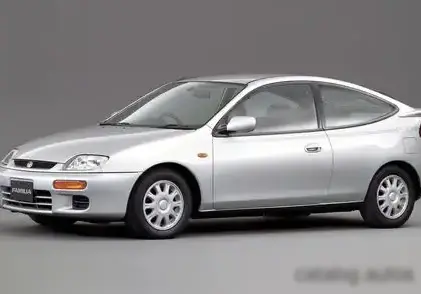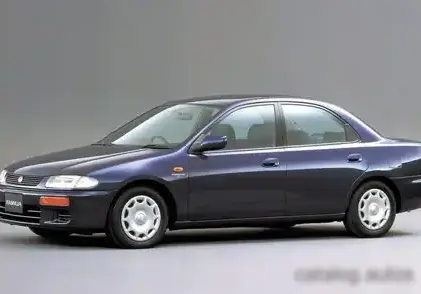
The Mazda Familia 1.6, producing 90 horsepower, was a mainstay of the compact car market from 1989 to 1994. Representing the third generation (BD series) of the Familia, this variant played a crucial role in Mazda’s lineup, offering an affordable and practical option for families and commuters. Positioned as an entry-level to mid-range trim, it provided a balance between fuel efficiency and acceptable performance. The Familia, known as the Mazda 323 in many export markets, was a significant model for Mazda, contributing to their growing reputation for reliability and value. This specific 1.6-liter configuration was particularly popular in Japan and several Asian markets, where fuel economy and compact size were highly valued.
Technical Specifications
| Brand | Mazda |
| Model | Familia |
| Generation | Familia (BD Series) |
| Type (Engine) | 1.6 (90 Hp) |
| Start of production | 1989 |
| End of production | 1994 |
| Powertrain Architecture | Internal Combustion engine |
| Body type | Sedan |
| Seats | 5 |
| Doors | 4 |
| Fuel Type | Petrol (Gasoline) |
| Power | 90 Hp @ 5300 rpm |
| Power per litre | 56.3 Hp/l |
| Torque | 135 Nm @ 4000 rpm / 99.57 lb.-ft. @ 4000 rpm |
| Engine layout | Front, Transverse |
| Engine displacement | 1598 cm3 / 97.52 cu. in. |
| Number of cylinders | 4 |
| Engine configuration | Inline |
| Cylinder Bore | 78 mm / 3.07 in. |
| Piston Stroke | 83.6 mm / 3.29 in. |
| Compression ratio | 9:1 |
| Number of valves per cylinder | 4 |
| Fuel injection system | Multi-port manifold injection |
| Engine aspiration | Naturally aspirated engine |
| Valvetrain | OHC |
| Fuel tank capacity | 50 l / 13.21 US gal | 11 UK gal |
| Length | 4215 mm / 165.94 in. |
| Width | 1675 mm / 65.94 in. |
| Height | 1375 mm / 54.13 in. |
| Wheelbase | 2500 mm / 98.43 in. |
| Minimum turning circle | 9.6 m / 31.5 ft. |
| Drivetrain Architecture | Front wheel drive |
| Front brakes | Ventilated discs |
| Rear brakes | Drum |
Powertrain & Engine Architecture
The heart of the Familia 1.6 was the Mazda B6 engine, a 1.6-liter inline-four cylinder gasoline engine. This engine, often referred to by its internal code (typically B6 or similar depending on specific market variations), was a relatively simple and robust design. It featured a single overhead camshaft (OHC) operating four valves per cylinder. The fuel delivery system utilized multi-port fuel injection, a significant improvement over earlier carburetor-based systems, contributing to better fuel efficiency and smoother operation. The engine’s 9:1 compression ratio was a compromise between performance and the ability to run on the available fuel grades in its target markets. The Familia 1.6 was almost exclusively offered with a four-speed automatic transmission. This transmission, while providing convenience, was not known for its sportiness and was geared towards comfortable cruising rather than spirited driving.
Driving Characteristics
The 90 horsepower output of the Familia 1.6, coupled with the four-speed automatic transmission, resulted in a driving experience best described as adequate. Acceleration was not brisk, with 0-60 mph times estimated around 12-14 seconds. The automatic transmission’s gear ratios were spaced to prioritize fuel economy, meaning the engine often felt strained during overtaking maneuvers or when climbing hills. Compared to the five-speed manual transmission available on other Familia variants, the automatic version felt noticeably slower. However, the automatic offered a smoother and more relaxed driving experience, particularly in urban traffic. The suspension was tuned for comfort, providing a reasonably compliant ride, although it wasn’t particularly engaging for enthusiastic drivers.
Equipment & Trim Levels
The Familia 1.6 typically came with a fairly basic level of equipment, reflecting its position as an entry-level model. Standard features generally included power steering, a basic audio system (often a cassette player), and cloth upholstery. Air conditioning was often an optional extra, as were power windows and central locking. Interior trim was functional and durable, prioritizing practicality over luxury. Higher trim levels, if available, might have added features like upgraded upholstery, a more sophisticated audio system, and alloy wheels. The dashboard layout was straightforward and easy to use, with clearly labeled controls.
Chassis & Braking
The Familia 1.6 utilized a front-wheel-drive layout with a MacPherson strut suspension in the front and a torsion beam suspension in the rear. The front brakes were ventilated discs, providing adequate stopping power for the vehicle’s weight and performance. However, the rear brakes were typically drum brakes, which were less effective than disc brakes and could fade under heavy use. The chassis was relatively lightweight, contributing to the car’s fuel efficiency. Stabilizer bars were often included, helping to reduce body roll during cornering, but the overall handling was geared towards comfort and stability rather than sporty dynamics.
Market Reception & Comparison
The Mazda Familia 1.6 was generally well-received by critics as a practical and affordable family car. It was praised for its reliability, fuel efficiency, and comfortable ride. However, the automatic transmission was often criticized for its lack of responsiveness and its impact on performance. Compared to other trims in the Familia lineup, such as the higher-powered 1.8-liter versions, the 1.6 offered a more economical option but at the expense of performance. Fuel economy was a key selling point, with the 1.6-liter engine achieving around 28-32 mpg in mixed driving conditions. In terms of reliability, the Familia 1.6 proved to be a durable and long-lasting vehicle, with many examples remaining on the road today.
Legacy
The Mazda Familia 1.6, particularly the automatic transmission variant, has become a relatively common sight in the used car market. Its simple mechanical design and robust engine contribute to its continued reliability. While not a particularly sought-after model by enthusiasts, it remains a practical and affordable option for those seeking a dependable and economical compact car. Parts availability is generally good, and maintenance costs are relatively low. The Familia 1.6 represents a significant chapter in Mazda’s history, demonstrating their commitment to producing well-built and value-for-money vehicles. It served as a stepping stone for Mazda’s future success in the global automotive market.