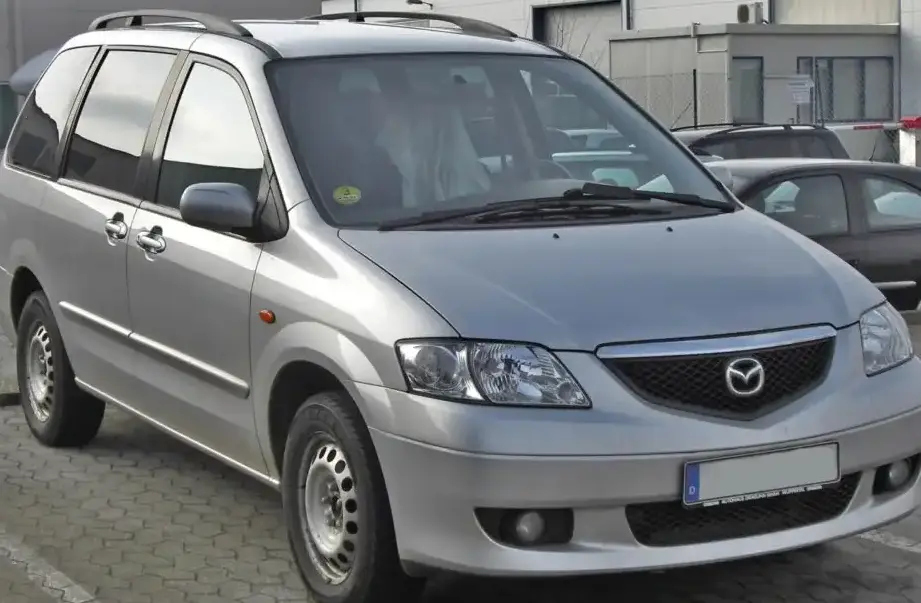
The Mazda MPV II (LW) 2.0 CRDi, produced between 2003 and 2006, represented Mazda’s second-generation entry into the highly competitive minivan segment, primarily aimed at the European and Asian markets. This variant, powered by a 2.0-liter turbocharged diesel engine producing 136 horsepower, occupied a middle ground within the MPV II lineup, offering a balance between fuel efficiency, practicality, and a more accessible price point compared to higher-trim models. The LW generation MPV was a significant departure from its predecessor, adopting a more modern and car-like design, and focusing on improved interior space and comfort. It was built on Mazda’s GC platform, shared with other models like the Mazda Premacy/Familia.
Technical Specifications
| Brand | Mazda |
| Model | MPV |
| Generation | MPV II (LW) |
| Type (Engine) | 2.0 CRDi (136 Hp) |
| Start of production | 2003 |
| End of production | 2006 |
| Powertrain Architecture | Internal Combustion engine |
| Body type | Minivan |
| Seats | 7 |
| Doors | 5 |
| Fuel consumption (urban) | 8.6 l/100 km (27.4 US mpg) |
| Fuel consumption (extra urban) | 6.2 l/100 km (37.9 US mpg) |
| Fuel consumption (combined) | 7.1 l/100 km (33.1 US mpg) |
| Fuel Type | Diesel |
| Acceleration 0 – 100 km/h | 13.2 sec |
| Acceleration 0 – 62 mph | 13.2 sec |
| Acceleration 0 – 60 mph | 12.5 sec |
| Maximum speed | 176 km/h (109.36 mph) |
| Weight-to-power ratio | 13.3 kg/Hp |
| Weight-to-torque ratio | 5.8 kg/Nm |
| Power | 136 Hp @ 3500 rpm |
| Torque | 310 Nm @ 2000 rpm (228.64 lb.-ft. @ 2000 rpm) |
| Engine layout | Front, Transverse |
| Engine Model/Code | RF5C |
| Engine displacement | 1998 cm3 (121.93 cu. in.) |
| Number of cylinders | 4 |
| Engine configuration | Inline |
| Cylinder Bore | 86 mm (3.39 in.) |
| Piston Stroke | 86 mm (3.39 in.) |
| Compression ratio | 18.4:1 |
| Number of valves per cylinder | 4 |
| Fuel injection system | Diesel Commonrail |
| Engine aspiration | Turbocharger, Intercooler |
| Valvetrain | OHC |
| Engine oil capacity | 5 l (5.28 US qt | 4.4 UK qt) |
| Coolant capacity | 8.6 l (9.09 US qt | 7.57 UK qt) |
| Kerb Weight | 1807 kg (3983.75 lbs.) |
| Max. weight | 2395 kg (5280.07 lbs.) |
| Max load | 588 kg (1296.32 lbs.) |
| Trunk (boot) space – minimum | 294 l (10.38 cu. ft.) |
| Trunk (boot) space – maximum | 2745 l (96.94 cu. ft.) |
| Fuel tank capacity | 75 l (19.81 US gal | 16.5 UK gal) |
| Length | 4805 mm (189.17 in.) |
| Width | 1830 mm (72.05 in.) |
| Height | 1785 mm (70.28 in.) |
| Wheelbase | 2840 mm (111.81 in.) |
| Front track | 1540 mm (60.63 in.) |
| Rear track | 1550 mm (61.02 in.) |
| Drivetrain Architecture | Front wheel drive |
| Number of gears | 5 |
| Gearbox type | Manual transmission |
| Front suspension | Spring Strut |
| Rear suspension | Coil spring |
| Front brakes | Ventilated discs |
| Rear brakes | Ventilated discs |
| Assisting systems | ABS (Anti-lock braking system) |
| Steering type | Steering rack and pinion |
| Power steering | Hydraulic Steering |
| Tires size | 215/60 R16 |
| Wheel rims size | 6J x 16 |
Powertrain & Engine Architecture
The heart of the MPV II 2.0 CRDi was the RF5C engine, a 1.998-liter inline-four cylinder diesel. This engine utilized a common rail direct injection system, a technology that allowed for precise fuel delivery and improved combustion efficiency. The RF5C was turbocharged and intercooled, boosting power output to 136 horsepower at 3500 rpm and 310 Nm (228.64 lb-ft) of torque at 2000 rpm. The engine featured an overhead camshaft (OHC) valvetrain with four valves per cylinder. The five-speed manual transmission was the standard offering for this variant, providing a relatively direct connection between the engine and the front wheels. The engine’s design prioritized fuel economy and low-end torque, making it well-suited for hauling passengers and cargo.
Driving Characteristics
The 2.0 CRDi MPV II, with its 136 hp and manual transmission, offered a practical and reasonably responsive driving experience. Acceleration was adequate for everyday driving, with a 0-60 mph time of around 12.5 seconds. However, it wasn’t designed for spirited performance. The engine’s strong low-end torque made it easy to navigate city streets and handle moderate inclines. Compared to the more powerful gasoline engine options available in the MPV II range, the 2.0 CRDi prioritized fuel efficiency over outright speed. The five-speed manual transmission allowed for good control over the engine’s power band, but the gear ratios were tuned for economy rather than performance. The driving experience was generally comfortable, thanks to the MPV’s suspension setup, but it wasn’t particularly engaging.
Equipment & Trim Levels
The 2.0 CRDi trim typically included features such as air conditioning, power windows, central locking, and an integrated audio system. Interior upholstery was generally cloth, with options for upgraded materials available. Safety features included ABS brakes and front airbags. Optional extras could include alloy wheels, a sunroof, and a more advanced audio system. The specific trim level and available options varied depending on the market. The 2.0 CRDi was positioned as a mid-range offering, providing a good balance of features and affordability.
Chassis & Braking
The MPV II utilized a front-engine, front-wheel-drive layout. Suspension consisted of a MacPherson strut setup at the front and a coil spring arrangement at the rear. Braking duties were handled by ventilated discs on all four wheels, providing adequate stopping power for the vehicle’s weight. The chassis was designed to prioritize ride comfort and stability, rather than sporty handling. The steering was a hydraulic rack and pinion system, offering reasonable precision and feedback.
Market Reception & Comparison
The Mazda MPV II 2.0 CRDi was generally well-received in European and Asian markets as a practical and fuel-efficient family vehicle. Critics praised its spacious interior, comfortable ride, and relatively affordable price. However, some reviewers noted that the engine lacked the refinement and power of some of its competitors. Compared to gasoline-powered MPV II variants, the 2.0 CRDi offered significantly better fuel economy, making it a popular choice for drivers who prioritized running costs. Compared to other diesel-powered minivans in its class, the MPV II 2.0 CRDi offered a competitive combination of performance, fuel efficiency, and features.
Legacy
The Mazda MPV II 2.0 CRDi has proven to be a relatively reliable vehicle, with the RF5C engine generally considered durable. Common issues include wear and tear on suspension components and potential problems with the turbocharger. However, with proper maintenance, these engines can reach high mileage. In the used car market, the MPV II 2.0 CRDi remains a popular choice for budget-conscious buyers seeking a spacious and practical family vehicle. Its fuel efficiency and relatively low running costs continue to make it an attractive option, even after two decades on the road. Parts availability is generally good, and the vehicle’s simple mechanical design makes it relatively easy to maintain.