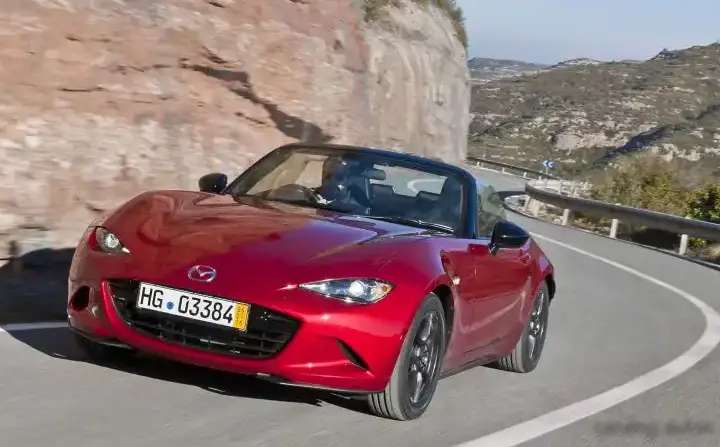
Technical Specifications
| Brand | Mazda |
| Model | MX-5 |
| Generation | MX-5 IV (ND) |
| Type (Engine) | 2.0 SkyActiv-G (160 Hp) |
| Start of production | 2015 |
| End of production | 2018 |
| Powertrain Architecture | Internal Combustion engine |
| Body type | Roadster |
| Seats | 2 |
| Doors | 2 |
| Fuel consumption (urban) | 9.3 l/100 km (25.3 US mpg) |
| Fuel consumption (extra urban) | 5.5 l/100 km (42.8 US mpg) |
| Fuel consumption (combined) | 6.9 l/100 km (34.1 US mpg) |
| CO2 emissions | 161 g/km |
| Fuel Type | Petrol (Gasoline) |
| Acceleration 0 – 100 km/h | 7.3 sec |
| Acceleration 0 – 62 mph | 7.3 sec |
| Acceleration 0 – 60 mph | 6.9 sec |
| Maximum speed | 214 km/h (132.97 mph) |
| Emission standard | Euro 6 |
| Weight-to-power ratio | 6.3 kg/Hp |
| Weight-to-torque ratio | 5 kg/Nm |
| Power | 160 Hp @ 6000 rpm |
| Torque | 200 Nm @ 4600 rpm (147.51 lb.-ft. @ 4600 rpm) |
| Engine layout | Front, Longitudinal |
| Engine displacement | 1998 cm3 (121.93 cu. in.) |
| Number of cylinders | 4 |
| Engine configuration | Inline |
| Cylinder Bore | 83.5 mm (3.29 in.) |
| Piston Stroke | 91.2 mm (3.59 in.) |
| Compression ratio | 13:1 |
| Number of valves per cylinder | 4 |
| Fuel injection system | Direct injection |
| Engine oil capacity | 4.3 l (4.54 US qt | 3.78 UK qt) |
| Coolant capacity | 6 l (6.34 US qt | 5.28 UK qt) |
| Kerb Weight | 1000 kg (2204.62 lbs.) |
| Max. weight | 1260 kg (2777.82 lbs.) |
| Max load | 260 kg (573.2 lbs.) |
| Trunk (boot) space – minimum | 130 l (4.59 cu. ft.) |
| Fuel tank capacity | 45 l (11.89 US gal | 9.9 UK gal) |
| Length | 3915 mm (154.13 in.) |
| Width | 1735 mm (68.31 in.) |
| Width including mirrors | 1918 mm (75.51 in.) |
| Height | 1230 mm (48.43 in.) |
| Wheelbase | 2310 mm (90.94 in.) |
| Front track | 1495 mm (58.86 in.) |
| Rear track | 1505 mm (59.25 in.) |
| Ride height (ground clearance) | 125 mm (4.92 in.) |
| Minimum turning circle | 9.4 m (30.84 ft.) |
| Drivetrain | Rear wheel drive |
| Number of gears | 6 |
| Gearbox type | Manual transmission |
| Front brakes | Ventilated discs |
| Rear brakes | Disc |
| Steering type | Steering rack and pinion |
| Power steering | Electric |
The 2.0-liter SkyActiv-G engine in the ND MX-5 represented a cornerstone of Mazda’s engineering philosophy – achieving high performance through efficiency. This engine, paired with a six-speed manual transmission, was the most popular configuration for enthusiasts seeking a truly engaging driving experience. The ND MX-5, built on the 1HX0 platform, aimed to be lighter and more compact than the outgoing NC model, and the 2.0L variant was instrumental in achieving this goal. It was marketed towards drivers who prioritized handling and responsiveness over outright speed, embodying the “Jinba Ittai” (horse and rider as one) philosophy central to Mazda’s design ethos.
Powertrain & Engine Architecture
The 2.0-liter SkyActiv-G engine (PE-VPH) is a naturally aspirated inline-four cylinder engine. A key feature is its high compression ratio of 13:1, achieved through advanced combustion control and precise fuel injection. This allowed for increased thermal efficiency and power output without the need for forced induction. The engine utilizes direct injection, optimizing fuel delivery and reducing knocking. The valvetrain employs dual overhead camshafts (DOHC) and four valves per cylinder, maximizing airflow. The six-speed manual transmission featured closely spaced gear ratios designed to keep the engine within its optimal power band. The transmission was known for its precise shift feel and relatively short throw.
Driving Characteristics
The 160 hp and 147 lb-ft of torque delivered by the 2.0-liter engine, combined with the MX-5’s lightweight chassis (around 2200 lbs), resulted in a lively and engaging driving experience. Acceleration from 0-60 mph took approximately 6.9 seconds. While not exceptionally quick in absolute terms, the car felt much faster due to its responsiveness and excellent balance. The manual transmission allowed for precise control, and the short gear ratios encouraged frequent shifting to maintain optimal engine speed. Compared to the 1.5-liter version, the 2.0-liter offered noticeably more power and torque throughout the rev range, making it more suitable for spirited driving and highway cruising. It also provided a more confident experience when carrying a passenger or luggage.
Equipment & Trim Levels
The 2.0-liter MX-5 typically came standard with features like power windows and locks, a leather-wrapped steering wheel, and a basic audio system. Higher trim levels, such as the Club and Grand Touring, added features like a limited-slip differential (Club), heated leather seats, a Bose premium audio system, and advanced safety features like blind-spot monitoring and lane-departure warning. Interior upholstery was typically cloth on the base model, with leather options available on higher trims. Dashboard configuration was relatively simple and driver-focused, emphasizing functionality over luxury.
Chassis & Braking
The ND MX-5 featured a MacPherson strut front suspension and a multi-link rear suspension, optimized for handling and ride comfort. The Club trim often included a suspension upgrade with Bilstein dampers and a front strut tower brace for improved rigidity. Braking duties were handled by ventilated discs at the front and solid discs at the rear. Anti-lock brakes (ABS) were standard. The lightweight construction of the chassis contributed significantly to the car’s agility and responsiveness. The relatively narrow tires (typically 195/50R16 or 205/45R17) prioritized grip and feedback over outright traction.
Market Reception & Comparison
The ND MX-5 2.0L was widely praised by automotive critics for its engaging driving dynamics, responsive engine, and overall fun-to-drive character. It was often compared favorably to other affordable sports cars, such as the Subaru BRZ/Toyota 86, but was generally considered to offer a more refined and polished driving experience. Fuel economy was respectable, averaging around 34 mpg combined. Reliability has been generally good, with few major issues reported. Compared to the 1.5-liter MX-5, the 2.0-liter offered a more satisfying driving experience for enthusiasts, but at a slightly higher price point.
Legacy
The ND MX-5 2.0L has established itself as a modern classic, appreciated by driving enthusiasts for its purity and simplicity. The SkyActiv-G engine has proven to be a reliable and durable powerplant, and well-maintained examples continue to command strong prices on the used car market. The ND generation, and particularly the 2.0-liter variant, has helped to solidify the MX-5’s reputation as one of the most iconic and enjoyable roadsters of all time. Its focus on driver engagement and lightweight design continues to influence automotive design today.