
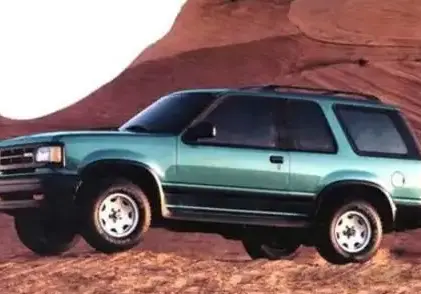
The Mazda Navajo, produced between 1991 and 1995, was a compact sport utility vehicle (SUV) built by Mazda under license from Ford. Essentially a rebadged Ford Explorer, the Navajo was specifically designed and marketed for the Japanese domestic market (JDM) as a means of circumventing Japanese import restrictions on larger American vehicles. This allowed Japanese consumers to purchase an American-style SUV through a domestic manufacturer. The Navajo occupied a unique niche, offering American ruggedness and space within a package compliant with Japanese regulations. This article focuses on the 4.0i V6 4WD DX variant, a mid-range offering within the Navajo lineup.
Technical Specifications
| Brand | Mazda |
| Model | Navajo |
| Generation | Navajo |
| Type (Engine) | 4.0 i V6 4WD DX (162 Hp) |
| Start of production | 1991 |
| End of production | 1995 |
| Powertrain Architecture | Internal Combustion engine |
| Body type | SUV |
| Seats | 5 |
| Doors | 3 |
| Fuel consumption (combined) | 12.4 l/100 km (19 US mpg, 22.8 UK mpg, 8.1 km/l) |
| Fuel Type | Petrol (Gasoline) |
| Maximum speed | 160 km/h (99.42 mph) |
| Weight-to-power ratio | 11.1 kg/Hp, 89.8 Hp/tonne |
| Weight-to-torque ratio | 6.1 kg/Nm, 165.1 Nm/tonne |
| Power | 162 Hp @ 4500 rpm |
| Power per litre | 40.9 Hp/l |
| Torque | 298 Nm @ 2200 rpm (219.79 lb.-ft. @ 2200 rpm) |
| Engine layout | Front, Longitudinal |
| Engine displacement | 3958 cm3 (241.53 cu. in.) |
| Number of cylinders | 6 |
| Engine configuration | V-engine |
| Cylinder Bore | 100 mm (3.94 in.) |
| Piston Stroke | 84 mm (3.31 in.) |
| Compression ratio | 9:1 |
| Number of valves per cylinder | 2 |
| Fuel injection system | Multi-port manifold injection |
| Engine aspiration | Naturally aspirated engine |
| Kerb Weight | 1805 kg (3979.34 lbs.) |
| Trunk (boot) space – minimum | 597 l (21.08 cu. ft.) |
| Trunk (boot) space – maximum | 1273 l (44.96 cu. ft.) |
| Fuel tank capacity | 73 l (19.28 US gal | 16.06 UK gal) |
| Length | 4453 mm (175.31 in.) |
| Width | 1783 mm (70.2 in.) |
| Height | 1730 mm (68.11 in.) |
| Wheelbase | 2593 mm (102.09 in.) |
| Front track | 1481 mm (58.31 in.) |
| Rear (Back) track | 1481 mm (58.31 in.) |
| Drive wheel | All wheel drive (4×4) |
| Number of gears and type of gearbox | 5 gears, manual transmission |
| Front suspension | Trailing arm |
| Rear suspension | Leaf spring |
| Front brakes | Ventilated discs |
| Rear brakes | Drum |
| Assisting systems | ABS (Anti-lock braking system) |
| Power steering | Hydraulic Steering |
| Tires size | 225/75 R15 |
| Wheel rims size | 6.5J x 15 |
Powertrain & Engine Architecture
The 4.0i V6 engine powering the Navajo DX is a 3.958-liter (241.53 cubic inch) naturally aspirated V6. This engine, derived from Ford’s Cologne V6 family, featured a 9:1 compression ratio and a multi-port fuel injection system. The engine produced 162 horsepower at 4500 rpm and 298 Nm (219.79 lb-ft) of torque at 2200 rpm. The engine’s longitudinal mounting and rear-wheel-drive bias, coupled with the four-wheel-drive system, provided a traditional SUV driving experience. The five-speed manual transmission was the standard offering for this trim, providing direct control over the engine’s powerband. The engine’s architecture, while robust, was relatively simple, relying on proven technology rather than cutting-edge innovations.
Driving Characteristics
The 4.0i V6 with the five-speed manual transmission offered a reasonable balance of power and control. While not exceptionally quick, the engine’s torque output at low to mid-range RPMs made it capable of handling everyday driving and moderate off-road conditions. The manual gearbox allowed drivers to fully utilize the engine’s powerband, providing more responsive acceleration compared to an automatic transmission. The four-wheel-drive system enhanced traction on slippery surfaces, making it a capable vehicle in inclement weather. However, the leaf spring rear suspension, while durable, contributed to a somewhat firm ride quality, especially when unladen. The gear ratios were tuned for practicality rather than outright performance, prioritizing fuel economy and towing capacity.
Equipment & Trim Levels
The DX trim level represented a mid-range offering in the Navajo lineup. Standard features included air conditioning, power steering, and an AM/FM radio. The interior typically featured cloth upholstery and a relatively basic dashboard layout. Optional extras included power windows, power door locks, and a cassette player. The DX trim aimed to provide a balance of affordability and essential features, appealing to buyers who wanted a capable SUV without the added cost of luxury amenities. The exterior typically featured black plastic trim and steel wheels, although alloy wheels were sometimes available as an option.
Chassis & Braking
The Mazda Navajo utilized a body-on-frame construction, providing a robust and durable chassis. The front suspension employed a trailing arm design, while the rear suspension utilized leaf springs. This setup prioritized load-carrying capacity and durability over refined handling. The braking system consisted of ventilated discs on the front wheels and drum brakes on the rear. Anti-lock braking system (ABS) was included as a standard safety feature. The tires were typically 225/75 R15, providing a good balance of on-road comfort and off-road traction. The chassis and braking system were designed to handle the vehicle’s weight and provide adequate stopping power in various conditions.
Market Reception & Comparison
The Mazda Navajo was generally well-received in the Japanese market, particularly among those seeking an American-style SUV. Critics praised its spacious interior, rugged construction, and capable four-wheel-drive system. However, some criticized its relatively basic interior and firm ride quality. Compared to other trims in the Navajo lineup, the 4.0i V6 DX offered a good value proposition, providing a capable powertrain and essential features at a reasonable price. The manual transmission version was favored by enthusiasts who appreciated its greater control and responsiveness. Fuel economy, at 12.4 l/100 km, was typical for a vehicle of this size and type during the early 1990s, but it was higher than smaller, more fuel-efficient Japanese SUVs.
Legacy
The Mazda Navajo, while a relatively short-lived model, holds a unique place in automotive history as a product of Japan’s “bubble economy” and import restrictions. Today, the Navajo is a sought-after vehicle among collectors and enthusiasts, particularly those interested in JDM vehicles. The 4.0i V6 engine is known for its durability and reliability, although maintenance can be more complex than with smaller Japanese engines. Parts availability can be a challenge, but a dedicated community of owners and enthusiasts helps to keep these vehicles on the road. The Navajo’s legacy lies in its ability to bridge the gap between American ruggedness and Japanese practicality, offering a unique and memorable driving experience.
