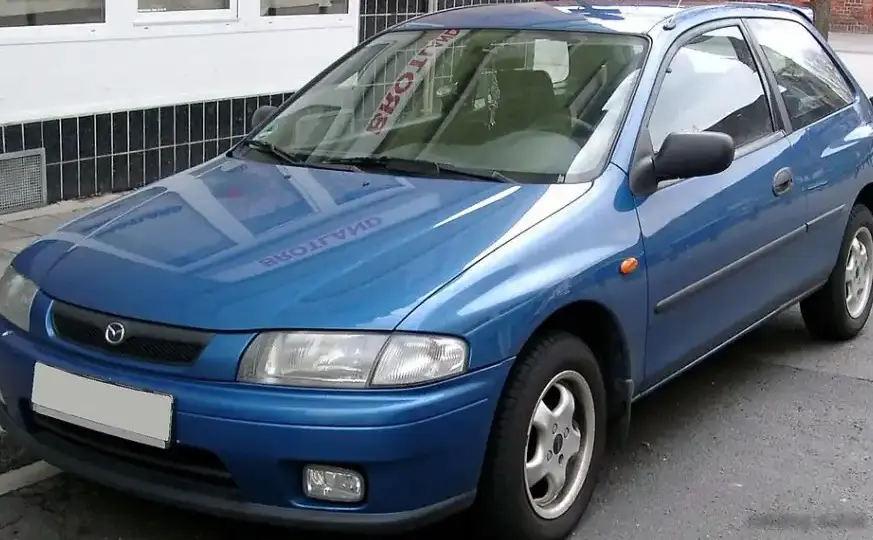
The Mazda Protege 1.5 i, producing 97 horsepower, was a key variant of the Protege (also known as the Mazda 323 in some markets) produced between 1994 and 1998. This generation, internally designated as the BG series, represented Mazda’s entry into the compact sedan segment, aiming to provide affordable and reliable transportation. The 1.5 i trim served as the base model in many regions, offering a balance of economy and practicality. It was positioned below the higher-performance 1.8L variants and, in some markets, diesel options, targeting budget-conscious buyers and those prioritizing fuel efficiency.
Technical Specifications
| Brand | Mazda |
| Model | Protege |
| Generation | Protege |
| Type (Engine) | 1.5 i (97 Hp) |
| Start of production | 1994 |
| End of production | 1998 |
| Powertrain Architecture | Internal Combustion engine |
| Body type | Sedan |
| Seats | 5 |
| Doors | 4 |
| Fuel Type | Petrol (Gasoline) |
| Power | 97 Hp @ 5500 rpm |
| Power per litre | 65.1 Hp/l |
| Torque | 132 Nm @ 4000 rpm |
| Torque (lb.-ft.) | 97.36 lb.-ft. @ 4000 rpm |
| Engine layout | Front, Transverse |
| Engine Model/Code | Z5-DE |
| Engine displacement | 1489 cm3 |
| Engine displacement (cu. in.) | 90.86 cu. in. |
| Number of cylinders | 4 |
| Engine configuration | Inline |
| Cylinder Bore | 75.3 mm |
| Cylinder Bore (in.) | 2.96 in. |
| Piston Stroke | 83.6 mm |
| Piston Stroke (in.) | 3.29 in. |
| Compression ratio | 9:1 |
| Number of valves per cylinder | 4 |
| Fuel injection system | Multi-port manifold injection |
| Engine aspiration | Naturally aspirated engine |
| Valvetrain | DOHC |
| Max. weight | 1040 kg |
| Max. weight (lbs.) | 2292.81 lbs. |
| Fuel tank capacity | 50 l |
| Fuel tank capacity (US gal) | 13.21 US gal |
| Fuel tank capacity (UK gal) | 11 UK gal |
| Length | 4335 mm |
| Length (in.) | 170.67 in. |
| Width | 1695 mm |
| Width (in.) | 66.73 in. |
| Height | 1420 mm |
| Height (in.) | 55.91 in. |
| Wheelbase | 2605 mm |
| Wheelbase (in.) | 102.56 in. |
| Front track | 1460 mm |
| Front track (in.) | 57.48 in. |
| Rear track | 1460 mm |
| Rear track (in.) | 57.48 in. |
| Minimum turning circle | 9.6 m |
| Minimum turning circle (ft.) | 31.5 ft. |
| Drivetrain Architecture | The Internal combustion engine (ICE) drives the front wheels of the vehicle. |
| Drive wheel | Front wheel drive |
| Front brakes | Ventilated discs |
| Rear brakes | Drum |
Powertrain & Engine Architecture
The heart of the Protege 1.5 i was the Z5-DE engine, a 1.5-liter inline-four cylinder gasoline engine. This engine utilized a naturally aspirated configuration with a multi-port fuel injection system, delivering fuel directly to each intake port. The engine featured a double overhead camshaft (DOHC) valvetrain, operating four valves per cylinder, which helped optimize airflow and improve volumetric efficiency. The 9:1 compression ratio was a compromise between performance and the ability to run on readily available fuel grades. The engine was transversely mounted in the front of the vehicle, driving the front wheels. While a five-speed manual transmission was available, the 1.5 i was often equipped with a four-speed automatic transmission. This automatic, while providing ease of use, was known for its relatively conservative gear ratios, prioritizing fuel economy over spirited acceleration.
Driving Characteristics
The 97 horsepower and 132 Nm (97.36 lb.-ft) of torque produced by the 1.5 i powertrain resulted in modest, but adequate, performance. Acceleration was not a strong point, with 0-60 mph times estimated to be around 11-12 seconds. The four-speed automatic transmission further dampened performance, with noticeable delays in downshifting and a tendency to hunt for gears on inclines. However, the engine proved to be smooth and relatively refined for its class. The focus was clearly on providing a comfortable and economical driving experience. Compared to the 1.8L versions, the 1.5 i felt noticeably slower, particularly during overtaking maneuvers. The manual transmission offered a more engaging driving experience and slightly improved acceleration, but the automatic was favored by many buyers for its convenience.
Equipment & Trim Levels
The 1.5 i trim level typically represented the entry point into the Protege lineup. Standard features generally included power steering, air conditioning (often optional), a basic AM/FM radio, and cloth upholstery. Interior appointments were functional and durable, rather than luxurious. Optional extras could include power windows and locks, a better audio system, and alloy wheels. The dashboard layout was straightforward and easy to use, with clearly marked controls. Safety features were relatively basic for the time, typically including seatbelts and a driver’s side airbag. The overall interior ambiance was designed to be practical and family-friendly.
Chassis & Braking
The Protege 1.5 i utilized a MacPherson strut front suspension and a torsion beam rear suspension. This setup provided a comfortable ride quality, although handling was not particularly sporty. The front brakes were ventilated discs, offering adequate stopping power, while the rear brakes were drums, a cost-saving measure common in this segment. The relatively light weight of the vehicle (around 1040 kg or 2292.81 lbs) helped to offset the limitations of the braking system. Stabilizer bars were typically fitted to the front, helping to reduce body roll during cornering.
Market Reception & Comparison
The Mazda Protege 1.5 i was generally well-received by critics as a practical and affordable compact sedan. It was praised for its reliability, fuel efficiency, and comfortable ride. However, its lack of performance and somewhat basic interior were often noted. Compared to competitors like the Honda Civic and Toyota Corolla, the Protege offered a slightly more engaging driving experience, but lacked the established reputation for bulletproof reliability of its Japanese rivals. The 1.8L Protege models offered a significant performance upgrade, but at a higher price point. The 1.5 i appealed to buyers who prioritized economy and practicality over outright performance.
Legacy
The Z5-DE engine, while not known for being particularly powerful, proved to be a durable and reliable unit. Protege 1.5 i models from the 1994-1998 period are still occasionally seen on the roads today, a testament to their longevity. The four-speed automatic transmission, however, is sometimes cited as a potential weak point, with some units experiencing issues with age. In the used car market, these Proteges are typically very affordable, making them attractive options for budget-conscious buyers or those seeking a simple and reliable transportation solution. While not a collector’s item, the 1.5 i represents a significant part of Mazda’s history in the compact car segment.