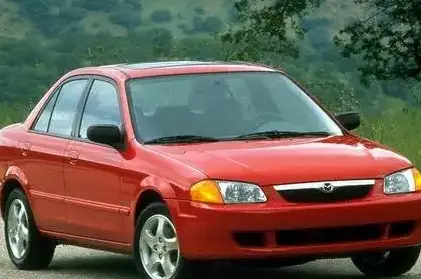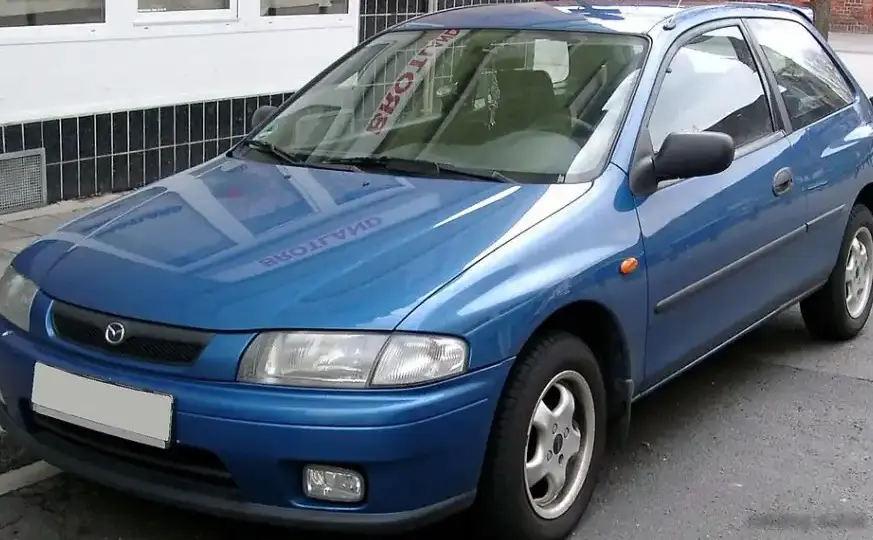
The Mazda Protege Wagon 1.5i, produced between 2002 and 2004, represented Mazda’s entry into the compact wagon segment in North America. Positioned as a practical and affordable vehicle, it offered a blend of fuel efficiency and utility. This variant, powered by a 1.5-liter inline-four engine producing 113 horsepower, served as the base engine option for the Protege Wagon, targeting buyers prioritizing economy and everyday usability over outright performance. It was part of the PGF series Protege, which included sedan and hatchback body styles, but the wagon offered a unique cargo capacity that appealed to small families and those needing versatile space.
Technical Specifications
| Brand | Mazda |
| Model | Protege |
| Generation | Protege Wagon |
| Type (Engine) | 1.5 i (113 Hp) |
| Start of production | 2002 |
| End of production | 2004 |
| Powertrain Architecture | Internal Combustion engine |
| Body type | Station wagon (estate) |
| Seats | 5 |
| Doors | 5 |
| Fuel Type | Petrol (Gasoline) |
| Power | 113 Hp @ 6000 rpm |
| Power per litre | 75.4 Hp/l |
| Torque | 140 Nm @ 4000 rpm |
| Torque (lb.-ft.) | 103.26 lb.-ft. @ 4000 rpm |
| Engine layout | Front, Transverse |
| Engine displacement | 1498 cm3 |
| Engine displacement (cu. in.) | 91.41 cu. in. |
| Number of cylinders | 4 |
| Engine configuration | Inline |
| Cylinder Bore | 78 mm |
| Cylinder Bore (in.) | 3.07 in. |
| Piston Stroke | 78.4 mm |
| Piston Stroke (in.) | 3.09 in. |
| Compression ratio | 9.4:1 |
| Number of valves per cylinder | 4 |
| Fuel injection system | Multi-port manifold injection |
| Engine aspiration | Naturally aspirated engine |
| Valvetrain | OHC |
| Max. weight | 1170 kg |
| Max. weight (lbs.) | 2579.41 lbs. |
| Fuel tank capacity | 50 l |
| Fuel tank capacity (US gal) | 13.21 US gal |
| Fuel tank capacity (UK gal) | 11 UK gal |
| Length | 4200 mm |
| Length (in.) | 165.35 in. |
| Width | 1695 mm |
| Width (in.) | 66.73 in. |
| Height | 1420 mm |
| Height (in.) | 55.91 in. |
| Wheelbase | 2610 mm |
| Wheelbase (in.) | 102.76 in. |
| Front track | 1470 mm |
| Front track (in.) | 57.87 in. |
| Rear track | 1470 mm |
| Rear track (in.) | 57.87 in. |
| Drivetrain | Front wheel drive |
| Front brakes | Ventilated discs |
| Rear brakes | Drum |
Powertrain & Engine Architecture
The heart of the Protege Wagon 1.5i was the F8E engine, a 1.5-liter (1498cc) inline-four cylinder gasoline engine. This engine utilized a single overhead camshaft (SOHC) valvetrain with four valves per cylinder. Fuel delivery was managed by a multi-point fuel injection system, contributing to reasonable fuel efficiency. The engine’s 9.4:1 compression ratio was a compromise between performance and the ability to run on regular unleaded gasoline. The F8E engine was known for its simplicity and relative reliability, though it wasn’t a powerhouse. The engine was transversely mounted in the front of the vehicle, driving the front wheels. The transmission paired with this engine was a four-speed automatic, chosen for its ease of use and appeal to a broader range of drivers. This automatic transmission, while providing smooth shifts, did contribute to slightly lower fuel economy and slower acceleration compared to the available five-speed manual transmission.
Driving Characteristics
The 113 horsepower and 103 lb-ft of torque produced by the 1.5-liter engine resulted in adequate, but not exhilarating, performance. Acceleration from 0 to 60 mph was estimated to be around 11-12 seconds. The four-speed automatic transmission had relatively widely spaced gear ratios, prioritizing fuel economy over rapid acceleration. In real-world driving, the Protege Wagon 1.5i felt most comfortable during city commuting and highway cruising at moderate speeds. Compared to the higher-output 2.0-liter engine option available in other Protege models, the 1.5i felt noticeably slower, particularly when fully loaded with passengers and cargo. The automatic transmission, while convenient, lacked the responsiveness of a manual gearbox, and downshifts could sometimes feel sluggish. However, the engine was generally smooth and quiet, contributing to a comfortable driving experience.
Equipment & Trim Levels
The 1.5i trim level of the Protege Wagon was generally considered the base model. Standard features typically included air conditioning, power steering, an AM/FM radio, and basic cloth upholstery. Safety features included dual front airbags. Optional extras, depending on the year and package, could include power windows and locks, a CD player, and alloy wheels. The interior was functional and straightforward, with a focus on durability rather than luxury. The dashboard layout was simple and easy to use, with clearly marked controls. The wagon’s rear seats could be folded down to create a larger cargo area, enhancing its practicality.
Chassis & Braking
The Protege Wagon utilized a MacPherson strut front suspension and a torsion beam rear suspension. This setup provided a comfortable ride, although it wasn’t particularly sporty. The front brakes were ventilated discs, offering adequate stopping power, while the rear brakes were drum brakes, a cost-saving measure common in this class of vehicle. The steering was hydraulically assisted, providing light and easy steering feel. The relatively lightweight construction of the wagon helped to offset the modest engine output, contributing to reasonable handling characteristics. Stabilizer bars were present, but were relatively thin compared to those found on higher-performance models.
Market Reception & Comparison
The Mazda Protege Wagon 1.5i was generally well-received as an affordable and practical wagon. Critics praised its fuel efficiency and spacious interior, but noted its lack of outright performance. Compared to other compact wagons of the time, such as the Toyota Corolla Wagon or the Honda Civic Wagon, the Protege Wagon offered a competitive price point and a slightly more engaging driving experience. However, the 2.0-liter Protege models offered significantly more power and were often preferred by drivers seeking a more dynamic driving experience. Fuel economy for the 1.5i was rated around 26 mpg city and 33 mpg highway, making it an attractive option for budget-conscious buyers.
Legacy
The Mazda Protege Wagon 1.5i, while not a particularly collectible vehicle, has proven to be relatively reliable over the long term. The F8E engine is known for its durability, and with proper maintenance, can last for many years. The four-speed automatic transmission is also generally reliable, although it may require servicing as it ages. Today, these wagons can be found in the used car market at very affordable prices. They represent a practical and economical option for those seeking a simple and reliable vehicle for commuting or light hauling. Parts availability is generally good, as many components are shared with other Mazda models of the same era. The Protege Wagon 1.5i remains a testament to Mazda’s commitment to building affordable and dependable vehicles.