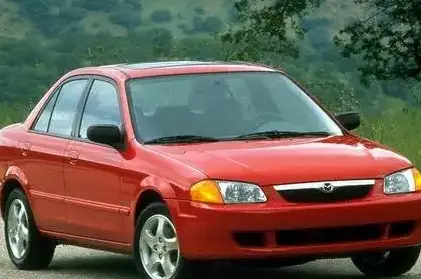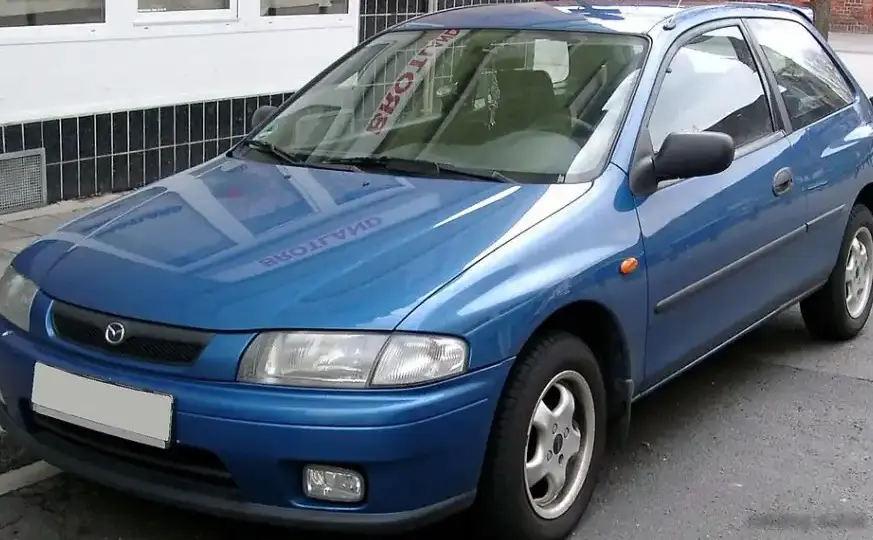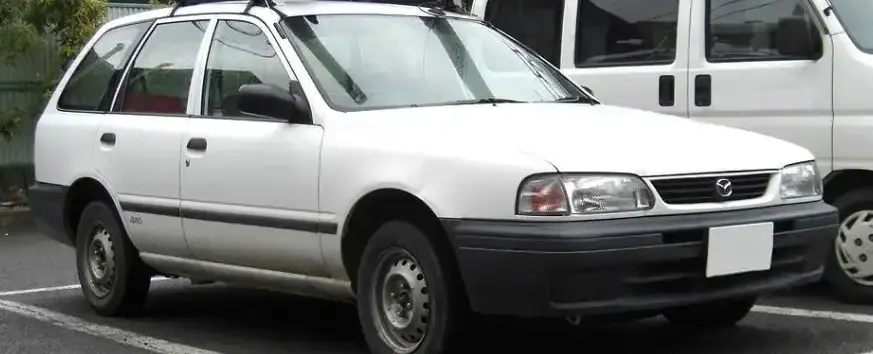
The Mazda Protege Wagon 1.8i, produced between 2002 and 2004, represented Mazda’s entry into the compact wagon segment in North America. Positioned as a practical and affordable alternative to hatchbacks and sedans, the Protege Wagon aimed to provide family-friendly versatility with Mazda’s reputation for reliability and driving enjoyment. This particular 1.8i variant, equipped with a 135 horsepower engine, served as a mid-range offering within the Protege Wagon lineup, slotting between the base 1.6-liter engine and potential higher-performance trims depending on the market. It was built on the P platform, shared with other Ford and Mazda vehicles of the era.
Technical Specifications
| Brand | Mazda |
| Model | Protege |
| Generation | Protege Wagon |
| Type (Engine) | 1.8 i (135 Hp) |
| Start of production | 2002 |
| End of production | 2004 |
| Powertrain Architecture | Internal Combustion engine |
| Body type | Station wagon (estate) |
| Seats | 5 |
| Doors | 5 |
| Fuel Type | Petrol (Gasoline) |
| Power | 135 Hp @ 7000 rpm |
| Power per litre | 73.2 Hp/l |
| Torque | 157 Nm @ 4500 rpm |
| Torque (lb-ft) | 115.8 lb.-ft. @ 4500 rpm |
| Engine layout | Front, Transverse |
| Engine Model/Code | BP-ZE |
| Engine displacement | 1845 cm3 |
| Engine displacement (cu. in.) | 112.59 cu. in. |
| Number of cylinders | 4 |
| Engine configuration | Inline |
| Cylinder Bore | 83 mm |
| Cylinder Bore (in.) | 3.27 in. |
| Piston Stroke | 85 mm |
| Piston Stroke (in.) | 3.35 in. |
| Compression ratio | 9:1 |
| Number of valves per cylinder | 4 |
| Fuel injection system | Multi-port manifold injection |
| Engine aspiration | Naturally aspirated engine |
| Valvetrain | DOHC |
| Engine oil capacity | 3.3 l |
| Engine oil capacity (US qt) | 3.49 US qt |
| Engine oil capacity (UK qt) | 2.9 UK qt |
| Max. weight | 1170 kg |
| Max. weight (lbs) | 2579.41 lbs |
| Fuel tank capacity | 50 l |
| Fuel tank capacity (US gal) | 13.21 US gal |
| Fuel tank capacity (UK gal) | 11 UK gal |
| Length | 4200 mm |
| Length (in.) | 165.35 in. |
| Width | 1695 mm |
| Width (in.) | 66.73 in. |
| Height | 1420 mm |
| Height (in.) | 55.91 in. |
| Wheelbase | 2610 mm |
| Wheelbase (in.) | 102.76 in. |
| Front track | 1470 mm |
| Front track (in.) | 57.87 in. |
| Rear track | 1470 mm |
| Rear track (in.) | 57.87 in. |
| Drivetrain Architecture | The Internal combustion engine (ICE) drives the front wheels of the vehicle. |
| Drive wheel | Front wheel drive |
| Front brakes | Ventilated discs |
| Rear brakes | Drum |
Powertrain & Engine Architecture
The heart of the Protege Wagon 1.8i is the BP-ZE engine, a 1.8-liter inline-four cylinder gasoline engine. This engine is part of Mazda’s BP series, known for its durability and relatively simple design. The BP-ZE utilizes a multi-port fuel injection system, delivering fuel directly into the intake ports just before the intake valves. The engine features a double overhead camshaft (DOHC) valvetrain, operating four valves per cylinder, contributing to improved breathing and higher-end power. The 9:1 compression ratio was a standard figure for naturally aspirated engines of this era, balancing performance and fuel efficiency. The engine’s output of 135 horsepower at 7000 rpm and 157 Nm (115.8 lb-ft) of torque at 4500 rpm provided adequate power for everyday driving. The engine was typically paired with a four-speed automatic transmission, offering smooth shifts but lacking the efficiency of more modern gearboxes.
Driving Characteristics
The 1.8i automatic Protege Wagon offered a comfortable and predictable driving experience. Acceleration was adequate for merging onto highways and passing slower traffic, but it wasn’t particularly sporty. The four-speed automatic transmission, while smooth, had relatively wide gear ratios, which could sometimes result in the engine feeling strained during hard acceleration. Compared to the five-speed manual transmission available on some Protege models, the automatic version sacrificed some responsiveness and fuel economy. The suspension was tuned for comfort, providing a reasonably smooth ride over most road surfaces. However, this comfort came at the expense of handling precision; the Protege Wagon wasn’t designed for aggressive cornering.
Equipment & Trim Levels
The 1.8i trim level generally included standard features such as air conditioning, power windows and locks, and an AM/FM stereo. Interior upholstery was typically cloth, with a relatively simple dashboard layout. Optional extras included features like a sunroof, upgraded audio systems, and alloy wheels. The Protege Wagon prioritized practicality, so even the 1.8i trim focused on providing essential features without excessive luxury. The wagon body style itself was a key feature, offering a generous cargo area for its size, making it suitable for families or individuals needing to transport larger items.
Chassis & Braking
The Protege Wagon utilized a front-wheel-drive chassis with an independent front suspension and a torsion beam rear suspension. The front suspension consisted of MacPherson struts, while the rear employed a simpler torsion beam setup to save cost and space. Braking duties were handled by ventilated disc brakes at the front and drum brakes at the rear. This configuration was typical for compact cars of this era, balancing cost and performance. Anti-lock brakes (ABS) were often available as an option, enhancing safety in emergency braking situations. Stabilizer bars were included to reduce body roll during cornering, but the overall handling characteristics were geared towards comfort rather than sporty performance.
Market Reception & Comparison
The Mazda Protege Wagon 1.8i was generally well-received by critics as a practical and affordable wagon. It offered a good balance of fuel economy, reliability, and interior space. However, some reviewers noted that the automatic transmission felt somewhat dated compared to newer designs, and the overall driving experience wasn’t as engaging as some of its competitors. Compared to other trims in the Protege lineup, the 1.8i automatic offered a more accessible price point than the higher-performance models, but it lacked the responsiveness and fuel efficiency of the manual transmission versions. Fuel economy was rated around 24 mpg city and 31 mpg highway, which was competitive for its class at the time.
Legacy
The Mazda Protege Wagon, and specifically the 1.8i variant, has developed a reputation for long-term reliability. The BP-ZE engine is known to be durable and relatively easy to maintain, and parts availability remains good. In the used car market, these wagons are often sought after by buyers looking for an affordable and dependable vehicle. While not a collector’s item, well-maintained examples can still provide years of service. The Protege Wagon represents a period when Mazda focused on building practical and reliable vehicles that offered a good value for the money, and the 1.8i automatic trim served as a solid and dependable option for many buyers.